Nora Ephron e Lonesome George | The Economist

Ho già commemorato sia, su questo blog,  Nora Ephron, sia Lonesome George (su facebook).

Ora The Economist dedica loro un necrologio congiunto, a partire da un pretesto molto delicato. Vale la pena di leggerlo. Come le Vite parallele di Plutarco.

Nora Ephron

economist.com

Nora Ephron and Lonesome George: When Nora met George | The Economist

THE first story Nora Ephron had to write for the New York Post – the one that made the guys on the city desk fall around laughing, got her the job, and launched her on a career of witty, wise writing on surviving modern life – was about a pair of hooded seals at the Coney Island aquarium. They were not only not mating, as they were supposed to, but also refusing to have anything to do with each other.

Lonesome George could relate to that. Though he was probably the last surviving example of the giant Galápagos tortoise Chelonoidis nigra abingdonii, he too refused to perform. Scientists, tourists, journalists, conservationists and the government of Ecuador all waited for two decades for him to mate successfully or, indeed, get it on at all. He wasn’t playing. In 1993 two females of a slightly different subspecies were put into his corral. He ignored them. When at last he decided to do his duty, in 2008 and occasionally later, the eggs failed to hatch. Clearly, he was a slow burner. Possibly he was gay. He refused to be turned on even when a female Swiss zoology graduate, smeared with tortoise hormones, gave him manual stimulation for four months.

At which stage Ms Ephron might have asked, couldn’t he at least have faked it? Women did that all the time. The most famous scene of her highly successful screenwriting career – which included “Sleepless in Seattle”, “You’ve Got Mail” and “Julie and Julia” – was the one in “When Harry Met Sally” (1989) in which Sally faked an orgasm over lunch at a deli on New York’s Lower East Side. After she had reared, moaned, gasped and shouted “Yes!” for what seemed like five minutes, the elderly lady at a nearby table told the waiter: “I’ll have what she’s having.”

George couldn’t. But then he didn’t have the advantage of living, like Ms Ephron, in Manhattan, where something was almost bound to happen to you if you simply stepped outside, and if it didn’t happen you could pick up the phone and order it. He was living in a volcanic field on Santa Cruz island 500 miles off the coast of Ecuador, where you couldn’t find a decent bagel if you tried: in fact, a place a lot like Washington.

Besides, he was no looker. Ms Ephron, though striking and svelte all her life, worried in the niggling way of women that her breasts were too small, her neck too crêpy (“I Feel Bad About My Neck” was the title of one book), her skin dry and her purse just wrong. George, whose neck was three feet of scrag and whose skin would have made several dozen purses, all thick, dry leather, didn’t care two hoots. His one concession to fashion was a shell in taupe. Ms Ephron preferred black; but taupe, especially on a couch, didn’t show the dirt.

Couches arose because they were part of the extra-domestic arrangements of her second husband, Carl Bernstein of the Washington Post. (Hence her Washington exile.) He left her when she was pregnant with their second child, falling for a woman whose neck was approximately as long as George’s and whose feet were splayed. Ms Ephron triumphantly got over it by turning the saga into a bestseller, “Heartburn”, in 1983, and then into a screenplay for the film, in which she was played by Meryl Streep. (“If your husband is cheating on you with a carhop, get Meryl Streep to play you. You’ll feel much better.”)

Her problem, she admitted, was falling in the first place for a priapic Jewish prince (Homo princeps judaicus incapax) – the sort who asked, “Where’s the butter?” when he meant, “Get me the butter.” She would hardly have done much better with George, whose neglected and expendable paramours were called No. 106 and No. 107, and whose rear-end shoves of his female companions were not, as scientists first thought, a playful invitation to sex but an order to quit the mud wallow, now, and leave it to him. The wallow was where El Solitario Jorge spent much of his time, smiling inanely and with the odd bit of food trailing from his mouth. All he needed was a copy of Architectural Digest to look like someone she knew.

To get her own back at Mr Bernstein, in a way befitting her love of food and her urge to cook, Ms Ephron in her book threw a key lime pie at him. She also provided the recipe. An erring tortoise would need sterner treatment. For tortoise soup, take one reptile, eviscerate, remove skin and all fat, remove shell. Simmer with lots of vegetables for two hours. Serves eight. This soup is illegal outside South Carolina.

And that was precisely how George had attained his solitary state: fishermen and sailors had eaten his tribe, goats had competed for the sparse vegetation, pigs had devoured the eggs, until he alone remained on Pinta Island, where a Hungarian looking for snails had discovered him in 1971. On his new island, he wasn’t truly alone: what with 180,000 tourists a year, 20,000 other tortoises, a team of scientists watching his every move, and journalists fighting on the bridge beside his pen. He was just the rarest creature in the world.

Equally, Ms Ephron – though she became the model of the defiant single woman – was not alone for long. She surrounded herself with blaring, cornucopian Manhattan, plunged into her work and then, in 1987, discovered the “secret to life” by marrying an Italian. But she was rare because, being very hurt, she got over it by making the world laugh at and with her.

150 anni fa la gita in barca da cui nasce Alice

Il 4 luglio 1862, 150 anni fa esatti, un gruppetto di amici fa una gita in barca da Oxford a Godstow, dove si ferma per un picnic sulla riva. Sono della partita il giovane matematico Charles Dodgson (meglio noto come Lewis Carroll), il suo amico Rev. Robinson Duckworth e le 3 sorelline di un altro amico, Harry Liddell: Edith (8 anni), Alice (10) e Lorina (13).

Lorina si fa pipì addosso: no, questa è un’altra storia, ma il calembour era irresistibile, mi è scappato (e 2).

Dodgson ha il compito di intrattenere le sorelline e si inventa una storia, con Alice protagonista. Entusiasta, Alice la vuole per iscritto: dopo qualche giorno Dodgson le manda un manoscritto intitolato Alice’s Adventures Under Ground.

Le 3 sorelline Liddell

brainpickings.org

La foto sopra è del 1859 (3 anni prima) e Alice è quella di destra con la frangetta.

Incoraggiato a pubblicare la storia da altre reazioni positive, Dodgson la amplia fino a raddoppiarne le dimensioni (è in questa seconda versione che vengono inseriti il tè del Cappellaio matto e il gatto del Cheshire) e cambia il titolo in quello che conosciamo (Alice’s Adventures in Wonderland). Per le illustrazioni di John Tenniel, Dodgson propone come modello non Alice (che, come avete visto, è bruna) ma la bionda Mary Hilton Badcock, un’altra delle sue giovani amiche. Ma in realtà pare che Tenniel non abbia usato neppure lei come modello.

L'Alice di Tenniel

brainpickings.org

La mia copia di Alice (un consunto paperback Penguin) viene dalla libreria Shakespeare & Co. di Parigi.

Grazie, ancora una volta, a Brain Pickings.

How the Story of Alice in Wonderland Was Born 150 Years Ago Today | Brain Pickings

Il bosone di Higgs spiegato al popolo

Beh, non esattamente. Bisogna sapere bene l’inglese, perché Daniel Whiteson del CERN parla veramente alla svelta. Ma il cartoon è godibilissimo.

Grazie a Flowing Data.

The Higgs Boson Explained from PHD Comics on Vimeo.

Il transito di Venere del 6 giugno 2012

Il 6 giugno 2012, all’alba, dall’Italia era possibile osservare la fase finale del transito di Venere davanti al disco del sole. A Roma, dove abito io, era caliginoso e non si è visto proprio nulla. Peccato, perché la prossima volta sarà l’11 dicembre del 2117 e noi non ci saremo, come canta il poeta.

Per fortuna, in altre parti del mondo si è visto, e molto meglio di quello che si sarebbe visto dall’Italia (oltre che a orari meno scomodi). Questa è la foto più bella che ho trovato:

Transito di Venere

whyevolutionistrue.files.wordpress.com

Altre belle foto le trovate sul sito del National Geographic e su quello di Focus.

Obituary: Nora Ephron 1941-2012

Da: Harry ti presento Sally, 1989

Harry Burns: I love that you get cold when it’s 71 degrees out. I love that it takes you an hour and a half to order a sandwich. I love that you get a little crinkle above your nose when you’re looking at me like I’m nuts. I love that after I spend the day with you, I can still smell your perfume on my clothes. And I love that you are the last person I want to talk to before I go to sleep at night. And it’s not because I’m lonely, and it’s not because it’s New Year’s Eve. I came here tonight because when you realize you want to spend the rest of your life with somebody, you want the rest of your life to start as soon as possible.

Anatomia della noia

Maria Popova (di cui abbiamo parlato più volte, da ultimo qui) recensisce su Brain Pickings un libro di Peter Toohey, Boredom: A Lively History.

Boredom

brainpickings.org

Io non l’ho letto e quindi posso soltanto limitarmi a citare alcune delle considerazioni di Maria Popova:

Toohey argues that boredom, unlike primary emotions like happiness, sadness, fear, anger, surprise, or disgust, takes a secondary role, alongside “social emotions” like sympathy, embarrassment, shame, guilt, pride, jealousy, envy, gratitude, admiration, and contempt. He delineates between two main types of boredom — simple boredom, which occurs regularly and doesn’t require that you be able to name it, and existential boredom, a grab-bag condition that is “neither an emotion, nor a mood, nor a feeling” but, rather, “an impressive intellectual formulation” that has much in common with depression and is highly self-aware, something Toohey calls the most self-reflective of conditions.
Toohey examines the relationship between boredom and disgust, the former being a mild derivation of the latter — boredom is to disgust what annoyance is to anger. Boredom is also connected to surfeit — surfeit, coupled with monotony, predictability, and confinement, produces boredom.
«Boredom is an emotion usually associated with a nourished body: like satiety, it is not normally for the starving.»
But our reflexive means of alleviating boredom — novelty-seeking, drugs, extreme behaviors — are, as most of us are intellectually aware but have at some point been experientially blind to, remarkably ineffective. Toohey observes:
«As fast as the new is experienced…it is liable to become boring. The new becomes a variant of the infinite. It recedes infinitely.»
This touches on what’s perhaps the most transfixing aspect of boredom — its relationship with time:
«Infinity is of course temporal as well as spatial. Time has a very interesting relationship with boredom and its representations. We have all experienced the sluggishness of time when we have been confined in boring situations. According to one of the late Clement Freud’s famous witticisms, ‘if you resolve to give up smoking, drinking and loving you don’t actually live longer, it just seems longer.’»

Queste riflessioni portano Maria Popova a collocare la noia all’interno del noto schema di Mihaly Csikszentmihalyi , dove la noia sta quasi al polo opposto del flusso (flow), quello stato di grazia in cui entri quando fai qualcosa con grande gioia e concentrazione e perdi la misura del tempo che passa.

Mihaly Csikszentmihalyi

wikipedia.org

La noia ha una funzione adattiva quando è una reazione transitoria, ma diventa patologica quando si trasforma in una condizione cronica. Per contribuire a distinguere tra queste due forme, nel 1986 Richird Farmer e Norman D. Sundberg (“Boredom Proneness – The Development and Correlates of a New Scale”, Journal of Personality Assessment) hanno proposto un test (le rispioste vanno date su una scala che varia tra 1 – «non sono d’accordo per niente» – a 4 – «neutrale» – a 7 – «sono pienamente d’accordo»:

  1. Trovo facile concentrarmi su quello che faccio.
  2. Mentre sto lavorando spesso la mia mente divaga.
  3. Mi sembra che il tempo non passi mai.
  4. Spesso mi sento spaesato, non so che fare.
  5. Mi trovo spesso in situazioni in cui devo fare cose senza senso.
  6. Guardare le diapositive delle vacanze degli altri mi annoia a morte.
  7. Ho in mente un sacco di progetti e di cose da fare.
  8. Trovo facile intrattenermi con me stesso.
  9. Molte delle cose che devo fare sono ripetitive e monotone.
  10. Ho bisogno di più stimoli della maggior parte delle persone.
  11. La maggior parte delle cose che faccio mi stimola molto.
  12. Sono raramente intrigato dal mio lavoro.
  13. In ogni situazione riesco a trovare qualche cosa da fare o che mi interessa.
  14. Per la maggior parte del tempo sto seduto senza fare niente.
  15. So aspettare con pazienza.
  16. Spesso non ho niente da fare, con un sacco di tempo a disposizione.
  17. Quando devo aspettare, come in una fila, divento irrequieto.
  18. Spesso mi sveglio con un’idea nuova.
  19. Sarebbe difficile per me trovare un lavoro abbastanza intrigante.
  20. Mi piacerebbe dover fare più cose difficili nella vita.
  21. Sento che per la maggior parte del tempo lavoro sotto le mie capacità.
  22. Molti dicono che sono creativo o pieno d’immaginazione.
  23. Ho così tanti interessi da non riuscire a fare tutto.
  24. Tra i miei amici sono il più perseverante.
  25. Se non faccio qualcosa di eccitante, addirittura pericoloso, mi sento opaco e mezzo morto.
  26. Per essere veramente felice ho bisogno di un sacco di varietà e di cambiamento.
  27. Alla televisione e al cinema è sempre la stessa solfa.
  28. Quando ero giovane, mi trovavo spesso in situazioni monotone o pallose.

Per scoprire quanto siete propensi ad annoiarvi, rispondete al questionario (qui trovate un foglio excel, in inglese, che vi facilita il compito) e sommate i punteggi di ogni risposta. Io l’ho fatto e mi sono trovato patologicamente propenso alla noia.

L’articolo di Maria Popova è qui: Anatomy of Boredom | Brain Pickings.

Il senso dell’ingiustizia tra le scimmie cappuccine

Frans de Waal – probabilmente il più grande primatologo vivente – riproduce in questo breve filmato un esperimento fatto da lui e dai suoi collaboratori più di 10 anni fa.

Frans de Waal

wikipedia.org

A due scimmie cappuccine, esposte per la prima volta a questo esperimento, viene dato un semplice compito: restituire un sasso che la sperimentratrice le ha dato. Se lo fa (e lo fa con grande facilità) riceve un premio una fettina di cetriolo.

Scimmia cappuccina

wikipedia.org

Fin qui tutto bene: nella prima replicazione dell’esperimento, entrambe le scimmie – che sono fianco a fianco in una gabbia trasparente e quindi si vedono tra loro – fanno l’esercizio e ricevono la loro fettina di cetriolo in premio.

Ma dalla seconda replicazione in avanti, la scimmia di sinistra continua ad avere il cetriolo, mentre la seconda viene premiata con un acino d’uva.

Guardate voi stessi che cosa succede:

Chiunque di voi abbia subito il trattamento del cetriolo, ormai proverbiale, sa la rabbia che si prova.

Fransiscus Bernardus Maria de Waal, conosciuto semplicemente come Frans de Waal (‘s-Hertogenbosch, 29 ottobre 1948), è un etologo e primatologo olandese. La sua attività scientifica verte principalmente sullo studio comportamento sociale dei primati, in particolare scimpanzè e bonobo. È professore di Primate behavior (comportamento dei primati) presso la Emory University, direttore del Living Links Center presso lo Yerkes National Primate Research Center e membro della Koninklijke Nederlandse Akademie van Wetenschappen e della National Academy of Sciences. È inoltre autore di molti libri divulgativi su bonobo e scimpanzè. [dalla voce di wikipedia]

Qui sotto, se volete, l’intera conferenza:

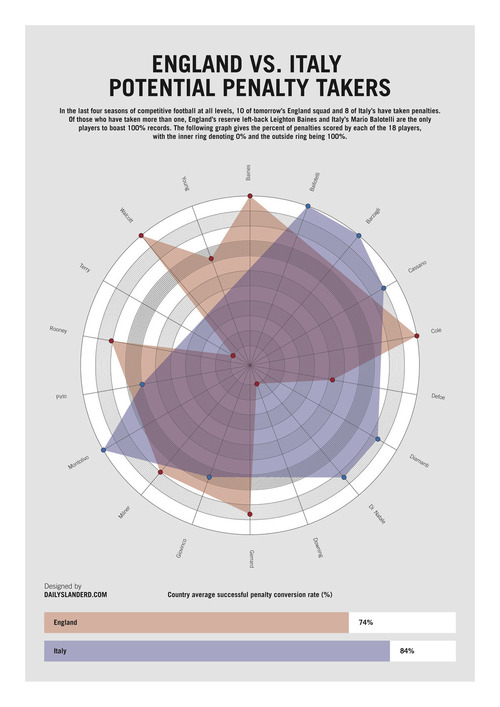
Italia-Inghilterra: e se finisse ai rigori?

Italia-Inghilterra: e se finisse ai rigori?

An infographic depicting the penalty success rates of the England and Italy squads of Euro 2012.

See on Scoop.itSpigolature

See on www.dailyslandered.com

Continua l’incubo di 2666

Abbiamo già parlato, in questo blog, della scomparsa e dell’uccisione di centinaia di donne a Ciudad Juárez, nello stato messicano di Chihuahua, vicino al confine degli Stati Uniti, a partire dal 1993. Ne avevamo parlato recensendo lo sterminato romanzo 2666 di Roberto Bolaño, di cui quei fatti sono un’ispirazione importante.

La strage non è mai cessata, anche se sono passati vent’anni e Bolaño non è più qui a parlarcene.

Ne scrive Damien Cave sul New York Times di oggi, 24 giugno 2012: Wave of Violence Swallows More Women in Juárez.

Ciudad Juárez

nytimes.com

See on Scoop.itSpigolature

Ciudad Juárez became infamous for attacks beginning in the 1990s that left hundreds of women dead, but as international attention moved on, the killings have continued.

See on www.nytimes.com

“Is Modern Capitalism Sustainable?” by Kenneth Rogoff | Project Syndicate

See on Scoop.itSpigolature

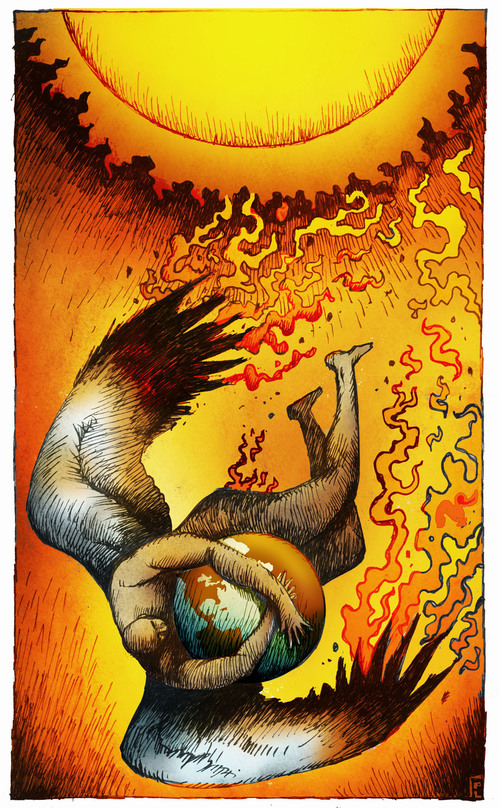
Today’s capitalist systems vastly undervalue the welfare of unborn generations. For most of the era since the Industrial Revolution, this has not mattered, as the continuing boon of technological advance has trumped short-sighted policies. By and large, each generation has found itself significantly better off than the last. But, with the world’s population surging above seven billion, and harbingers of resource constraints becoming ever more apparent, there is no guarantee that this trajectory can be maintained.

See on www.project-syndicate.org