La fine del contante

Tra le misure del Governo Monti c’è il divieto di usare denaro contante per le transazioni economiche al di sopra di una certa soglia, più bassa che in passato. La cosa ha fatto e fa discutere: da una parte, la destra più radicale sostiene che in questo modo si riduce la libertà economica, anzi la libertà tout court e ci si consegna a uno Stato di polizia (mi sembra che l’abbia detto lo stesso Berlusconi, tra i cui primi atti da presidente del consiglio dei ministri, nel 2006, ci fu quello di alzare la soglia al di sopra della quale non si potevano utilizzare i contanti); dall’altra, ci sono i timori che per questa via si aumentino i poteri e i profitti delle banche.

Negli Stati Uniti David Wolman, un giornalista di Wired, ha vissuto per un anno intero senza utilizzare contanti e ne ha tratto un libro uscito da poco: The End of Money: Counterfeiters, Preachers, Techies, Dreamers – and the Coming Cashless Society. Non l’ho ancora letto (benché l’abbia comprato proprio ora), ma la sinossi di Amazon è sufficiente a incuriosire:

For ages, money has meant little metal disks and rectangular slips of paper. Yet the usefulness of physical money—to say nothing of its value—is coming under fire as never before. Intrigued by the distinct possibility that cash will soon disappear, author and Wired contributing editor David Wolman sets out to investigate the future of money … and how it will affect your wallet.
Wolman begins his journey by deciding to shun cash for an entire year—a surprisingly successful experiment (with a couple of notable exceptions). He then ventures forth to find people and technologies that illuminate the road ahead. In Honolulu, he drinks Mai Tais with Bernard von NotHaus, a convicted counterfeiter and alternative-currency evangelist whom government prosecutors have labeled a domestic terrorist. In Tokyo, he sneaks a peek at the latest anti-counterfeiting wizardry, while puzzling over the fact that banknote forgers depend on society’s addiction to cash. In a downtrodden Oregon town, he mingles with obsessive coin collectors—the people who are supposed to love cash the most, yet don’t. And in rural Georgia, he examines why some people feel the end of cash is Armageddon’s warm-up act. After stops at the Digital Money Forum in London and Iceland’s central bank, Wolman flies to Delhi, where he sees first-hand how cash penalizes the poor more than anyone—and how mobile technologies promise to change that.
Told with verve and wit, The End of Money explores an aspect of our daily lives so fundamental that we rarely stop to think about it. You’ll never look at a dollar bill the same again.

The End of Money

amazon.com

Ieri (12 marzo 2012) Davit Sirota, un giornalista di Salon, gli ha fatto una lunga intervista, che trovate per intero al link sottostante. Più sotto, un’anticipazione della parte in  cui affronta le preoccupazioni che hanno accompagnato anche il dibattito italiano sulle scelte del Governo Monti.

Should we fear a cashless society? – U.S. Economy – Salon.com

Should we fear a cashless society?

salon.com / Credit: Repina Valeriya via Shutterstock

One of the arguments against getting rid of cash is that once we become a fully cashless society then basically we have put big corporations even more in the center of our lives. Cash is the one way within our financial architecture to avoid both having our financial transactions skimmed off the top of by credit card companies, and it’s also a way to avoid basic scrutinies of our transactions. How powerful is that argument and will corporate power in a cashless society inevitably be abused?

That’s the central question, and it’s something I address a lot in the book. Some of this has to do with the distinction between what is anonymity and what is privacy. Even though everyone loves cash for the anonymity of it, it’s not really something that goes along with our lives in a modern democracy. There’s nothing that guarantees your anonymity in the Bill of Rights.

So this is the tension between civil liberties and privacy. It’s why we have cameras on subway platforms in case there’s ever a violent crime committed, and I really don’t think there’s a way to dismiss privacy concerns, but most of us think it’s probably okay for law enforcement to have some kind of break-the-glass access to information about who was on that train platform when a crime was committed. It’s the same way we deal with airport securities and on and on it goes.

I’m sensitive to those concerns, but we’ve kind of relinquished so much of our financial lives to the banks and credit card companies already. I don’t say that to say we might as well go the final 2 percent here, I think it’s the other way, that when you talk about cashlesness and finally going 100 percent cashless, you see it kind of brings these fears to the surface in a way that people don’t really think about even though they’re never really using cash.

Though the difference between the train platform metaphor and cashless economy is that you’re making transaction, the train platform is a public piece of property, it is in a place that we acknowledge as public. But lots of people say they don’t want their transactions to be public. Do we have a right to that expectation of privacy?

They say they don’t want transactions to be public, but then when your credit card company calls you to say, “Hey were you in Hong Kong yesterday and did you buy this $12,000 diamond necklace,” and you say, “No, I didn’t.” That intervention is because they were monitoring transactions.

Of course, when we talk about monitoring transactions that’s scary and sort of Big Brothery talk. I’m not excited about that either. But do we want the authorities for example to know that somebody in the mountainous region of Pakistan is suddenly wiring a lot of money to Sacramento? I think that really does matter.

But the bigger question to cashlessness really is the idea that it’s either cash or the credit card companies. I actually think that when we go cashless, people would wake up to this great flowering of payment options that are out there and we’ll be more demanding of the banks and mobile services to lower their fees and provide us with the service we can be confident with. That’s why PayPal was so successful, because they finally convinced people: you can do this securely. It’s not perfect but it’s safe enough that people are game to go along with it or it wouldn’t be the gazillion dollar company that it is today.

So people are seeing options coming. Some are still worried that doing away with cash means enriching the fat cats at Mastercard and Visa, but that’s really a false dichotomy.

Can we ever really get rid of cash in this sense? We call the bills in our wallet cash, but if we immediately eliminated all of that there would still be an economy that existed on other currency — or maybe even bartering.

Cash in this book is rectangular slips of paper and coinage. What you’re talking about is money, and money is an idea.

Titolazione, analita, stechiometria

Secondo il Vocabolario Treccani, titolazione è:

L’operazione di titolare, cioè di determinare il titolo di leghe, filati, filamenti, ecc. In chimica, procedimento, detto anche analisi volumetrica o titrimetrica, mediante il quale si determina la quantità di una sostanza presente in un dato volume di soluzione mediante aggiunta graduale della soluzione titolata (cioè a titolo noto) di un’altra sostanza capace di reagire quantitativamente con essa; il punto finale della reazione (che può essere di neutralizzazione, di ossidoriduzione, di complessazione, ecc.) è individuato in base al brusco cambiamento di colore di un indicatore appositamente aggiunto o in base alla variazione di una qualche grandezza fisica che viene misurata durante la titolazione: potenziale (titolazioni potenziometriche), corrente (titolazioni amperometriche), resistenza elettrica (titolazioni conduttometriche). Completata la reazione, dalla quantità di reattivo aggiunto si risale alla concentrazione della sostanza nella soluzione analizzata.

Titolazione

wikipedia.org

Titolazione deriva dal latino titŭlus, “titolo”, una parola che anche in italiano ha una caterva di accezioni (non ve le trascrivo tutte, potete andare a vedere da soli sul Vocabolario Treccani): quella che ci interessa qui è la settima di nove:

7.Titolo di una lega, di una soluzione, di una miscela, ecc., il rapporto tra la quantità di uno dei suoi componenti e la quantità della soluzione o miscela che lo contiene, espresso usualmente in forma percentuale e riferito al peso o al volume. […]

E in particolare:

b. In chimica, la concentrazione (che si determina mediante la titolazione) di un costituente di una soluzione; può essere espressa in varie maniere: più comunemente in grammi di sostanza (elemento, composto) per litro di soluzione, in grammi equivalenti o in grammomolecole (o frazioni di esse) per litro di soluzione […].

In francese il latino titŭlus diventa titre e per questo in francese e in inglese la titolazione diventa rispettivamente titrage e titration.

Come è abbastanza intuitivo anche per chi non è proprio un chimico esperto (come non sono esperto io, ma qui ci soccorre wikipedia), l’idea dietro la tecnica d’analisi è abbastanza semplice: se io conosco già il titolo di un reagente (titolante) e la proporzione secondo la quale due elementi si combinano (per l’appunto il titolante e il titolando o analita), risalire alla concentrazione del titolando o analita è una questione di semplici calcoli.

Insisto sul termine analita per pura malizia (ho il cervello di un bambino delle elementari): il lemma non compare nel Vocabolario Treccani, ma wikipedia lo spiega:

L’analita è quella sostanza che deve essere determinata durante un’analisi chimica.
L’individuazione dell’analita è una parte fondamentale nella definizione del problema analitico. La sua determinazione può avvenire con metodi assoluti o relativi. Nel caso dei metodi assoluti la quantità di analita viene determinata sfruttando la correlazione con delle costanti fondamentali accuratamente note. Mentre nei metodi relativi (più comuni) si effettua la misurazione di specifici parametri del campione in esame che permettono di stabilire la relazione tra il parametro misurato e la quantità di analita; in questo caso si fa sovente uso di curve di taratura.

La proporzione secondo la quale due elementi si combinano è l’oggetto della stechiometria e ci permette di definire e studiare la 3ª parola curiosa di oggi (ricorro come al solito al Vocabolario Treccani):

[comp. del gr. στοιχεῖον «elemento» e –metria]. – Termine con cui originariamente si indicava la parte della chimica che s’interessa delle leggi secondo le quali gli elementi si uniscono per formare i varî composti, e con cui oggi è indicato il settore che studia le relazioni numeriche fra elementi e composti, le proporzioni secondo le quali gli elementi si combinano, e le quantità di elementi o di composti che prendono parte a una reazione chimica o che si formano in essa.

Il Viagra dell’Himalaya mette a repentaglio l’economia nepalese

Il funghetto che vedete qui sotto, che cresce negli altipiani del Tibet e del Nepal, avrebbe molte proprietà medicinali, ma sarebbe soprattutto un potente afrodisiaco. Quanto basta per provocare una sorta di “corsa all’oro” e mettere in crisi gli equilibri economici e sociali di quelle regioni.

Yarsagumba, il Viagra dell'Himalaya

Salon.com / Credit: Thomas Kelly

La storia la raccontano su Salon Jamie James e il Center for Investigative Reporting:

The boom in “Himalayan Viagra” – Drugs – Salon.com

Fortunes are being made – and lives are being ruined – not over gleaming metal nuggets, but in the reckless pursuit of yarsagumba. A rare hybrid of caterpillar and mushroom that grows only in the high alpine meadows of Tibet, Nepal and India, it has been prescribed by traditional healers in Asia for centuries to treat lung and kidney diseases, build up bone marrow and stop hemorrhaging. But it is prized above all for its reputation as a powerful aphrodisiac, earning it the nickname “Himalayan Viagra.”

Yarsagumba – also known by its scientific name, Cordyceps sinesis – was unknown in the Western world until 1994, when two female Chinese athletes at the Asian Games in Hiroshima, Japan, set new world records for mid- and long-distance running.

The astonishing times they posted gave rise to suspicions that they were using illegal performance enhancers such as anabolic steroids, but post-race drug tests revealed no trace of illegal substances. The runners’ controversial coach, Ma Junren, told foreign reporters that the women got their championship edge from daily doses of Cordyceps.

Thus began the yarsagumba boom. It is difficult to find an accurate estimate of the total production of yarsagumba, owing to the high degree of cross-border smuggling to avoid paying taxes and bribes. But according to Daniel Winkler, a botanist specializing in the fungus, it quickly has become the most expensive herbal remedy in traditional Chinese medicine.

Winkler estimates the annual yarsagumba harvest at between 85 and 185 tons, and in some areas, the crop represents the most significant source of income for residents, even greater than mining and industrial production. One official in Tibet’s Dengqen County estimated that 37,000 of the area’s 60,000 inhabitants had participated in fungus collection, Winkler reported in a recent scholarly journal.

“Among the wealthy and powerful in China,” Winkler wrote, “Cordyceps has come to rival French champagne as a status symbol at dinner parties or as a prestigious gift.”

The explosive growth in the yarsagumba market beggars the most extravagant superlatives: In 1992, a pound of the stuff sold for $3; today, the same quantity retails for around $9,400.

Nathan Lee, an apothecary in Hong Kong, said he has customers who spend thousands of dollars a month for daily doses of yarsagumba. “They give their children three to seven pieces a day, to promote good health and help them study,” he said. “They mix it with their breakfast cereal.”

The lucrative trade in the mushroom has transformed the economy of the Himalaya region. An ancient, yak-based culture that survived for centuries in one of the most extreme environments on earth is now unraveling in a tragic collision with the global marketplace.

Tibet is the main source of Cordyceps, but the trade may be having its most profound impact on Nepal, where extreme poverty and decades of political instability have led to deepening social entropy.

Jonathan Ive, il designer della Apple

Il Financial Times del 9 marzo 2012 ha dedicato un articolo di April Dembosky a Jonathan Ive, vice-presidente della Apple e responsabile del suo (fantastico) design industriale.

Apple’s invisible aesthete emerging from Jobs’ shadow – FT.com

The value of an iPhone or an iPad is not the object itself, despite the price tag. The value is the information held within it: the photos, the friend updates, the news articles, all accessible with the swipe of a finger. The object itself is designed with that in mind: sleek, smooth, and above all simple, so that what’s inside defines the experience.

The device’s architect is much like that himself: introverted and, to the vast majority of people who carry one of his creations, all but invisible. But inside Apple’s tightly guarded design studios, Jonathan Ive is complex and powerful, much like the inner workings of an iPhone.

Jonathan Ive

ft.com / Cummings

Ive è anche uno dei protagonisti di Objectified, un documentario di Gary Hustwit, presentato nel marzo del 2009 al festival del cinema di South by Southwest (SxSW per gli amici).

Qui potete vedere la parte dedicata ad Ive:

Douglas Adams The Party – The Greatest Show in The Galaxy

Oggi, 11 marzo 2012, Douglas Adams avrebbe compiuto 60 anni, se non fosse morto a 49 l’11 maggio 2001.

To celebrate this event, Douglas’ family and friends, in association with ‘Save The Rhino’ (one of Douglas’ favourite charities) are holding a very special birthday celebration in his honour at the Hammersmith Apollo in London. An evening’s entertainment from some of the finest names in the world of science, comedy, entertainment and music, with a very special premiere performance of Douglas’ material, this is one event that is definitely not to be missed.

Get Tickets for Douglas Adams The Party – The Greatest Show in The Galaxy

Douglas Adams The Party - The Greatest Show in The Galaxy

douglasadamstheparty.com

Vorrei ricordarlo in 2 modi:

  1. Con le parole che scrisse Richard Dawkins il giorno della sua morte: «Science has lost a friend, literature has lost a luminary, the mountain gorilla and the black rhino have lost a gallant defender.»

    Douglas Adams

    wikipedia.org

  2. The Ultimate Question of Life, the Universe and Everything (di cui per la verità abbiamo già parlato qui) tratto dalla versione televisiva BBC (e non dallo stupido filmetto di qualche anno fa).

    There are of course many problems connected with life, of which some of the most popular are Why are people born? Why do they die? Why do they want to spend so much of the intervening time wearing digital watches?
    Many many millions of years ago a race of hyperintelligent pandimensional beings (whose physical manifestation in their own pan-dimensional universe is not dissimilar to our own) got so fed up with the constant bickering about the meaning of life which used to interrupt their favourite pastime of Brockian Ultra Cricket (a curious game which involved suddenly hitting people for no readily apparent reason and then running away) that they decided to sit down and solve their problems once and for all.
    And to this end they built themselves a stupendous super computer which was so amazingly intelligent that even before the data banks had been connected up it had started from I think therefore I am and got as far as the existence of rice pudding and income tax before anyone managed to turn it off .
    It was the size of a small city.
    […]
    The subtlest of hums indicated that the massive computer was now in total active mode. After a pause it spoke to them in a voice rich resonant and deep.
    It said: “What is this great task for which I, Deep Thought, the second greatest computer in the Universe of Time and Space have been called into existence?”
    […]
    “I speak of none but the computer that is to come after me!”
    Fook was losing patience. He pushed his notebook aside and muttered, “I think this is getting needlessly messianic.”
    “You know nothing of future time,” pronounced Deep Thought, “and yet in my teeming circuitry I can navigate the in nite delta streams of future probability and see that there must one day come a computer whose merest operational parameters I am not worthy to calculate, but which it will be my fate eventually to design.”
    […]
    “O Deep Thought Computer,” he said, “the task we have designed you to perform is this. We want you to tell us . . . ” he paused, “. . . the Answer!”
    “The answer?” said Deep Thought. “The answer to what?”
    “Life!” urged Fook.
    “The Universe!” said Lunkwill.
    “Everything!” they said in chorus.
    Deep Thought paused for a moment’s reflection.
    “Tricky,” he said finally.
    “But can you do it?”
    Again, a signifi cant pause.
    “Yes,” said Deep Thought, “I can do it.”
    “There is an answer?” said Fook with breathless excitement.”
    “A simple answer?” added Lunkwill.
    “Yes,” said Deep Thought. “Life, the Universe, and Everything. There is an answer. But,” he added, “I’ll have to think about it.”
    […]
    Fook glanced impatiently at his watch.
    “How long?” he said.
    “Seven and a half million years,” said Deep Thought.
    Lunkwill and Fook blinked at each other.
    “Seven and a half million years . . . !” they cried in chorus.
    “Yes,” declaimed Deep Thought, “I said I’d have to think about it, didn’t I? And it occurs to me that running a programme like this is bound to create an enormous amount of popular publicity for the whole area of philosophy in general. Everyone’s going to have their own theories about what answer I’m eventually to come up with, and who better to capitalize on that media market than you yourself? So long as you can keep disagreeing with each other violently enough and slagging each other o in the popular press, you can keep yourself on the gravy train for life. How does that sound?”
    […]
    “O people waiting in the Shadow of Deep Thought!” he cried out. “Honoured Descendants of Vroomfondel and Majikthise, the Greatest and Most Truly Interesting Pundits the Universe has ever known . . . The Time of Waiting is over!”
    Wild cheers broke out amongst the crowd. Flags, streamers and wolf whistles sailed through the air. The narrower streets looked rather like centipedes rolled over on their backs and frantically waving their legs in the air.
    “Seven and a half million years our race has waited for this Great and Hopefully Enlightening Day!” cried the cheer leader. “The Day of the Answer!”
    Hurrahs burst from the ecstatic crowd.
    “Never again,” cried the man, “never again will we wake up in the morning and think Who am I? What is my purpose in life? Does it really, cosmically speaking, matter if I don’t get up and go to work? For today we will finally learn once and for all the plain and simple answer to all these nagging little problems of Life, the Universe and Everything!”
    […]
    There was a moment’s expectant pause whilst panels slowly came to life on the front of the console. Lights ashed on and o ff experimentally and settled down into a businesslike pattern. A soft low hum came from the communication channel.
    “Good morning,” said Deep Thought at last.
    “Er . . . Good morning, O Deep Thought,” said Loonquawl nervously, “do you have . . . er, that is . . . ”
    “An answer for you?” interrupted Deep Thought majestically. “Yes. I have.”
    The two men shivered with expectancy. Their waiting had not been in vain.
    “There really is one?” breathed Phouchg.
    “There really is one,” confi rmed Deep Thought.
    “To Everything? To the great Question of Life, the Universe and Everything?”
    “Yes.”
    Both of the men had been trained for this moment, their lives had been a preparation for it, they had been selected at birth as those who would witness the answer, but even so they found themselves gasping and squirming like excited children.
    “And you’re ready to give it to us?” urged Loonquawl.
    “I am.”
    “Now?”
    “Now,” said Deep Thought.
    They both licked their dry lips.
    “Though I don’t think,” added Deep Thought, “that you’re going to like it.”
    “Doesn’t matter!” said Phouchg. “We must know it! Now!”
    “Now?” inquired Deep Thought.
    “Yes! Now . . . ”
    “All right,” said the computer and settled into silence again. The two men fidgeted. The tension was unbearable.
    “You’re really not going to like it,” observed Deep Thought.
    “Tell us!”
    “All right,” said Deep Thought. “The Answer to the Great Question . . . ”
    “Yes . . . !”
    “Of Life, the Universe and Everything . . . ” said Deep Thought.
    “Yes . . . !”
    “Is . . . ” said Deep Thought, and paused.
    “Yes . . . !”
    “Is . . . ”
    “Yes . . . !!!. . . ?”
    “Forty-two,” said Deep Thought, with in finite majesty and calm.
    It was a long time before anyone spoke.
    Out of the corner of his eye Phouchg could see the sea of tense expectant faces down in the square outside.
    “We’re going to get lynched aren’t we?” he whispered.
    “It was a tough assignment,” said Deep Thought mildly.
    “Forty-two!” yelled Loonquawl. “Is that all you’ve got to show for seven and a half million years’ work?”
    “I checked it very thoroughly,” said the computer, “and that quite definitely is the answer. I think the problem, to be quite honest with you, is that you’ve never actually known what the question is.”
    “But it was the Great Question! The Ultimate Question of Life, the Universe and Everything!” howled Loonquawl.
    “Yes,” said Deep Thought with the air of one who suff ers fools gladly, “but what actually is it?”
    A slow stupe fied silence crept over the men as they stared at the computer and then at each other. “Well, you know, it’s just Everything . . . Everything . . . ” o ffered Phouchg weakly.
    “Exactly!” said Deep Thought. “So once you do know what the question actually is, you’ll know what the answer means.”
    “Oh terrificc,” muttered Phouchg flinging aside his notebook and wiping away a tiny tear.
    “Look, alright, alright,” said Loonquawl, “can you just please tell us the Question?”
    “The Ultimate Question?”
    “Yes!” “Of Life, the Universe, and Everything?”
    “Yes!”
    Deep Thought pondered this for a moment.
    “Tricky,” he said.
    “But can you do it?” cried Loonquawl.
    Deep Thought pondered this for another long moment.
    Finally: “No,” he said firmly.
    Both men collapsed on to their chairs in despair.
    “But I’ll tell you who can,” said Deep Thought.
    They both looked up sharply.
    “Who?”
    “Tell us!”
    […]
    “I speak of none other than the computer that is to come after me,” intoned Deep Thought, his voice regaining its accustomed declamatory tones. “A computer whose merest operational parameters I am not worthy to calculate – and yet I will design it for you. A computer which can calculate the Question to the Ultimate Answer, a computer of such infinite and subtle complexity that organic life itself shall form part of its operational matrix. And you yourselves shall take on new forms and go down into the computer to navigate its ten-million-year program! Yes! I shall design this computer for you. And I shall name it also unto you. And it shall be called . . . The Earth.”

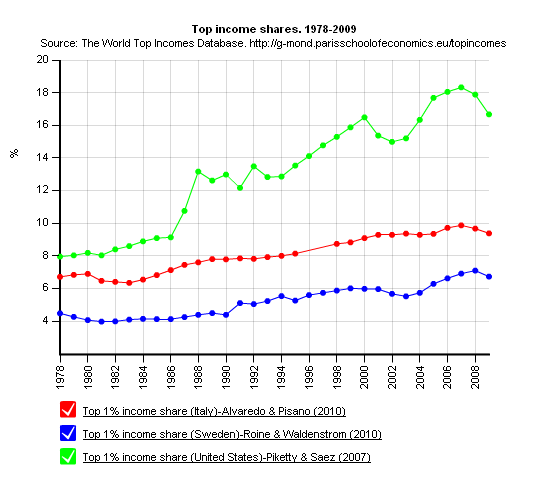
L’un per cento svedese, quello americano e quello italiano

Nel suo blog sul New York Times, il 10 marzo 2012 Paul Krugman (premio Nobel per l’economia, editorialista del NYT e liberal militante) interviene in una polemica sulla distribuzione del reddito negli Stati Uniti: The Swedish One Percent – NYTimes.com.

Premessa che potete saltare se siete persone informate sui fatti. Il movimento Occupy Wall Street (OWS) con lo slogan “We are the 99%” ha attirato l’attenzione sul tema delle crescenti diseguaglianze in termini di distribuzione del reddito e della ricchezza negli Stati Uniti tra l’1% più ricco e il resto della popolazione.

Recentemente (9 marzo 2012) è intervenuto sul tema Allan Meltzer sul Wall Street Journal (A Look at the Global One Percent) sostenendo che l’andamento di lungo periodo delle diseguaglianze è simile in tutti i principali paesi sviluppati e dunque non può essere attribuito alle politiche economiche (che sono state diverse da Paese a Paese e da epoca a epoca).

The remarkable similarity in income distribution across countries over the past century means domestic policy has less effect than many believe on who gets what.

Meltzer basa la sua argomentazione su un paper di due economisti svedesi (Roine, Jesper e Daniel Waldenström. “The Evolution of Top Incomes in an Egalitarian Society; Sweden, 1903-2004“. Journal of Public Economics, Vol. 92, Nos. 1-2, 2008 ) e ne trae queste conclusioni:

[…] an examination of changes in income distribution over nearly 100 years, not just in the United States but elsewhere in the developed world, does not bear this out. […] Jesper Roine and Daniel Waldenström compared the income share of the top 1% of earners in seven countries from the early 1900s to 2004. Those countries — the U.S., Sweden, France, Australia, Britain, Canada and the Netherlands—all practice some type of democratic capitalism but also a fair amount of redistribution.
As the nearby chart from the Roine and Waldenström study shows, the share of income for the top 1% in these seven countries generally follows the same trend line. That means domestic policy can’t be the principal reason for the current spread between high earners and others. Since the 1980s, that spread has increased in nearly all seven countries. The U.S. and Sweden, countries with very different systems of redistribution, along with the U.K. and Canada show the largest increase in the share of income for the top 1%.
The main reasons for these increases are not hard to find. Adding a few hundred million Chinese and Indians to the world’s productive labor force after 1980 slowed the rise in income for workers all over the developed world. That’s the most important factor at work. The top 1% gain relatively because they are less affected by the hordes of newly productive workers.
But the top 1% have another advantage. Many of them have unique skills that are difficult to replicate.

Roine Waldenstrom

wsj.net / Roine Waldenstrom

Prima di tutto, Krugman contrappone a queste tesi quelle di Daron Acemoglu e James Robinson – due economisti che stanno per andare in libreria con un volume intitolato Why Nations Fail e che sul loro blog hanno pubblicato il 9 marzo 2012 una risposta a Meltzer (Is the one percent the same everywhere?) articolata in 3 punti:

  1. Non è vero che l’andamento della quota di reddito dell’1% più ricco è andato crescendo nella stessa misura in tutti i Paesi sviluppati. Il lavoro di riferimento in materia è quello di Anthony Atkinson, Thomas Piketty ed Emmanuel Saez (“Top Incomes in the Long Run of History“. Journal of Economic Literature2011, 49:1, 3–71), che mostrano come gli Stati Uniti (e in misura minore il Regno Unito) si discostino nettamente dagli altri Paesi per andamento della quota di reddito dell’1% più ricco.

    Top 1%

    whynationsfail.com

  2. Nel periodo considerato i salari mediani negli Stati Uniti hanno ristagnato, negli altri Paesi sviluppati no.

    Salari mediani

    whynationsfail.com

  3. Non è chiaro come i cambiamenti della domanda di lavoro per le professioni a elevata qualificazione possa avere spinto così verso l’alto le retribuzioni del top 1%. Anche ammesso che ci sia un crescente premio retributivo per l’istruzione, questo non spiega come esso sia andato a vantaggio di una frazione così sparuta della popolazione a elevata istruzione.

Anche la critica di Krugman muove dalla critica delle fonti statistisiche e del loro uso e rinvia al poderoso database messo in piedi dai citati Atkinson, Piketty e Saez:

And you have no business talking about international income distribution if you don’t know about the invaluable World Top Incomes Database. What does this database tell us about Sweden versus America?, addresses the growing income inequality and wealth distribution in the U.S. between the wealthiest 1% and the rest of the population.

USA e Svezia

nytimes.com

Il grafico presentato da Krugman gli permette di concludere sarcasticamente:

Hey, it looks just the same — or, actually, not.
Yes, the top one percent has risen a bit in Sweden. But how anyone could look at this and see the story as similar boggles the mind.

E l’Italia?

La medesima fonte permette di collocare l’andamento della quota di reddito detenuta dall’1% più ricco a metà strada tra quello statunitense e quello svedese. Nel 1978 il top 1% deteneva il 6,71% del reddito (contro il 4,47% della Svezia e il 7,95% degli Stati Uniti), mentre nel 2009 la quota era salita al 9,38% (nello stesso periodo, in Svezia sale al 6.72% e gli Stati Uniti al 16,68%). In altre parole, nel periodo d’osservazione negli Stati Uniti l’1% più ricco della popolazione – che pure partiva da una quota di reddito a sua disposizione più elevata – è riuscita ad appropriarsi di una quota doppia di quella iniziale, con dinamiche particolarmente sostenute nei periodo 1986-1988 e 2002-2007; in Svezia, che partiva da una situazione relativamente più equilibrata, il guadagno di quote è stato dell’ordine del 50%; in Italia, infine, dove la situazione iniziale era più diseguale (è da notare che soltanto nel 2009, alla fine del periodo, il top 1% svedese giunge ad appropriarsi della quota di reddito che caratterizzava l’Italia all’inizio del periodo), la crescita è stata particolarmente lenta (+40%) anche con riferimento a questo particolare fenomeno.

Il sesso, la spesa e le statistiche sulla felicità

Nella speranza di non violare troppe norme sui diritti d’autore, traduco per voi all’impronta questo articolo di Tim Hardford, comparso sul suo sito e sul Financial Times.

Tim Hardford

bbc.co.uk

* * *

“Quanto sei soddisfatto della tua vita in questi giorni?”

Scusa?

Su una scala da 0 a 10. Leggo il quesito dall’ultimo rapporto sulla felicità dell’Istituto nazionale di statistica. Eccone un altro: “Quanto eri felice ieri?” Su una scala da 0 a 10.

Non saranno mica quelle sciocchezze sull’economia della felicità, vero?

Chiaro che sì. “Quanto ti sentivi ansioso ieri?”

Su una scala da 0 a 10?

Già.

Non mi sentivo ansioso ieri, ma ora che me lo chiedi lo sono diventato. Quante altre domande mi devi fare?

Sono quattro in tutto. Questa è l’ultima: “In che misura senti che le cose che fai nella vita hanno valore?”

Perfetto. E immagino che la mia risposta sia destinata a rivoluzionare la politica economica e spianare la strada a un’alternativa al Pil come misura del benessere nazionale? Ti avverto che non tratterrò il fiato.

Ti aspetti troppo dalla tua risposta. Che peraltro non mi hai neppure dato.

Non intendevo la mia risposta in particolare, ma le nostre risposte nel complesso: quante persone hanno intervistato?

Ottantamila.

Ottantamila, càspita. E quanti milioni di euro hanno speso per andare in giro per il Paese a chiedere a 80.000 persone se il giorno prima si sentivano felici? È un esercizio statistico rivoluzionario, suppongo. Guarda, faccio io una domanda a te, adesso: “In che misura senti che le cose che il governo fa per misurare la felicità abbiano valore?”

Su una scala da 0 a 10?

Ma sta zitto, va!.

Direi, 4 su 10. Sospetto che sarà
utile soltanto un po’, ma immagino anche che non costi poi molto. Certamente, l’Istituto nazionale di statistica ha speso un sacco di tempo e denaro per intervistare un campione significativo di 80.000 persone su molti temi, ma aggiungere 4 quesiti non dev’essere costato molto.

Che cosa abbiamo imparato, allora, da questo allegro ed economico esercizio?

Non molto, per il momento, ma soltanto perché l’Istituto nazionale di statistica non ha ancora pubblicato un rapporto dettagliato. Sappiamo però che gli abitanti di Londra sono i più ansiosi del Paese e che i nord-irlandesi i più soddisfatti della loro vita in tutte e tre le dimensioni misurate. Le donne sono più contente degli uomini. Le persone di mezza età sono meno felici, più ansiose e meno propense a considerare la loro esistenza degna di essere vissuta.

E ti pare sorprendente?

Be’, non sapevo che i nord-irlandesi fossero dei cuorcontenti. Però che essere maschi di mezza età influisse negativamente sull’essere soddisfatti della propria vita in effetti si sapeva già, da ricerche precedenti. Quindi questa non è una novità.

E che altro sappiamo già della felicità, oltre che il fatto che non si compra con i soldi?

Veramente, una delle poche cose che sappiamo della felicità è che si compra con i soldi. In tutte le società i ricchi sono più felici dei poveri: è più probabile che dichiarino che la loro vita va “molto bene”.

Eppure ero convinto che gli studi sulla felicità dicessero che i soldi non comprano la felicità.

Ti riferisci al Paradosso di Easterlin. L’economista Richard Easterlin, negli anni Settanta, non riuscì a trovare evidenze statistiche che le società nel complesso si arricchissero al crescere della felicità. Ma è un paradosso perché invece gli individui ricchi tendono a essere più felici degli individui poveri. La componente sociale del Paradosso di Easterlin è tuttora oggetto di controversia.

Grazie a David Cameron e all’Istituto nazionale di statistica.

Be’, per il momento grazie a sondaggi condotti da privati come Gallup. Ma immagino che l’impegno dell’Istituto nazionale di statistica non potrà che esserci utile, alla fine.

E tuttavia pensi che l’Istituto nazionale di statistica  potrebbe fare meglio e di più.

Vorrei che ponesse dei quesiti più profondi, come quelli suggeriti da Alan Krueger and Daniel Kahneman.

Sono nomi che mi suonano familiari ….

Il primo presiede il Comitato dei consiglieri economici di Barack Obama, il secondo ha vinto il Nobel per l’economia. Ma prima del recente incarico istituzionale di Krueger, lui e Kahneman avevano messo in piedi un programma di ricerca che forniva molti più dettagli sui tipi di attività che rendono le persone infelici, come il tempo sprecato per andare in macchina o partecipare a riunioni.

Capisco. Qualche risultato prezioso da questa linea di ricerca?

Il sesso è divertente, fare la spesa è scocciante. Alle persone piace andare a pranzo insieme e stare in compagni d’altri. E infatti è stato bello passare del tempo con te: non sei felice della nostra conversazione?

Obituary: Buon viaggio, Moebius

Tom Rachman – The Imperfectionists

Rachman, Tom (2010). The Imperfectionsts. New York: The Dial Press. 2010.
ISBN 9780385343664. Pagine 306. 13,44 US$

The Imperfectionists

about.com

Romanzo d’esordio di un autore trentaseienne all’epoca dell’uscita del libro, The Impressionists ha suscitato molto interesse e più d’un entusiasmo. A me è piaciuto senza entusiasmarmi.

Tom Rachman

tomrachman.com

Il romanzo è costruito molto abilmente. In realtà, gli 11 capitoli in cui è articolato il romanzo sono altrettanti racconti, tenuti insieme da riferimenti incrociati e dal comune riferimento al quotidiano in lingua inglese di Roma al centro del romanzo. Il trucco è vecchio come il mondo, o quanto meno come la letteratura, dai Racconti di Canterbury al Decamerone. Un trucco non particolarmente apprezzato da chi, come me, preferisce i romanzi-romanzi alle raccolte di racconti, per quanto mentite siano le spoglie dietro cui si nascondono.

Non tutti i racconti sono ben riusciti. In molti casi, anche se non in tutti, il racconto si chiude in modo inatteso, un po’ come nelle storie del Roald Dahl “da grandi” (Tales of the Unexpected, per esempio). La recensione del New York Times, molto più entusiastica della mia, tira in ballo anche Saki e O. Henry, e in quella che io vedo come frammentazione e incapacità di tenere in piedi un romanzo-romanzo, il NYT ci vede una “lente cubista”.

Al termine di ogni capitolo, in caratteri corsivi, la ricostruzione di varie fasi nella “vita” del quotidiano, dalla nascita negli anni Cinquanta alla morte nel 2004, fa da filo conduttore della storia complessiva. Non tutti i capitoli e non tutti i personaggi sono riusciti nello stesso modo: il primo, per esempio, è dedicato al patetico e deprimentissimo Lloyd Burko e mi ha fatto venir voglia di non andare più avanti. E di storie deprimenti ce n’è più d’una. Meglio, molto meglio, la chiave grottesca (il giovane Winston Cheung al Cairo) o dickensiana (la Signora Ornella de Monterecchi è una Miss Havisham attualizzata in chiave ossessivo-compulsiva).

In conclusione, anche se il libro si lascia leggere con piacere, non penso che Tom Rachman sia un nuovo grande scrittore e non aspetterò con ansia la sua prossima prova. Molto accurate, e vi assicuro che è molto raro, le ambientazioni romane.

* * *

Come di consueto, qualche citazione annotata durante la lettura sul Kindle.

After listening to several variations of no, Lloyd puts down the phone. [161]

Most of the journalists were men, Americans chiefly, but with a few Britons, Canadians, and Australians, too. All had been based in Italy when hired, and all could speak the local language. But the paper’s newsroom was strictly Anglophone. Someone hung a sign on the elevator door that read, LASCIATE OGNI SPERANZA, VOI CH’USCITE—OUTSIDE IS ITALY.
And when staffers went downstairs for sandwiches they’d say, “I’m headed to Italy—anyone need anything?”
[977]

He doesn’t call. She wants to scream. But this is how he is: easygoing, which means tough-going for everyone else. [1244]

“I’m still funny. I’m just not funny ha-ha. More funny weird.” [1338]

Leopold Bloom was his hero, not least because they shared a taste for animal innards—fried pork kidneys in particular. [1610]

He is more a skulking fornicator, not a marriage-busting cheater. [1975]

“[…] how about the Cohibatini?” he responds. “Vodka, Virginia tobacco leaves, eight-year-old Bacardi rum, lime juice, and corbezzolo honey.” [1989]

“I have a plan,” he responds archly, but goes no further. He isn’t going to reveal himself to her. And, anyway, he doesn’t have a plan. [2918]

What are all these paintings for? A woman with a ridiculously long neck. Wine bottles and hats. A chicken in midair. A shipwreck. [3291. Si tratta, naturalmente, di un Modigliani, un Léger, uno Chagall e un Turner]

She had never learned the technique of newspaper reading, so took it in order like a book, down the columns, left to right, page after page. She read every article and refused to move on until she was done, which meant that each edition took several days to complete. [3807]

Obituary: Elio Pagliarani (1927-2012) è morto, i coniglipolli restano per sempre

È morto ieri (8 marzo 2012) Elio Pagliarani, poeta. Era nato a Viserba, sulla riviera romagnola, il 25 maggio 1927.

Elio Pagliarani

rainews24.it

Perdonatemi se nel rendergli omaggio con la sua famosa poesia dei coniglipolli non riesco a riprodurne l’andamento grafico alla Majakovskij, che potete però vedere nelle immagini qui sotto.

dittico della merce: la merce esclusa
a Ferruccio Rossi-Landi

Uso e scambi linguistici b) L’equazione di valore linguistico Consideriamo l’equazione x merce A =
y merce B
e applichiamola al linguaggio
Dio è l’essere onnipotente

Qui la quantità (x,y) per entrambi i termini è ridotta a uno
c’è un solo Dio ed egli è l’unico essere onnipotente Sarebbe facile
quantificare, dicendo per esempio che gli dei
sono esseri onnipotenti
seguendo l’analisi marxiana
finì con centodieci a un pelo dalla lode, i corsi in medicina
una scelta ragionata: è mondana ed è sociale
quel rapporto con il corpo
coscienza fisica non basta
non è ancora conoscenza
nuovi allori in giurisprudenza
se i rapporti offuscassero le cose ne violassero l’essenza se fosse troppo empirica la scienza
dell’espressione Dio
Dio assume il valore di scambio
relativamente a essere onnipotente
e può essere immerso nella circolazione linguistica
come portatore di tale valore In termini di lavoro
Problema: un ragazzo vede conigli e polli in un cortile Conta
18 teste e 56 zampe
quanti polli e conigli ci sono nel cortile?
Si consideri una specie animale
a sei zampe e due teste: il conigliopollo; ci sono nel cortile 56 zampe : 6 zampe = 9 coniglipolli
Nove coniglipolli che necessitano di 9×2, 18 teste
restano dunque 18 – 18, 0 teste nel cortile
laurea in filosofia poi lo cacciarono via
non che violasse le leggi è che dissero basta
la famiglia gli amici gli esempi dei libri di testo la sua testa
avrebbero potuto lucidissimamente, in realtà fu lui che non volle demandò alla vita
la grandezza di lavoro umano linguistico generico medio
Ma questi animali hanno 9×6, 54 zampe allora 56–54 = 2 Restano due zampe nel cortile
Si consideri quindi un’altra specie di animale che potrebbe essere il coniglio spollato Si sottrae
un pollo da un coniglio l’animale che avanza è il coniglio spollato che ha
1 testa – 1 testa = 0 testa, 4 zampe – 2 zampe = 2 zampe: le due zampe che stanno nel cortile
la grandezza di lavoro umano linguistico generico medio
con il naso giusto, un’altezza che supera la media
non che vita non fosse anche nell’aule
dei suoi vent’anni trenta
non era ancora stato richiamato sotto le armi forse perché non sapevano bene dove metterlo
c’è dunque nel cortile 9 coniglipolli + 1 coniglio spollato Detto in altri termini
9 conigli + 9 polli + 1 coniglio – 1 pollo Ed ora i conigli coi conigli e i polli coi polli, si avrà
9 + 1, 10 conigli, 9 – 1, 8 polli
Risultano otto polli e dieci conigli nel cortile
e può essere immesso nella circolazione linguistica
come portatore di tale valore In termini di lavoro
la grandezza di lavoro umano linguistico generico medio
con cui si misura Dio
con cui si misura Dio in termini di lavoro
ridono le ragazze, ondeggiano sopra tacchi di sughero
attraverso la forma di valore totale o dispiegato che Marx esprime con l’equazione plurima
passiamo alla forma generale di valore nella quale un certo numero di merci
esprime il proprio valore per mezzo di un’unica merce esclusa
ridono le ragazze

Non mi rinvengo ben, pensa e ripensa
che barzelletta è questa: io non l’ho ‘ntesa
se non confusamente
Questa si chiama ‘l Pettine. E perché?
Perché le rime paion fatte a denti,
e mostra pettinar vari costumi.
Egli era gaio e festoso
e si mise a raccontare una delle sue barzellette. Ne sapeva sempre nuove
e allora sorrideva anche sussultando.
La merce esclusa
nella quale come valore d’uso avviene la misurazione del valore di scambio
quello là con tre lauree lo presero l’autunno 43
spiegò le barzellette a San Vittore
mica credettero subito che gli appunti nel taccuino
fossero per figurare
con capuffici e donne
la merce esclusa
nella quale come valore d’uso avviene la misurazione del valore di scambio
di tutte le altre merci quali tempo di lavoro oggettivato
corrisponde linguisticamente al termine noto di una serie definitoria.

La merce esclusa

Seconda pagina

Terza pagina

Avrei forse ignorato per sempre l’esistenza di Elio Pagliarani se non fosse stato per il mio fortuito e fortunato incontro, nel fatale 1977, con Andrea Ciullo, curiosa figura di laureato in statistica e autore teatrale, che di Pagliarani era “vice” come critico di teatro sul Paese sera. Penso che Andrea Ciullo abbia mantenuto i suoi rapporti con il maestro, dal momento che sul web circola una composizione scritta ed eseguita per il compleanno di Pagliarani.