Shields – Reality Hunger

Shields, David (2010). Reality Hunger: A Manifesto. New York: Vintage. 2010. ISBN 9780307387974. Pagine 242. 13.79$

Reality Hunger

davidshields.com

Libro difficile da classificare, per esplicita scelta dell’autore. David Shields è (era?) essenzialmente un romanziere, ma la stessa Wikipedia lo definisce “an American author of non-fiction, fiction, and works that resist generic classification.”

Il libro ha molti temi, ma la sua tesi principale mi sembra essere quella che in una cultura così frammentata e ricca di informazione, le persone (i lettori) sono affamati di realtà, mentre il romanzo, la fiction, più in generale la forma-libro sono rimasti legati a categorie tradizionali. Frammentazione e ubiquità dell’informazione spingono ineluttabilmente verso il mash-up (più che il collage) e la letteratura non può sottrarsi a questa tendenza. Inevitabilmente, quindi, un altro tema di fondo del testo è il plagio (e la proprietà intellettuale).

Sotto il profilo strutturale, il libro è articolato in 26 capitoli (uno per ogni lettera dell’alfabeto inglese) a loro volta articolati in 618 paragrafi numerati (confesso che non ho potuto fare a meno di pensare al Tractatus logico-philosophicus di Wittgenstein, anche se è una somiglianza assolutamente superficiale).

Il libro è ampiamente debitore di citazioni di altri autori, di ogni epoca e di ogni disciplina, citati letteralmente o parafrasati o rielaborati. Mai citati tra virgolette, anche se metà delle parole del libro (per ammissione dell’autore) non sono originali. Su richiesta dei legali dell’editore, alla fine del libro le attribuzioni sono riconosciute paragrafo per paragrafo, ma Shields invita a non leggere quelle pagine, anzi a tagliarle via dal volume (cosa alquanto difficile nella versione elettronica) per conservare il desiderato effetto di disorientamento.

This book contains hundreds of quotations that go unacknowledged in the body of the text. I’m trying to regain a freedom that writers from Montaigne to Burroughs took for granted and that we have lost. Your uncertainty about whose words you’ve just read is not a bug but a feature.
A major focus of Reality Hunger is appropriation and plagiarism and what these terms mean. I can hardly treat the topic deeply without engaging in it. That would be like writing a book about lying and not being permitted to lie in it. Or writing a book about destroying capitalism but being told it can’t be published because it might harm the publishing industry.
However, Random House lawyers determined that it was necessary for me to provide a complete list of citations; the list follows (except, of course, for any sources I couldn’t find or forgot along the way).
If you would like to restore this book to the form in which I intended it to be read, simply grab a sharp pair of scissors or a razor blade or box cutter and remove by cutting along the dotted line.
Who owns the words? Who owns the music and the rest of our culture? We do—all of us—though not all of us know it yet. Reality cannot be copyrighted.
Stop; don’t read any farther. [p. 208]

Quello di Shields è insieme un manifesto (nel senso politico del termine) e un esperimento. Il manifesto mi trova largamente d’accordo. Quanto all’esperimento, va detto che non è del tutto originale: in questo blog ho recensito, tempo fa, Una storia romantica di Antonio Scurati (e ci sono tornato su anche qui) e, più di recente, Il cimitero di Praga di Umberto Eco, entrambi scritti come pastiche o centoni di testi altrui più o meno rielaborati. Eppure, nei casi nostrani gli uffici legali delle case editrici non hanno obbligato gli autori a denunciare il prestito: resta il dubbio se la differenza dipenda dal fatto che in Europa siamo più avanti o più indietro degli Stati Uniti su questo terreno.

Qui un po’ di materiale promozionale, giusto per darvi un’idea di che tipo è questo David Shields:

Se volete (ma serve molto più tempo e più pazienza) un suo intervento all’università di Richmond:

* * *

E adesso, come di consueto, la parola al testo (non all’autore, ovviamente, perché non saprete mai di chi è la citazione originaria):

74. The opposite of broadcast: the distribution economics of the internet favor infinite niches, not one-size-fits-all. The web’s peer-to-peer architecture: a symmetrical traffic load, with as many senders as receivers and data transmissions spread out over geography and time. […] Art is a conversation, not a patent office. The citation of sources belongs to the realms of journalism and scholarship, not art. Reality can’t be copyrighted. [pp. 26-27]

140. Plot, like erected scaffolding, is torn down, and what stands in its place is the thing itself. [p. 47. So che auto citarsi – citarsi addosso, per dirla con Woody Allen – non è elegante, ma ho usato la stessa metafora in un articolo scritto insieme a una collega: Gauss trovava che per rendere elegante una dimostrazione fosse necessario abbattere i ponteggi intellettuali che ne avevano permesso la costruzione, mentre Renzo Piano nell’edificio del Beaubourg ne capovolge la concezione, facendo dell’infrastruttura l’involucro formale]

162. Reality takes shape in memory alone.
163. Memory: the past rewritten in the direction of feeling.
164. Human memory, driven by emotional self-interest, goes to extraordinary lengths to provide evidence to back up whatever understanding of the world we have our hearts set on—however removed that may be from reality. [p. 54]

173. […] In a sense, all memories have been forgotten. [p. 56]

185. Tell all the Truth but tell it slant – [p. 61]

197. We all stretch the truth and tell lies by omission. Just getting along with people involves both. Humans are hardwired to deceive. We deceive when we’re competing with other members of the same sex; we deceive when we’re trying to attract the other sex. Deception is more the state of nature than not deceiving. In the animal kingdom, virtually every species deceives all the time. Why don’t we lie even more? It helps our reputation for people to know they can believe us. [p. 64]

201. […] Everything is always already invented; we merely articulate, arrange. [p. 66]

224. […] friend of the great, the near great, the ingrate. [p. 72]

252. […] We like nonfiction because we live in fictitious times. [p. 83]

253. People like you are in what we call the reality-based community. You believe that solutions emerge from judicious study of discernible reality. That’s not the way the world really works anymore. We’re an empire now, and when we act, we create our own reality. And while you’re studying that reality (judiciously, as you will), we’ll act again, creating other realities, which you can study, too, and that’s how things will sort out. We’re history’s actors, and you—all of you—will be left to just study what we do. [p. 83]

289. […] Replication isn’t reproduction. The copy transcends the original. The original is nothing but a collection of previous cultural movements. All of culture is an appropriation game. [p. 98]

307. There’s no longer any such thing as fiction or nonfiction; there’s only narrative. (Is there even narrative?) [p. 108]

330. Everything I write, I believe instinctively, is to some extent collage. Meaning, ultimately, is a matter of adjacent data. [p. 113. Meaning is a matter of adjacent data. È vero? Quanto è vero? È una strada verso il web semantico? È un suggerimento su come offrire informazione (anche) statistica? Quanto conta il contesto? Quanto conta il montaggio? È deontologico il montaggio?]

350. Thomas Jefferson went through the New Testament and removed all the miracles, leaving only the teachings. Take a source, extract what appeals to you, discard the rest. Such an act of editorship is bound to reflect something of the individual doing the editing: a plaster cast of an aesthetic—not the actual thing, but the imprint of it. [p. 117]

382. The line of beauty is the line of perfect economy.
383. It is my ambition to say in ten sentences what everyone else says in a whole book—what everyone else does not say in a whole book. [p. 117]

403. Negative capability: capable of being in uncertainties, mysteries, doubts, without any irritable reaching after fact and reason. [p. 134]

448. […] To go on for five hundred pages developing an idea whose perfect oral exposition is possible in a few minutes! A better course of procedure is to pretend that these books already exist and then offer a résumé, a commentary. [p. 145]

525. I do not know if it has ever been noted before that one of the main characteristics of life is discreteness. Unless a film of flesh envelops us, we die. Man exists only insofar as he is separated from his surroundings. The cranium is a space traveler’s helmet. Stay inside or you perish. Death is divestment; death is communion. It may be wonderful to mix with the landscape, but to do so is the end of the tender ego. [p. 178. Contravvengo alle regole mie e di Shields: l’osservazione è di Nabokov]

566. We have too many things and not enough forms. [p. 185: questa è di Flaubert]

575. You can always recognize the pioneers by the number of arrows in their back. [p. 186: questa è di Nicholas Perricone, un dermatologo. Giuro]

597. A novel, for most readers—and critics—is primarily a “story.” A true novelist is one who knows how to “tell a story.” To “tell a story well” is to make what one writes resemble the schemes people are used to—in other words, their ready-made idea of reality. But a work of art, like the world, is a living form. It’s in its form that its reality resides. [p. 198: Alain Robbe-Grillet]

617. Never again will a single story be told as though it were the only one. [p. 202]

Guccini – Dizionario delle cose perdute

Guccini, Francesco (2012). Dizionario delle cose perdute. Milano: Mondadori. 2012. ISBN 9788852023378. Pagine 140. 4,99€

Dizionario delle cose perdute

amazon.com

Doverosa premessa: sono un gucciniano, se non della prima, della seconda ora. Come tante cose di quegli anni, ho scoperto Guccini grazie a Per voi giovani, a una lunga intervista (di chi? Paolo Giaccio? Carlo Massarini? Raffaele Cascone?) che presentava Radici. Dunque era il 1970. Primavera, stanza inondata dal sole, caldo e finestra aperta ma scuola non ancora finita, se i ricordi non mi ingannano (il 1970, per motivi che non sto a raccontarvi, è stato un anno speciale per me). La casa sul confine dei ricordi per me era la casa dei nonni non lontana da Po e immaginavo che quella di Guccini, che sapevo modenese, non fosse poi lontana (mi sbagliavo, naturalmente, nulla sapendo all’epoca di Pàvana). Da Radici sono risalito a ritroso, L’isola non trovata e Due anni dopo e Folk Beat n. 1, e ho scoperto così che Guccini era l’autore di canzoni dell’Equipe84 che avevo amato. E per lungo tempo ho comprato il nuovo disco di Guccini, quando usciva, proprio quel giorno preciso lì, e lo studiavo quasi religiosamente (ancora adesso posso recitarvi a memoria lunghi brani, come di Foscolo o dell’Odissea). Posso persino raccontare di avergli scroccato un’MS una volta nel retropalco del Palalido.

Tutto questo per potervi dire in tutta tranquillità che questa è un’opera minore del nostro. Non perché l’idea sia cattiva, no, ma perché è troppo scontata, troppo raccontata in mille occasioni (dalle canzoni alle affabulazioni durante i concerti, alle interviste, alle altre sue opere letterarie).

E poi, sinceramente, un divertissement leggero leggero: la cosa che ricorda di più, anche come stile letterario, è La Genesi di Opera buffa. Ecco, la cosa che poteva scrivere uno bravo ma non secchione sul giornalino autogestito del liceo (non ci provo nemmeno a usare l’aggettivo goliardico, perché sono post-sessantottino e me ne vanto, e mi rattrista non poco aver dovuto veder cadere con ignominia anche l’ultima conquista del Sessantotto: che la laurea fosse una cosa di cui andare orgogliosi ma tutto sommato “normale” – “hai fatto la metà del tuo dovere”, ci dicevano, quando portavamo a casa un bel voto – da festeggiare tra amici, senza rituali tra il nonnismo e il bullismo).

D’altro canto, questa nuova collana di Mondadori è volutamente leggera, come il nome Libellule della nuova collana Mondadori rivela.. Ma in questo caso forse dovrebbe chiamarsi Pappi.

Pappo di tarassaco

wikipedia.org

E allora continuerò anch’io questo gioco leggero e, avendo una dozzina d’anni meno di Guccini ma venendo quasi dalla stessa area geografica, ripercorrerò l’indice del libro scrivendovi quello che ricordo io.

  • La banana: direi che l’ho scampata. Ma la foto prono a culo nudo no. e i capelli il barbiere me li tagliava con la sfumatura alta, con la macchinetta. Odio tuttora tagliarmi gli ormai pochi che mi restano.
  • Il chewing gum: proibitomi dai miei per anni, e dunque perdutamente desiderato e invidiato.
  • La siringa: ahimè sì.
  • I cantastorie: ahimè no. Ricordo però i venditori ambulanti “porta a porta” e le giostre della sagra.
  • Il flit: certo che sì. E ricordo anche i lunghi studi (proibiti, e dunque fatti di nascosto) per capire come funzionasse.
  • La maglia di lana: sì, ma non fatta in casa, ma comprata (marca Alpina); ho smesso di soffrire di tosse e bronchite soltanto quando, in seconda media, mi sono rifiutato di portarla. E ricordo anche, e ho indossato, i micidiali costumi da bagno di lana.
  • Le targhe che invitavano a non bestemmiare e a non sputare per terra: oltre che nei negozi c’erano anche sui tram di Milano.
  • Il lattaio no, ma la carta moschicida sì.
  • Il chioccaballe: no.
  • I coperchini (tollini a Milano): sì. I miei figli qui a Roma giocavano a pignette, una variante più vicina alla natura ma sostanzialmente equivalente.
  • Le palline: sì, ma soprattutto quelle di plastica per metà trasparenti con la foto del ciclista.
  • La fionda: vietata, pochi timidi tentativi. Un po’ di più artigianali archi e frecce.
  • La cerbottana: no.
  • I cariolini: sì, il nonno me li faceva con i cuscinetti a sfere presi alla Rovere (era un fabbrica, un deposito?), ma in pianura non c’erano discese.
  • Il carro armato: un vago ricordo.
  • La lippa: da noi si chiamava sciàncul, ma io non ero capace.
  • Il Meccano: l’aveva qualche amico ricco, io l’ho sognato tanto da regalarlo appena in età al mio figlio maggiore, che l’ha schifato. Sic transit
  • Shangai e pulce: sì, e condivido i giudizi di Guccini (pallosi ma incredibilmente conducive alla rissa).
  • I taxi (neri con la riga verde allo chassis): sì, e Guccini dimentica di dire che, soprattutto le 600 multiple, mandavano all’interno un odore di fintapelle e fumo stantio che a me faceva immancabilmente vomitare.
  • Il postino e il bigliettaio: ma certo!
  • Il tubetto del dentifricio: Guccini dimentica di dire che il dentifricio era rigorosamente bianco (salvo l’esotica Pasta del Capitano, che era rosa) fino agli anni Sessanta, quando arrivarono quelli a strisce colorate bianche rosse e blu.
  • I balli: ero da festicciole casalinghe (un fatto di classe, mi sa).
  • I liquori: ho odiato la zuppa inglese (che ora invece mi piace, quando la trovo: è rarissima) per quell’alchermes schifoso.
  • I treni a vapore: il Parma-Suzzara, che si vede in qualche film di Don Camillo, detto la rana, aveva i vagoncini separati da balconcini da far west; sul Modena-Verona (via Carpi-Suzzara-Mantova, che Guccini cita ampiamente in Vacca d’un cane) le carrozze ex-terza classe con una porta per scompartimento e i sedili di legno hanno resistito fino ad anni Settanta inoltrati.
  • Le braghe corte: tutto vero!
  • La naia: fortunatamente “scartato” ai 3 giorni.
  • La ghiacciaia: in casa d’altri, a casa mia da che ricordo io c’era il frigo (un vero monumento), ma il camioncino con le stecche di ghiaccio lo rammento.
  • Il telefono: tutto vero. Lo zio in farmacia (è stato il primo ad averlo) aveva il modello che si vede nei film americani, che si gira la manovella.
  • I pennini: quando racconto la storia del calamaio, della bidella con la brocca dell’inchiostro, delle palline di carta assorbente lasciate a macerare, mi guardano come se fossi pazzo. La mia maestra imponeva dei pennini razionalisti con tre fori (bellissimi, con il senno di poi) mentre mia sorella usava i barocchissimi Torre (che le invidiavo).
  • La topolino: no.
  • Il caffè d’orzo: non a casa mia, la ricordo a casa d’altri (sia La Vecchina che la Miscela Leone). A me hanno provato a dare l’orzo solubile Ecco (aveva una scatola a fasce diagonali bianche e nere e la o finale rossa) che odiavo. E dell’orzo odiavo anche la pubblicità, per il ricordo (sia Orzobimbo – bim bum bam – sia Orzoro con gli odiosi Guardacampo e Beccofino).
  • Il prete: ineludibile nei gelidi inverni. E conserviamo ancora sul balcone una mitica stufa Becchi di terracotta.
  • Le sigarette: anch’io ho sperimentato e ricordo le Turmac bleu ovali che fumava il mio raffinato nonno materno e le Giubek del più spartano nonno paterno, oltre alle più tarde Muratti Ambassador di mio padre (che prima però fumava le Nazionali esportazione). Io ho cominciato in Irlanda nel 1966, con le fighette Benson & Hedges.
  • Il cinema: epoche diverse, da quello dell’oratorio (né sigarette né brustolini, ma le stringhe di liquirizia per me), alle sale di terza visione (anche con due spettacoli), ai cineforum, alla cineteca nazionale di Milano durante l’università.

Dawkins – The Greatest Show on Earth

Dawkins, Richard (2009). The Greatest Show on Earth. New York: Free. 2011. ISBN 9781439164730. Pagine 470. 18.00 $

The Greatest Show on Earth

wikipedia.org

Durante il mese di dicembre del 2009 ho scritto due post (Pensare e studiare e Analogo e omologo) in cui anticipavo che stavo leggendo The Greatest Show on Earth, che stavo accumulando ritardi nelle mie recensioni su questo blog ma che avrei presto recuperato il ritardo. Eccomi qui: più di 2 anni.

Naturalmente, non sono più in grado di darvi le mie impressioni a caldo, e siete anche liberi di dubitare che mi ricordi tutti i dettagli del libro.

È ormai parecchio tempo che la produzione di Dawkins, anche quella rivolta al pubblico non specialistico, si è via via allontanata dalla frontiera della scoperta scientifica (The Selfish Gene, tanto per capirci, presentava idee piuttosto nuove al di fuori della cerchia degli addetti ai lavori, e infatti fece piuttosto discutere alla sua uscita: ne abbiamo parlato, anche se un po’ obliquamente, a proposito del recente libro di Trivers) per diventare un elegante apologeta delle teorie evoluzionistiche, anche e soprattutto contro l’attacco della destra religiosa americana e dei “creazionisti.”

Nei suoi libri precedenti sull’evoluzione – spiega l’autore nella prefazione – si era concentrato su temi quali la proposta di un punto di vista “non familiare” sulla familiare teoria dell’evoluzione (The Selfish Gene e The Extended Phenotype), la rimozione di ostacoli specifici alla comprensione dell’evoluzione stessa, cercando di rispondere a domande del tipo “a che serve mezzo occhio o mezza ala? come può funzionare l’evoluzione, se la maggior parte delle mutazioni sortisce effetti negativi?” (The Blind Watchmaker, River Out of Eden e Climbing Mount Improbable) e un pellegrinaggio chauceriano alla ricerca dei nostri antenati (The Ancestor’s Tale), in tutti i casi e sempre dando per scontati il fatto e la verità dell’evoluzione. In questo libro, Dawkins spiega che quella evoluzionistica non è “solo una teoria”, ma un fatto incontrovertibile:

This book is my personal summary of the evidence that the ‘theory’ of evolution is actually a fact – as incontrovertible a fact as any in science. [p. vii]

Dawkins stesso illustra molto bene il senso del suo libro in questa (lunga) intervista rilasciata in occasione dell’uscita del libro:

Come sempre con Dawkins, la lettura è appassionante anche se – a tratti – l’argomentazione è meno densa che in precedenti occasioni. Ma non saprei dire, sinceramente, se la stanchezza è la mia o la sua.

Non aggiungo altro di mio se non una serie di passi che (ormai oltre 2 anni fa) mi ero segnato. Vi invito a leggerli, però, questa volta, perché così vi renderete conto di come continuino a brillare la sua argomentazione scintillante e il suo talento per la spiegazione.

Plants have an energy economy and, as with any economy, trade-offs may favour different options under different circumstances. That’s an important lesson in evolution, by the way. Different species do things in different ways, and we often won’t understand the differences until we have examined the whole economy of the species. [p. 49]

Lenski’s research shows, in microcosm and in the lab, massively speeded up so that it happened before our very eyes, many of the essential components of evolution by natural selection: random mutation followed by non-random natural selection; adaptation to the same environment by separate routes independently; the way successive mutations build on their predecessors to produce evolutionary change; the way some genes rely, for their effects, on the presence of other genes. [p. 130]

It is hard to measure degrees of resemblance. And there is in any case no necessary reason why the common ancestor of two modern animals should be more like one than the other. If you take two animals, say a herring and a squid, it is possible that one of them resembles the common ancestor more than the other, but it doesn’t follow that this has to be the case. There has been an exactly equal amount of time for both to have diverged from the ancestor, so the prior expectation of an evolutionist might be, if anything, that no modern animal should be more primitive than any other. we might expect both of them to have changed to the same extent, but in different directions, since the time of the shared ancestor. […] Notice especially that ‘primitive’ in the sense of ‘resembling ancestors’ does not have to go with ‘simple’ (meaning less complex). A horse’s foot is simpler than a human foot (it has only a single digit instead of five, for example), but the human foot is more primitive (the ancestor that we share with horses had five digits, as we do, so the horse has changed more). [p. 157]

In animals, unlike bacteria, gene transfer seems almost entirely confined to sexual congress within species. Indeed, a species can pretty well be defined as a set of animals that engage in gene transfer among themselves. […] My colleague Jonathan Hodgkin, Oxford’s Professor of Genetics, knows of only three tentative exceptions to the rule that gene transfer is confined within species: in nematode worms, in fruit flies, and (in a bigger way) in bdelloid rotifers.
This last group is especially interesting because, uniquely among major groupings of eucaryotes, they have no sex. Could it be that they have been able to dispense with sex because they have reverted to the ancient bacterial way of exchanging genes? [p. 303]

[…] two organs – for example, bat hand and human hand – are homologous if it is possible to draw one on a sheet of rubber and then distort the rubber to make the other one. Mathematicians have a word for this: ‘homeomorphic’.
Zoologists recognized homology in pre-Darwinian times, and pre-evolutionists would describe, say, bat wings and human hands as homologous. If they had known enough mathematics, they would have been happy to use the word ‘homeomorphic’. In post-Darwinian times, when it became generally accepted that bats and humans share a common ancestor, zoologists started to define homology in evolutionary terms. Homologous resemblances are those inherited from a shared ancestor. The word ‘analogous’ came to be used for resemblances due to shared function, not ancestry. [pp. 312-313]

The often-quoted figure of about 98 per cent for the shared genetic material of humans and chimps actually refers neither to numbers of chromosomes nor to numbers of whole genes, but to number of DNA ‘letters’ (technically, base pairs) that match each other within the respective human and chimp genes. [p. 318]

A new mutation, if it is genuinely new, will have a low frequency in the gene pool. If you revisit the gene pool a million years later, it is possible that the mutation will have increased in frequency to 100 per cent or something close to it. If that happens, the mutation is said to have ‘gone to fixation’. […] The obvious way for a mutation to go to fixation is for natural selection to favour it. But there is another way. It can go to fixation by chance […] , given a large enough number of generations. And geological time is vast enough for neutral mutations to go to fixation at a predictable rate. The rate at which they do so varies, but is characteristic of particular genes, and, given that most mutations are neutral, this is precisely what makes the molecular clock possible. [p. 335]

When we are talking about natural selection, we think in terms of rare beneficial mutations turning up and being positively favoured by selection. But most mutations are disadvantageous, if only because they are random and there are many more ways of getting worse than there are ways of getting better.
Note: This is especially true of mutations of large effect. Think of a delicate machine, like a radio or a computer. Al large mutation is equivalent to kick it with a hobnailed boot, or cutting a wire at random and reconnecting it in a different place. It just might improve its performance, but it is not very likely. A small mutation, on the other hand, is equivalent to making a tiny adjustment to, say, one resistor, or to the tuning knob of a radio. The smaller the mutation, the more closely the probability of improvement approaches 50 per cent. [p. 352]

In a typical mature forest, the canopy can be thought of as an aerial meadow, just like a rolling grassland prairie, but raised on stilts. The canopy is gathering solar energy at much the same rate as a grassland prairie would. But a substantial proportion of the energy is ‘wasted’ by being fed straight into the stilts, which do nothing more useful than loft the ‘meadow’ high in the air, where it picks up exactly the same harvest of photons as it would – at far lower cost – if it were laid flat on the ground.
And this brings us face to face with the difference between a designed economy and an evolutionary economy. in a designed economy there would be no trees, or certainly no very tall trees: no forest, no canopy. Trees are a waste. Trees are extravagant. Tree trunks are standing monuments to futile competition – futile if we think in terms of a planned economy. But the natural economy is not planned. Individual plants compete with other plants, of the same and other species, and the result is that they grow taller and taller, far taller than any planner would recommend. Not indefinitely taller, however. There comes a point when growing another foot taller, although it confers a competitive advantage, costs so much that the individual tree doing it actually ends up worse off than its rivals that forgo the extra foot. It is the balance of costs and benefits to the individal trees that finally determines the height to which trees are press to grow, not the benefits that a rational planner could calculate for the trees as a group. And of course the balance ends up at a different maximum in different forests. The Pacific Coast redwoods (see them before you die) have probably never been exceeded.
Imagine the fate of a hypothetical forest – let’s call it the Forset of Friendship – in which, by some mysterious concordat, all the trees have somehow managed to achieve the desiderable aim of lowering the entire canopy to 10 feet. The canopy looks just like any other forest canopy except that it is only 10 feet high instead of 100 feet. From the point of view of a planned economy, the Forest of Friendship is more efficient as a forest than the tall forests with which we are familiar, beacause resources are not put into producing massive trunks that have no purpose apart from competing with other trees.
But now, suppose one mutant tree were to spring up in the middle of the Forest of Friendship. This rogue tree grows marginally taller than the ‘agreed’ norm of 10 feet. Immediately, this mutant secures a competitive advantage. Admittedly, it has to pay the cost of the extra length of the trunk. But it is more than compensated, as long as all other trees obey the self-denying ordinance, because the extra photons gathered more than pay the extra cost of lengthening the trunk. Natural selection therefore favours the genetic tendency to break out of the self-denying ordinance and grow a bit taller, say to 11 feet. As the generations go by, more and more trees break the embargo on height. When, finally, all the trees in the forest are 11 feet tall, they are all worse off than they were before: all are paying the cost of growing the extra foot. But they are not getting any extra photons for their trouble. And now natural selection favours any mutant tendency togrow to, say, 12 feet. And so the trees go on getting taller and taller. Will this futile climb towards the sun ever come to an end? Why not trees a mile high, why not Jack’s beanstalk? The limit is set at the height where the marginal cost of growing another foot outweighs the gain in photons from growing that extra foot.
We are talking individual costs and benefits throughout this argument. The forest would look very different if its economy had been designed for the benefit of the forest as a whole. In fact, what we actually see is a forest in which each tree species evolved through natural selection favouring individual trees that out-competed rival individual trees, whether of  their own or another species. [pp. 378-380]

Sulle spalle dei giganti: un aggiornamento

Grazie a Il barbarico re, ecco le vetrate della Cattedrale di Chartres di cui avevamo detto questo:

Nel transetto meridionale della Cattedrale di Chartres (ho cercato la foto ma non l’ho trovata), proprio sotto il rosone, quattro vetrate lunghe e strette rappresentano visivamente il concetto: i 4 evangelisti (Matteo, Marco, Luca e Giovanni) sono seduti sulle spalle di 4 giganteschi profeti dell’Antico testamento (Isaia, Geremia, Ezechiele e Daniele) ma, per quanto più piccoli, hanno potuto vedere meglio e riconoscere il Messia grazie alle parole e profezie dei loro giganteschi predecessori.

Cattedrale di Chartres, vetrate del transetto sud

wikipedia.org

Distopìa

Secondo il Vocabolario Treccani, nella sua seconda, ma più frequente accezione (nel linguaggio medico, la distopia è lo spostamento – in genere per malformazione congenita – di un viscere o di un tessuto dalla sua normale sede):

Previsione, descrizione o rappresentazione di uno stato di cose futuro, con cui, contrariamente all’utopia e per lo più in aperta polemica con tendenze avvertite nel presente, si prefigurano situazioni, sviluppi, assetti politico-sociali e tecnologici altamente negativi (equivale quindi a utopia negativa): le distopie della più recente letteratura fantascientifica.

Amo la fantascienza e di conseguenza adoro le distopie, e mentre parlo molti esempi mi si affollano nella mente, a partire da Erewhon di Samuel Butler, che mi sono trovato a raccomandare a un amico ignaro qualche giorno fa.

Secondo l’OED, il termine è stato inventato da John Stuart Mill nel 1868, ma già Jeremy Bentham nel 1816 aveva introdotto (con lo stesso significato) cacotopia: ci deve dunque essere un nesso profondo tra distopie a utilitarismo, ma al momento mi sfugge quale possa essere.

Wikipedia propone una lunga lista di opere narrative distopiche (tra cui, curiosamente, non c’è Erewhon), anche se ne sono citate molte altre che non io avrei messo: o perché non le ho lette, o perché non penso siano una distopia). Ecco la lista (tra parentesi quadra i miei commenti se ho letto il libro o, talora, visto il film):

Mah, lista molto discutibile, piena di buchi …

Ma adesso veniamo alla storia che volevo raccontarvi fin dall’inizio e che ho trovato qui:

Letters of Note: 1984 v. Brave New World

George Orwell

George Orwell / wikipedia.org

Ottobre 1949. 1984 è stato pubblicato da pochi mesi. George Orwell riceve una lettera da Aldous Huxley. Momento “forse non tutti sanno che …”: i due si conoscevano, perché oltre trent’anni prima, nel 1917, Huxley era stato per qualche tempo insegnante di francese di Orwell, a Eton. Huxley aveva pubblicato la sua distopia , Il mondo nuovo (Brave New World) 17 anni prima, nel 1932.

Quella che inizia come una lettera di lode diventa ben presto un confronto tra le prospettive presentate nelle due opere, e (prevedibilmente) Huxley resta convinto che la sua previsione sia più realistica. Ne sono convinto anch’io, dopo 80 anni, e resto anche convinto che Brave New World sia più bello di 1984.

Aldous Huxley

Wrightwood. Cal.
21 October, 1949

Dear Mr. Orwell,

It was very kind of you to tell your publishers to send me a copy of your book. It arrived as I was in the midst of a piece of work that required much reading and consulting of references; and since poor sight makes it necessary for me to ration my reading, I had to wait a long time before being able to embark on Nineteen Eighty-Four.

Agreeing with all that the critics have written of it, I need not tell you, yet once more, how fine and how profoundly important the book is. May I speak instead of the thing with which the book deals — the ultimate revolution? The first hints of a philosophy of the ultimate revolution — the revolution which lies beyond politics and economics, and which aims at total subversion of the individual’s psychology and physiology — are to be found in the Marquis de Sade, who regarded himself as the continuator, the consummator, of Robespierre and Babeuf. The philosophy of the ruling minority in Nineteen Eighty-Four is a sadism which has been carried to its logical conclusion by going beyond sex and denying it. Whether in actual fact the policy of the boot-on-the-face can go on indefinitely seems doubtful. My own belief is that the ruling oligarchy will find less arduous and wasteful ways of governing and of satisfying its lust for power, and these ways will resemble those which I described in Brave New World. I have had occasion recently to look into the history of animal magnetism and hypnotism, and have been greatly struck by the way in which, for a hundred and fifty years, the world has refused to take serious cognizance of the discoveries of Mesmer, Braid, Esdaile, and the rest.

Partly because of the prevailing materialism and partly because of prevailing respectability, nineteenth-century philosophers and men of science were not willing to investigate the odder facts of psychology for practical men, such as politicians, soldiers and policemen, to apply in the field of government. Thanks to the voluntary ignorance of our fathers, the advent of the ultimate revolution was delayed for five or six generations. Another lucky accident was Freud’s inability to hypnotize successfully and his consequent disparagement of hypnotism. This delayed the general application of hypnotism to psychiatry for at least forty years. But now psycho-analysis is being combined with hypnosis; and hypnosis has been made easy and indefinitely extensible through the use of barbiturates, which induce a hypnoid and suggestible state in even the most recalcitrant subjects.

Within the next generation I believe that the world’s rulers will discover that infant conditioning and narco-hypnosis are more efficient, as instruments of government, than clubs and prisons, and that the lust for power can be just as completely satisfied by suggesting people into loving their servitude as by flogging and kicking them into obedience. In other words, I feel that the nightmare of Nineteen Eighty-Four is destined to modulate into the nightmare of a world having more resemblance to that which I imagined in Brave New World. The change will be brought about as a result of a felt need for increased efficiency. Meanwhile, of course, there may be a large scale biological and atomic war — in which case we shall have nightmares of other and scarcely imaginable kinds.

Thank you once again for the book.

Yours sincerely,

Aldous Huxley

(Source: Letters of Aldous Huxley)

Sulle spalle dei giganti

Come molti (immagino) attribuivo la frase “sulle spalle dei giganti” (“on the shoulders of giants”) a Isaac Newton che, in una lettera a Robert Hooke del 5 febbraio 1676 (per l’esattezza, Newton ha scritto “If I have seen further it is by standing on ye sholders of Giants” e c’è il fondato sospetto che stesse prendendo Hooke per i fondelli a proposito della loro diatriba sull’ottica e la teoria dei colori, tant’è vero che i due non si parlarono né corrisposero mai più).

Sono stato scalzato dalla mia convinzione, alcuni anni fa, da un mio coltissimo collega (vorrei ringraziarlo pubblicamente, ma poiché è un giurista e un esperto di privacy mi limiterò a darne le iniziali: grazie, R. T.) che mi ha fatto presente che la metafora è medievale, se non più antica.

L’immagine è derivata dalla mitologia greco-romana: il gigante Orione (così detto perché nato dall’orina di Giove, Nettuno e Mercurio) durante un periodo della sua vita era stato accecato ma Efesto, impietositosi, lo affidò alla guida Cedalione, che gli si sedette sulle spalle e lo guidò a est, dove Eos, dea dell’aurora, gli ridonò la vista.

Orione

wikipedia.org

Il primo a utilizzare la metafora sarebbe stato Bernardo di Chartres. Scrive Giovanni da Salisbury nel suo Metalogicon del 1159:

Dicebat Bernardus Carnotensis nos esse quasi nanos, gigantium humeris insidentes, ut possimus plura eis et remotiora videre, non utique proprii visus acumine, aut eminentia corporis, sed quia in altum subvenimur et extollimur magnitudine gigantea.

Diceva Bernardo di Chartres che siamo come nani assisi sulle spalle dei giganti, cosicché possiamo vedere più cose e più lontano di loro, non perché abbiamo una vista più acuta o altra particolarità fisiologica, ma poiché siamo sollevati più in alto dalla loro mole gigantesca.

Nel transetto meridionale della Cattedrale di Chartres (ho cercato la foto ma non l’ho trovata), proprio sotto il rosone, quattro vetrate lunghe e strette rappresentano visivamente il concetto: i 4 evangelisti (Matteo, Marco, Luca e Giovanni) sono seduti sulle spalle di 4 giganteschi profeti dell’Antico testamento (Isaia, Geremia, Ezechiele e Daniele) ma, per quanto più piccoli, hanno potuto vedere meglio e riconoscere il Messia grazie alle parole e profezie dei loro giganteschi predecessori.

La porta occidentale della Cattedrale di Chartres

bluffton.edu

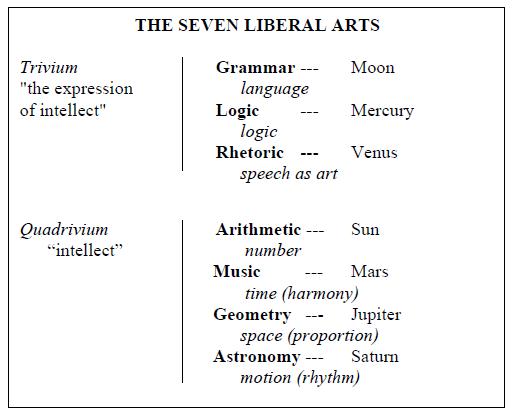
In realtà, è altrettanto probabile che Bernardo di Chartres facesse riferimento alla sintesi tra rivelazione delle scritture e pensiero greco (che proprio in quel XII secolo veniva riscoperto, tradotto dalle fonti arabe e studiato): sulla porta occidentale della Cattedrale sono rappresentate le 7 arti liberali, all’interno di un vertiginoso gioco di rimandi a suo tempo esplorato da Titus Burckhardt [“The Seven Liberal Arts and the West Door of Chartres Cathedral“, Studies in Comparative Religion, Vol. 3, No. 3 (Summer, 1969)]

Le 7 arti liberali

Sia come sia, la metafora doveva essere una specie di luogo comune nel Medioevo, se la usa anche Isaia di Trani, un commentatore del Talmud vissuto tra il 1180 e il 1250:

Non ho mai dichiarato arrogantemente “La mia saggezza mi ha servito. Ho invece applicato a me stesso la parabola che ho sentito narrare dei filosofi. Il più saggio dei filosofi chiese: “Ammettiamo che i nostri predecessori erano più saggi di noi. E tuttavia critichiamo i loro commenti, rigettandoli e sostenendo che abbiamo ragione noi. Come è possibile?” Il saggio filosofo rispose: “Chi vede più lontano, un nano o un gigante? Di certo un gigante, perché i suoi occhi sono a un livello più alto di quelli del nano. Ma se il nano è seduto sulle spalle del gigante, che vede più lontano? … Anche noi siamo nani a cavalcioni sulle spalle di giganti. Possediamo tutta la loro saggezza e poi proseguiamo oltre. Diventiamo saggi e siamo in grado di affermare quanto affermiamo grazie alla loro saggezza, non perché siamo più grandi di loro.

Nonostante la popolarità medievale, il detto scompare per qualche centinaio d’anni. Riaffiora nel XVII secolo: Robert Burton, nella sua Anatomia della melancolia del 1621, l’attribuisce al mistico spagnolo Diego de Estella o Didacus Stella (“I say with Didacus Stella, a dwarf standing on the shoulders of a giant may see farther than a giant himself”) e i commentatori più tardi confondono il riferimento di Diego al Vangelo di Luca con un commento alla Pharsalia di Lucano (ma nessuno dei due testi è pertinente).

Il poeta gallese George Herbert, più o meno nello stesso periodo, introduce nella sua raccolta di proverbi Jacula Prudentium del 1651 il detto: “A dwarf on a giant’s shoulders sees farther of the two.”

Dopo la citazione newtoniana, che abbiamo già ricordato, la metafora diventa luogo comune.

  • La riprende Samuel Taylor Coleridge, in The Friend (1828): “The dwarf sees farther than the giant, when he has the giant’s shoulder to mount on.”
  • La contesta (e che altro v’aspettavate) Friedrich Nietzsche, opinando che un nano (cioè un accademico) non può che portare al suo livello di comprensione persino i più elevati pensieri. Nel capitolo di Così parlò Zarathustra intitolato “Della visione e dell’enigma”, Zarathustra scala una montagna con un nano sulle spalle (“Verso l’alto: – sebbene mi stesse addosso, quello spirito, metà nano, metà talpa; storpio, storpiante; facendo gocciolare piombo nelle mie orecchie, e pensieri pesanti come piombo nel mio cervello”). Giunti in vetta, il nano con capisce nulla e Zarathustra si imbufalisce: “O spirito della gravità – dissi con ira. – Non prender con leggerezza la cosa! Se no ti abbandono sul tuo sasso, o sciancato – e pure ti portai ben in alto!” D’altra parte, una decina d’anni prima, ne La filosofia nell’epoca tragica dei Greci (1873) Nietzsche aveva affermato che se nella storia della filosofia c’era qualche cosa che assomigliasse al progresso, non poteva che venire dai rari giganti, ognuno dei quali chiamava il suo fratello attraverso i desolati intervalli del tempo.
  • La usa Umberto Eco ne Il nome della rosa, per la risposta di Guglielmo da Baskerville alla lamentela di Nicola da Morimondo, il vetraio, sulla perdita della sapienza degli antichi e la fine dell’era dei giganti,
  • La parafrasa il Dr. Ian Malcom in Jurassic Park: “I’ll tell you the problem with the scientific power you’re using here: it didn’t require any discipline to attain it. You read what others had done, and you took the next step. You didn’t earn the knowledge for yourselves, so you don’t take any responsibility for it. You stood on the shoulders of geniuses to accomplish something as fast as you could, and before you even knew what you had, you, you’ve patented it, and packaged it, you’ve slapped it on a plastic lunchbox, and now [pounds table with fists] you’re selling it. [pounds table again] You want to sell it, well… […] your scientists were so preoccupied with whether they could that they didn’t stop to think if they should.”
  • È inscritta (STANDING ON THE SHOULDERS OF GIANTS) sul bordo della moneta bimetallica da 2 sterline del 1997, come implicito omaggio a Newton che fu, negli ultimi anni della sua vita, Warden e Master della Royal Mint).
    2 pounds
  • È il titolo di un libro curato da Stephen Hawking: On The Shoulders of Giants. The Great Works of Physics and Astronomy.
  • I R.E.M. usano la frase “Standing on the shoulders of giants leaves me cold” (circa 0:30 nel video) nella canzone King of Birds:

Tutta questa fatica (che mi è costata quasi un’intera domenica di lavoro, in cui però ho imparato molte cose) per dirvi che ho scoperto un blog/rivista online/fiera delle delizie dedicato alla storia della scienza che si chiama The Giant’s Shoulders. Qui di seguito il link al numero più recente, il 45. Buon divertimento.

Hurley-Dennett-Adams – Inside Jokes: Using Humor to Reverse-Engineer the Mind

Hurley, Matthew M., Daniel C. Dennett, Reginald B. Adams Jr. (2011). Inside Jokes: Using Humor to Reverse-Engineer the Mind. Cambridge MA: The MIT Press. 2011. ISBN 9780262015820. Pagine 359. 29.95$

Inside Jokes

amazon.com

Un libro serissimo, naturalmente, anche se spesso capitoli e paragrafi sono introdotti da una barzelletta (ma joke è un po’ più polisemico di barzelletta).

All’origine del libro c’è la tesi di dottorato completata nel 2006 da Matthew Hurley, che può dunque essere considerato l’autore principale del volume. Adams e Dennett sono stati i suoi supervisors alla Tufts University. Inoltre, Dennett si era impegnato, nel suo Consciousness Explained del 1991, a fornire “a proper account of laughter” che andasse al di là della pura fenomenologia: sotto questo profilo si tratta dunque anche di una promessa tardivamente mantenuta.

Gli stessi autori introducono la loro tesi a partire da una nota nursery rhyme e anch’io seguirò le loro tracce:

There was an old woman who lived in a shoe.
She had so many children, she didn’t know what to do;
She gave them some broth without any bread;
Then whipped them all soundly and put them to bed.
[The Oxford Dictionary of Nursery Rhymes]

Old Woman in a Shoe

wikipedia.org

Soltanto che la storiella raccontata dai 3 autori prende una piega diversa:

(Their rooms where piled high with the playthings of boys:
comic books, fishing rods, discarded toys,
model planes, model trains and the dirt that goes with them
and huge piles of laundry that flowed out to the kitchen.
And try as she may to get them to sweep –
she’d scold them, and threaten, implore them, and weep;
she’d given them dust-cloths, and vacuums and brooms –
she just could not get them to clean up their rooms.)

… and, then, one night the old woman got a new idea:

She made them pajamas and bed socks of Swiffer cloth, and the next night while they slept she hid lots of candies around in their rooms, under the beds, under the piles of toys and clothes. In the morning when the children discovered the first of these candies, they went on a gleeful rampage, piling and sorting their belongings in the hunt for all the candies. By noon they were stuffed with candy-and their rooms were as orderly and clean as Martha Stewart’s front parlor. [59-64: il riferimento è come di consueto alle posizioni sul Kindle]

La tesi di fondo del libro è ben illustrata da questa metafora o parabola o filastrocca riveduta e corretta: la selezione naturale (impersonata da quella vecchia signora di Madre Natura) usa un trucco simile per indurre il nostro cervello a occuparsi del noioso debugging assolutamente necessario per sopravvivere (ancorché pericolosamente) all’accumularsi di scoperte ed errori accumulati dai nostri processi euristici. Non potendo semplicemente “comandare” al cervello di mettere in atto subroutine di pulizia (l’evoluzione non funziona così!), ha dovuto “corrompere” il cervello con il piacere: rendendo piacevole un dovere (o meglio una necessità). L’allegrezza che ci dà la scoperta di un errore d’inferenza è il senso dell’umorismo, che – una volta evolutosi – può essere “sfruttato” dagli stimoli supernormali inventati dai comici nel corso dei millenni. Come accade per il nostro gusto smodato per i dolci (e la pornografia).

Humor, we will try to show, evolved out of a computational problem that arose when our ancestors were furnished with open-ended thinking.

Il volume sviluppa questa idea di fondo in modo molto articolato, ponendo e dando risposta a 20 domande sulla “teoria cognitiva ed evoluzionistica dell’umorismo” proposta dagli autori. Ma per avere tutte le risposte dovete per forza leggere il libro.

Resta il dubbio – ma mi potrete dare una mano a scioglierlo soltanto dopo avere letto l’opera – se una teoria così ingegnosa sarebbe potuta venire in mente ad autori non anglosassoni di madrelingua, per i quali l’aggettivo funny ha due accezioni principali (cito dal Merriam-Webster online):

  1. a : affording light mirth and laughter : amusing
    b : seeking or intended to amuse : facetious
  2. : differing from the ordinary in a suspicious, perplexing, quaint, or eccentric way : peculiar — often used as a sentence modifier «funny, things didn’t turn out the way we planned»

Questi gli esempi (sempre dal Merriam-Webster):

  • He told a funny story.
  • He’s a very funny guy.
  • What are you laughing at? There’s nothing funny about it.
  • There’s something funny going on here.
  • She has some funny ideas about how to run a company.
  • “I can’t find my keys.” “That’s funny — they were here a minute ago.”
  • My car has been making a funny noise lately.
  • A funny thing happened to me the other day.
  • It feels funny to be back here again.
  • It’s funny that you should say that — I was just thinking the same thing myself.

* * *

Pignolerie: a un certo punto [1687] si dice che Being There (Oltre il giardino), del 1979, è l’ultimo film di Peter Sellars:

  1. il nome del grandissimo attore è Peter (oddio, Richard Henry detto Peter) Sellers!
  2. il suo ultimo film è il (peraltro non memorabile) Diabolico complotto del Dr. Fu Manchu (The Fiendish Plot of Dr. Fu Manchu), di cui sarebbe anche il regista (uncredited), anche se poi compare anche in Sulle orme della pantera rosa (Trail of the Pink Panther).

Trascuratezza imperdonabile per una casa editrice così importante. E dire che l’agente di Dennett è il leggendario John Brockman. In un libro sull’umorismo, poi!

Clouseau

wikipedia.org

* * *

Come al solito, vi propongo anche una selezione di citazioni – meno noiosa del solito, mi auguro, perché molte sono storielle e barzellette raccontate nel testo.

The most exciting phrase to hear in science, the one that heralds new discoveries, is not “Eureka!” (I found it!) but “That’s funny….” – Isaac Asimov [98]

Q: How do you tell the sex of a chromosome?
A: Pull down its genes. [189]

Circular definition: see Definition, circular.[358]

There are only 10 kinds of people in the world – those who read binary and those who don’t. [483: una delle mie preferite]

Email is the happy medium between male and female. (Hofstadter 2007) [621]

Photons have mass? I didn’t even know they were Catholic. [621]

The face of a child can say it all, especially the mouth part of the face. [622]

An atheist explorer in the deepest Amazon suddenly finds himself surrounded by a bloodthirsty group of natives. Upon surveying the situation, he says quietly to himself “Oh God, I’m screwed!”
There is a ray of light from heaven and a voice booms out: “No, you are not screwed. Pick up that stone at your feet and bash in the head of the chief standing in front of you.”
So the explorer picks up the stone and proceeds to bash the living heck out of the chief.
As he stands above the lifeless body, breathing heavily and surrounded by a hundred natives with a look of shock on their faces, God’s voice booms out again: “Okay … Now you’re screwed.” [730]

We know why we are born curious: We are, as George Miller once said, informavores. Our hunger for novelty drives us to fill our heads with facts we might need some day […] [895: questa è una cosa seria, e un argomento su cui avrei molto da dire. Non qui e non ora: vi prego di avere pazienza …]

If insight is like orgasm as Gopnik’s metaphor declares, then, likewise, curiosity might be the analogue of lust. The epistemic hunger of curiosity – a burning desire to find reason and order – prompts us to fervently advance upon situations that require explanatory exertion (often to exhaustion) that ultimately leads to that religiously adored moment of insight. And just as lust suddenly dissolves into triviality with orgasm, so does the hungry feeling of curiosity hastily retreat upon the achievement of insight. Though it may have killed the cat, curiosity more than compensates for its cost: Without it we mightn’t seek answers or theories at all. [1037]

Epistemic uncertainty – the lack of a persuasive answer to a pressing question – has its own emotional accompaniment, also called uncertainty […] [1048]

Love is like pi – natural, irrational, and very important.
– Lisa Hoffman [1052]

To say that you believe something is to say that that information successfully passed through your mind without triggering the emotions of confusion or humor, but quite possibly having triggered the sense of insight. [1190]

A mental space is a region of working memory where activated concepts and percepts are semantically connected into a holistic situational comprehension model. [1249]

People do generate – ceaselessly – a bounty of pertinent anticipations about the world, but such anticipations are not created through effortful enumeration of all possibilities followed by the comparisons of individual assessments of likelihoods for each possible future. Rather, the expectations we have at hand each are the result of current situation-pertinent thought or recollections of other pertinent-at-the-time thoughts […] [1315]

The answer “I don’t know” is a perfectly reasonable one, though perhaps less likely, empirically, given the social pressure to provide an answer when confronted with an interrogation. [1338]

A belief is a commitment to a fact about the world. [1345]

What gets us into trouble is not what we don’t know; it’s what we know for sure that just ain’t so.
– Mark Twain [1410]

Our brains are for “producing future” (as the poet Valery once put it) […] [1541: non sono riuscito a trovare la citazione esatta. Qualcuno mi può aiutare?]

One might even venture the maxim: The more arduous and even dangerous the job, the more intense the reward system must be to ensure its completion. [1631]

Did you hear about the fellow whose whole left side was cut off? He’s all right now. [1709]

Gravity makes a big difference. [1735: qui è rilevante la nota, ma non sono capace di citare le note con il Kindle. Geoffrey Hinton ha proposto un interessante puzzle sull’argomento. Supponete di prendere una manciata di bastoncini di Shanghai, di lanciarli in aria e di fotografarli mentre cadono. Quanti, grosso modo – decidete voi il grado di approssimazione – sono orizzontali e quanti verticali? più o meno lo stesso numero, vero? No, falso! Ci sono infiniti modi di essere orientati orizzontalmente, N E S W NE SE SW NW eccetera, ma un solo modo di essere verticali. Rifate l’esperimento con una paccata di CD: la risposta è invertita]

We see some traces of an analytic mode of construction in the deliberate editing of jokes, making them more streamlined, punching up the punchline by changing the word order, adding a beat here, a sly misdirecting digression there; but this is, in effect, “postproduction” […] [2010]

[…] in hearing a fiction, we enjoy it for its storytelling value, but we never commit to it as being reality and subsequently discover that it is not […] [2495]

What did the 0 say to the 8?
“Nice belt.” [2626]

When you look at the picture that has no woman in it (in fig. 11.1), you cannot stop yourself from seeing a woman there even if you are told ahead that she is not there. The only power the high-level belief has is in telling you that it’s not really true, after you’ve already seen her. [2944]

Sandro Del Prete. Sunrise in the Nature Reserve

© Sandro Del Prete. Sunrise in the Nature Reserve

Huron (2006) argues persuasively that most if not all excellence in music involves the artful alternation of fulfilled expectations and unexpected (not entirely predictable) variations. [3039: Huron, David (2006). Sweet Anticipation: Music and the Psychology of Expectation. Bradgord Books. 2008]

If you want to tell people the truth, make them laugh, otherwise they’ll kill you.
One should always play fairly when one has the winning cards.
I am not young enough to know everything.
Morality, like art, means drawing a line someplace. [3119. Tutte e 4 di Oscar Wilde]

People often make the mistake of thinking that “humorous” and “serious” are antonyms. They are wrong. “Humorous” and “solemn” are antonyms. I am never more serious than when I am being humorous. [3151. È una citazione di Bertrand Russell]

“It is not enough to succeed. Others must fail.” [3154. È una citazione di Gore Vidal]

Everybody anticipates, in mental spaces, as much of the relevant future as possible, to the best of their ability given the specific knowledge they have already collected. We aspire to decide on the basis of “all things considered,” but of course we must always truncate our considerations in order to meet the deadlines of effective action. So each of us is engaged in a never-ending round of heuristic search, building partial, and risky, structures-mental spaces-that depend on jumping to conclusions-as deftly as possible. [3329]

Both knowledge and ignorance are valuable strategic secrets. [3339]

(A “quidnunc” – from the Latin for “what now?” – is a person obsessed with the very latest news. We all have-and should have-quidnunc tendencies, since the latest news creates an information gradient that may be exploited by others at our expense.) [3343]

The pastime of permeating casual conversation with witticisms not only serves the simple selfish goal of flaunting one’s wit, but is also a method of trade in the currency of social capital. [3401]

[…] “Skinnerian” as opposed to “Darwinian” hard-wired organisms […] [3651: subito dopo introduce i concetti di creature “Popperiane” e “Gregoriane”]

To be precise, you can’t give yourself gargalesis – the laughter-inducing kind of tickling we usually think of as related to humor. But, you can self-induce knismesis, which is the kind of uncomfortable tickling sensation felt when an insect crawls on your skin or even when you drag a feather lightly across your skin (Hall and Allin 1897). [4754]

Roger Shepard

planetperplex.com / Roger Shepard

Tom Rachman – The Imperfectionists

Rachman, Tom (2010). The Imperfectionsts. New York: The Dial Press. 2010.
ISBN 9780385343664. Pagine 306. 13,44 US$

The Imperfectionists

about.com

Romanzo d’esordio di un autore trentaseienne all’epoca dell’uscita del libro, The Impressionists ha suscitato molto interesse e più d’un entusiasmo. A me è piaciuto senza entusiasmarmi.

Tom Rachman

tomrachman.com

Il romanzo è costruito molto abilmente. In realtà, gli 11 capitoli in cui è articolato il romanzo sono altrettanti racconti, tenuti insieme da riferimenti incrociati e dal comune riferimento al quotidiano in lingua inglese di Roma al centro del romanzo. Il trucco è vecchio come il mondo, o quanto meno come la letteratura, dai Racconti di Canterbury al Decamerone. Un trucco non particolarmente apprezzato da chi, come me, preferisce i romanzi-romanzi alle raccolte di racconti, per quanto mentite siano le spoglie dietro cui si nascondono.

Non tutti i racconti sono ben riusciti. In molti casi, anche se non in tutti, il racconto si chiude in modo inatteso, un po’ come nelle storie del Roald Dahl “da grandi” (Tales of the Unexpected, per esempio). La recensione del New York Times, molto più entusiastica della mia, tira in ballo anche Saki e O. Henry, e in quella che io vedo come frammentazione e incapacità di tenere in piedi un romanzo-romanzo, il NYT ci vede una “lente cubista”.

Al termine di ogni capitolo, in caratteri corsivi, la ricostruzione di varie fasi nella “vita” del quotidiano, dalla nascita negli anni Cinquanta alla morte nel 2004, fa da filo conduttore della storia complessiva. Non tutti i capitoli e non tutti i personaggi sono riusciti nello stesso modo: il primo, per esempio, è dedicato al patetico e deprimentissimo Lloyd Burko e mi ha fatto venir voglia di non andare più avanti. E di storie deprimenti ce n’è più d’una. Meglio, molto meglio, la chiave grottesca (il giovane Winston Cheung al Cairo) o dickensiana (la Signora Ornella de Monterecchi è una Miss Havisham attualizzata in chiave ossessivo-compulsiva).

In conclusione, anche se il libro si lascia leggere con piacere, non penso che Tom Rachman sia un nuovo grande scrittore e non aspetterò con ansia la sua prossima prova. Molto accurate, e vi assicuro che è molto raro, le ambientazioni romane.

* * *

Come di consueto, qualche citazione annotata durante la lettura sul Kindle.

After listening to several variations of no, Lloyd puts down the phone. [161]

Most of the journalists were men, Americans chiefly, but with a few Britons, Canadians, and Australians, too. All had been based in Italy when hired, and all could speak the local language. But the paper’s newsroom was strictly Anglophone. Someone hung a sign on the elevator door that read, LASCIATE OGNI SPERANZA, VOI CH’USCITE—OUTSIDE IS ITALY.
And when staffers went downstairs for sandwiches they’d say, “I’m headed to Italy—anyone need anything?”
[977]

He doesn’t call. She wants to scream. But this is how he is: easygoing, which means tough-going for everyone else. [1244]

“I’m still funny. I’m just not funny ha-ha. More funny weird.” [1338]

Leopold Bloom was his hero, not least because they shared a taste for animal innards—fried pork kidneys in particular. [1610]

He is more a skulking fornicator, not a marriage-busting cheater. [1975]

“[…] how about the Cohibatini?” he responds. “Vodka, Virginia tobacco leaves, eight-year-old Bacardi rum, lime juice, and corbezzolo honey.” [1989]

“I have a plan,” he responds archly, but goes no further. He isn’t going to reveal himself to her. And, anyway, he doesn’t have a plan. [2918]

What are all these paintings for? A woman with a ridiculously long neck. Wine bottles and hats. A chicken in midair. A shipwreck. [3291. Si tratta, naturalmente, di un Modigliani, un Léger, uno Chagall e un Turner]

She had never learned the technique of newspaper reading, so took it in order like a book, down the columns, left to right, page after page. She read every article and refused to move on until she was done, which meant that each edition took several days to complete. [3807]

Eli Gottlieb – The Face Thief

Gottlieb, Eli (2012). The Face Thief. New York: HarperCollins. 2012.
ISBN 9780061735059. Pagine 256. 11,33 €

The Face Thief

bookbirddog.blogspot.com

Avrei voluto iniziare la mia recensione levando il calice alla nascita di un’altra indimenticabile dark lady, come non ne incontravo da tempo. Ma poi una mia giovane amica, dotata di antica saggezza e cultrice della materia, mi ha domandato: “Dark lady, o gatta morta?” E, davanti alla mia espressione sconcertata, ha subito chiarito: “Dark lady è Barbara Stanwick in La fiamma del peccato, gatta morta è Anne Baxter in Eva contro Eva.”

Giusto per capire meglio le differenze, ecco la dark lady (La fiamma del peccato l’ho recensita qui: vi voglio anche segnalare che su YouTube è disponibile qui per intero, naturalmente nella versione originale):

PHYLLIS (Standing up again) Mr. Neff, why don’t you drop by tomorrow evening about eight-thirty. He’ll be in then.
NEFF Who?
PHYLLIS My husband. You were anxious to talk to him weren’t you?
NEFF Sure, only I’m getting over it a little. If you know what I mean.
PHYLLIS There’s a speed limit in this state, Mr. Neff. Forty-five miles an hour.
NEFF How fast was I going, officer?
PHYLLIS I’d say about ninety.
NEFF Suppose you get down off your motorcycle and give me a ticket.
PHYLLIS Suppose I let you off with a warning this time.
NEFF Suppose it doesn’t take.
PHYLLIS Suppose I have to whack you over the knuckles.
NEFF Suppose I burst out crying and put my head on your shoulder.
PHYLLIS Suppose you try putting it on my husband’s shoulder.
NEFF That tears it.
Neff takes his hat and briefcase.
NEFF Eight-thirty tomorrow evening then, Mrs. Dietrichson.
PHYLLIS That’s what I suggested.
They both move toward the archway.
NEFF Will you be here, too?
PHYLLIS I guess so. I usually am.
NEFF Same chair, same perfume, same anklet?
PHYLLIS (Opening the door) I wonder if I know what you mean.
NEFF I wonder if you wonder.
He walks out.

Anche la protagonista del romanzo di Gottlieb, Margot Lassiter, ha questa grande capacità dialettica, di contrastare e battere l’antagonista maschile sul suo stesso terreno e al suo stesso gioco (Margot, professionista dell’inganno, si fa beffe di un professionista della lettura e del disvelamento dell’inganno, Lawrence Billings, autore di un manuale di successo intitolato The Physique of Finance: The Art of Face Reading and Body Language for Professional Advantage), di fare del predatore la sua preda.

La gatta morta, invece, agisce diversamente. Si finge umile, indifesa, cedevole, ma alla fine micidiale. La gatta morta ottiene ciò che vuole. Chiara Moscardelli, che ci ha scritto un libro (che io però non ho letto: Volevo essere una gatta morta) la descrive così:

La gatta morta è una categoria poco conosciuta, nascosta, silenziosa ma micidiale.
Ha pochi pensieri, chiari, semplici. Nessuna dietrologia, nessuna complicazione. Ha una vita serena perché ha un unico scopo: il matrimonio.
A diciotto anni ha le idee chiare su tutto ed è in grado di realizzare una cena completa per otto persone con sedici portate. Voi non ne siete capaci? Imparate alla svelta.
A venti ha deciso quale sarà l’uomo che sposerà. Magari non è un uomo in carne e ossa ma è comunque la categoria a cui appartiene che inizia a prendere di mira: l’avvocato, l’architetto, il notaio, il dottore. Le qualifiche sono importanti.
[…]
Io le ho studiate a fondo e me ne sono fatta un’idea ben precisa. Le gatte morte sono geniali.
Dietro la loro apparente passività si nasconde una forza, un’aggressività senza pari. Sono burattinaie che muovono i fili di marionette inconsapevoli. Non c’è niente da fare. Contro di loro non esistono armi. Ve lo dico con tutto il cuore, arrendetevi! Perché gatta morta si nasce, non si diventa.

L’idealtipo della gatta morta è la Eva Harrington di Eva contro Eva, che fingendo una smisurata ammirazione per l’attrice Margo Channing (Bette Davis) si intrufola nella sua vita e le porta via la parte, il successo, il critico teatrale di riferimento (di cui diviene amante) e (poco ci manca) il fidanzato. Qui di seguito la scena memorabile in cui la nostra santarellina racconta a ciglio asciutto come abbia perso il marito in guerra e come la sua fervida adorazione l’abbia portata a seguire per anni la diva ad ogni suo spettacolo. Non c’è bisogno di capire l’inglese: guardate gli occhi e le posture.

Per completare il quadro delle tassonomie ci sarebbe anche la femme fatale, affine alla dark lady, ma a differenza di questa fatale, appunto, ma non necessariamente malvagia. Non necessariamente, cioè, infligge il male volontariamente, per conseguire un obiettivo o per desiderio di annientamento dell’altro. Anche qui, nella mia mente, c’è un idealtipo, ed è la Lola Lola (Marlene Dietrich) dell’Angelo Azzurro di Sternberg (qui in edizione integrale).

Un altro vocabolo che ha continuato a frullarmi per la testa durante la lettura del romanzo di Gottlieb è stato predatrice. E questo aspetto è quello che alla fine mi fa pensare che Margot Lassiter è soprattutto una dark lady. Margot persegue i suoi obiettivi e distrugge le sue vittime (perché in una certa misura potrebbe conseguire i suoi obiettivi anche senza annientare la vittima – come nel caso di John Potash – oppure indulge nella distruzione della vita di Lawrence Billings anche senza grande tornaconto economico) e lo fa reificandole, trattandole come oggetti, utilizzando la prevedibilità del corteggiamento maschile come arma contro i corteggiatori stessi, come accade per il principio dell’attacco-difesa proprio dello judo:

Yawara significa adeguarsi alla forza avversaria al fine di ottenere il pieno controllo. Esempio: se vengo assalito da un avversario che mi spinge con una certa forza, non devo contrastarlo, ma in un primo momento debbo adeguarmi alla sua azione e, avvalendomi proprio della sua forza, attirarlo a me facendogli piegare il corpo in avanti […] La teoria vale per ogni direzione in cui l’avversario eserciti forza. [Jigorō Kanō, (2005). Fondamenti del Judo. “Cos’è il Kodokan Judo”: pp. 23-24. Citato in Wikipedia]

Per scrivere di dark ladies è necessaria una buona dose di misoginia, perché la rappresentazione della dark lady (e delle sue varianti richiamate in precedenza) si pone all’estremo opposto della scala di idealizzazione della donna che vede all’estremo opposto la donna angelicata di Dante e l’eterno femminino di Goethe, ma anche di fascinazione. È necessario anche quel distacco dialettico che permette di comprendere che il comportamento che ci inorridisce in queste eroine femminili al negativo è la pratica quotidiana e la moneta corrente del comportamento maschile nei confronti delle donne, e non sarebbe nemmeno pensabile senza la premessa dell’atteggiamento maschile (ancora una volta il punto di vista dello judo).

Resta da dire che il romanzo, senza essere un capolavoro, è anche ben scritto e ben costruito: ben costruito, perché 4 storie e 4 piani temporali sono alternati e ricostruiti in flashback (in 3 casi su 4, per la verità) a partire dal rovinoso ruzzolone iniziale, mantenendo sempre vivissima l’attenzione (e la voglia di andare avanti) del lettore. Ben scritto, perché è evidente il divertimento dello scrittore nello sfottere un certo mondo (quello dei pomposi manuali per top manager, ad esempio) e nel mantenere la distanza dai suoi personaggi e dalla sua materia.

Di seguito, qualche piccolo esempio del suo stile e qualche curiosità (senza rovinare nulla del thriller):

Her nails were ridgeless and attested to a diet rich in vitamin B and iron, but the moons, he noticed, were invisible: pituitary problems? [616]

The science of touch is called haptics. [1297]

And it was at that moment, for the very first time, that Lawrence Billings felt old. He’d felt mature before; he’d felt accomplished; he’d felt at midcareer, midpoint, midlife before. But at the moment, beached on the sound of that word dear, he simply felt dusty. [1675]

Sex and curiosity occupied the same part of the brain. [2988]

Franz Schubert – Winterreise [2]

Il mio primo incontro con la Winterreise fu straordinario, una di quelle cose che ti capitano da ragazzo (eh sì, perché persino ai miei tempi a 21 anni si era ancora ragazzi, o almeno io lo ero, ragazzo e bamboccione, e non ho paura di dirlo; sfigato nel senso di Martone certamente no, anche se quella è un’altra storia), che non capisci fino in fondo che ti è successa una cosa straordinaria, e te ne rendi conto anni dopo: la consapevolezza cresce nel tempo. Forse sono questi gli ingredienti dei ricordi indimenticabili, delle cose che – pensi – ti hanno formato, hanno fatto di te quello che sei realmente. Che ti fanno dire “meglio una testa piena di musica che una testa piena di ambizioni” anche nei periodi più difficili (e questo ancora lo è).

Ho studiato musica, da ragazzo. Mio padre aveva un disco (un 33 giri piccolo come un 45, mi pare si chiamassero EP, extended play, ma posso sbagliarmi e non mi va di controllare adesso) dell’Eine Kleine Nachtmusik di Mozart, una delle prime cose che ho imparato a fischiare da piccolo, e sulla copertina azzurra c’era un ritratto di Mozart con i capelli lunghi. Pensavo che da grande avrei voluto avere i capelli lunghi (me li tagliavano a spazzola, con la sfumatura altissima fatta con la macchinetta) ed essere musicista. Alla televisione davano dei recital di Arturo Benedetti Michelangeli (qualche anno fa Roman Vlad li ha riproposti) e a me pareva che il piano avesse uno specchio in cui le mani si riflettevano.

Così a 7 anni cominciai a prendere lezioni con la signorina P. (aveva un alito micidiale) e i miei noleggiarono un pianoforte: ci rimasi malissimo perché non c’era lo specchio; pensai che i miei si erano fatti fregare o che avevano voluto risparmiare. Soltanto molti anni dopo capii che il legno era così lucido e le luci cosi forti che le mani del pianista vi si riflettevano. Ma ditemi voi stessi se non era facile cadere in inganno.

Per la verità su YouTube il recital chopiniano di Arturo Benedetti Michelangeli all’Auditorium RAI di Torino c’è tutto intero. Era il 21 settembre 1962, ma non so se l’abbiano trasmesso in diretta (e certamente non era questo il concerto che mi aveva tratto in inganno). Chi è interessato può ascoltarlo: dura quasi 2 ore, ma ne vale sicuramente la pena:

Insomma, per 2-3 anni mi fece lezione la signorina P., senza molto costrutto. Allora i miei decisero di cambiare insegnante. Il Maestro Mario M. era un collega di mio padre (e dunque faceva il bancario per campare) ma aveva studiato al conservatorio ed era – secondo me – molto bravo. Aveva capito che con me doveva spiegare tutto, che non ero interessato a suonare per suonare, ma volevo capire la teoria che c’era sotto la musica. Dunque mi conquistò subito.

Peccato che io non sia capace di fare nulla che richieda fisicità e coordinamento (be’, quasi nulla, di andare in bicicletta, nuotare e un paio d’altre cose sono capace). Facevo la seconda media (un anno che fu anche per molti altri motivi molto difficile per me) quando un giorno, infuriatosi, il Maestro M. sul quadernetto sul quale mi assegnava gli esercizi scrisse a caratteri cubitali: “Negato alla tastiera del pianoforte.” Non lo dimenticherò mai sembra una frase fatta, ma non lo è. Sono passati quasi 50 anni e non l’ho certo dimenticato.

Smise dunque di provare a insegnarmi a suonare (anche se qualcosina sono ancora in grado malamente di strimpellare), ma continuò a farmi lezione di musica. E mi insegnò a conoscere, ascoltare e capire la musica. Continuammo per molti anni, per il resto delle medie e il ginnasio e il liceo e l’università, a vederci 2 volte alla settimana, prima nella casa al 4° piano e poi in quella nuova, al 7°. Lo dico perché M. era rimasto sotto un bombardamento durante la guerra e da allora soffriva di claustrofobia: non prendeva mai la metropolitana ma rigorosamente il tram, e non saliva in ascensore ma rigorosamente a piedi, anche se i piani erano 7.

Si metteva al piano e suonava lo spartito di quello che stavamo studiando: le sinfonie di Beethoven, l’Incompiuta e i Trii di Schubert, Tristano e la tetralogia di Wagner, Don Giovanni di Mozart. Poi ascoltavamo sul disco (compravamo versioni economiche, perché per ascoltare bene era necessario spostare la puntina più e più volte). Se c’era da cantare, cantavamo a squarciagola. A volte, a motivare quello che studiavamo c’era qualche evento speciale in programma: così studiammo la tetralogia in vista di un’edizione scaligera (con l’all’epoca giovane Sawallisch), e Bach per un ciclo di lezioni settimanali bellissime di Giulio Confalonieri alla Piccola Scala.

M. aveva una passione sfrenata per i Lieder e studiammo quelli di Schubert e Schumann, soprattutto. E fu così che ci preparammo alla Winterreise che eseguirono una sera di marzo del 1974 piuttosto freddina (non vi so dire se lunedì 4, più probabilmente, o sabato 9) al Piccolo Teatro di via Rovello Dino Ciani al pianoforte e il baritono Claudio Desderi. Non sapevo chi fosse Dino Ciani (uno dei pianisti più promettenti della sua generazione) né (ovviamente) che sarebbe morto a 32 anni entro la fine di quel mese (il 27) al km 7 della Flaminia in un incidente automobilistico. Ma fui rapito da quella musica.

Ed è fantastico (trovo) che il web mi permetta di ricostruire la data e il repertorio di quel concerto. E di sciogliere il dubbio se fosse il concerto del lunedì (il suo terzultimo) o quello del sabato: era lunedì, e lo so perché su questo sito giapponese ho trovato anche l’elenco dei bis che eseguirono:

  • Trockne Blumen, n. 18 dal ciclo Die Schöne Müllerin D795
  • Die Forelle D550
  • Der Doppelgänger, n. 13 dal ciclo Schwanengesang D957

E, come dicevo prima, io quel Doppelgänger spero di non dimenticarlo mai.

In mancanza della versione di Desderi e Ciani, che non ho trovato, quella classica di Dietrich Fischer-Dieskau.

Il testo è di Heinrich Heine.

Still ist die Nacht, es ruhen die Gassen,
In diesem Hause wohnte mein Schatz;
Sie hat schon längst die Stadt verlassen,
Doch steht noch das Haus auf dem selben Platz.

Da steht auch ein Mensch und starrt in die Höhe,
Und ringt die Hände, vor Schmerzensgewalt;
Mir graust es, wenn ich sein Antlitz sehe –
Der Mond zeigt mir meine eigne Gestalt.

Du Doppelgänger! du bleicher Geselle!
Was äffst du nach mein Liebesleid,
Das mich gequält auf dieser Stelle,
So manche Nacht, in alter Zeit?

La mia rudimentale traduzione:

La notte è quieta, le strade sono calme.
In questa casa viveva il mio amore:
Da molto tempo ha lasciato la città,
Ma la casa è sempre qui, nello stesso posto.

Un uomo è là e guarda il cielo,
E si torce le mani sopraffatto dal dolore:
Vederlo in volto mi atterrisce –
La luna illumina le mie stesse fattezze!

Mio sosia! Mio pallido compagno!
Perché scimmiotti la mia pena d’amore
Che mi tormentò in questo stesso luogo,
Per tante notti, tanto tempo fa?