Sulle spalle dei giganti

Come molti (immagino) attribuivo la frase “sulle spalle dei giganti” (“on the shoulders of giants”) a Isaac Newton che, in una lettera a Robert Hooke del 5 febbraio 1676 (per l’esattezza, Newton ha scritto “If I have seen further it is by standing on ye sholders of Giants” e c’è il fondato sospetto che stesse prendendo Hooke per i fondelli a proposito della loro diatriba sull’ottica e la teoria dei colori, tant’è vero che i due non si parlarono né corrisposero mai più).

Sono stato scalzato dalla mia convinzione, alcuni anni fa, da un mio coltissimo collega (vorrei ringraziarlo pubblicamente, ma poiché è un giurista e un esperto di privacy mi limiterò a darne le iniziali: grazie, R. T.) che mi ha fatto presente che la metafora è medievale, se non più antica.

L’immagine è derivata dalla mitologia greco-romana: il gigante Orione (così detto perché nato dall’orina di Giove, Nettuno e Mercurio) durante un periodo della sua vita era stato accecato ma Efesto, impietositosi, lo affidò alla guida Cedalione, che gli si sedette sulle spalle e lo guidò a est, dove Eos, dea dell’aurora, gli ridonò la vista.

Orione

wikipedia.org

Il primo a utilizzare la metafora sarebbe stato Bernardo di Chartres. Scrive Giovanni da Salisbury nel suo Metalogicon del 1159:

Dicebat Bernardus Carnotensis nos esse quasi nanos, gigantium humeris insidentes, ut possimus plura eis et remotiora videre, non utique proprii visus acumine, aut eminentia corporis, sed quia in altum subvenimur et extollimur magnitudine gigantea.

Diceva Bernardo di Chartres che siamo come nani assisi sulle spalle dei giganti, cosicché possiamo vedere più cose e più lontano di loro, non perché abbiamo una vista più acuta o altra particolarità fisiologica, ma poiché siamo sollevati più in alto dalla loro mole gigantesca.

Nel transetto meridionale della Cattedrale di Chartres (ho cercato la foto ma non l’ho trovata), proprio sotto il rosone, quattro vetrate lunghe e strette rappresentano visivamente il concetto: i 4 evangelisti (Matteo, Marco, Luca e Giovanni) sono seduti sulle spalle di 4 giganteschi profeti dell’Antico testamento (Isaia, Geremia, Ezechiele e Daniele) ma, per quanto più piccoli, hanno potuto vedere meglio e riconoscere il Messia grazie alle parole e profezie dei loro giganteschi predecessori.

La porta occidentale della Cattedrale di Chartres

bluffton.edu

In realtà, è altrettanto probabile che Bernardo di Chartres facesse riferimento alla sintesi tra rivelazione delle scritture e pensiero greco (che proprio in quel XII secolo veniva riscoperto, tradotto dalle fonti arabe e studiato): sulla porta occidentale della Cattedrale sono rappresentate le 7 arti liberali, all’interno di un vertiginoso gioco di rimandi a suo tempo esplorato da Titus Burckhardt [“The Seven Liberal Arts and the West Door of Chartres Cathedral“, Studies in Comparative Religion, Vol. 3, No. 3 (Summer, 1969)]
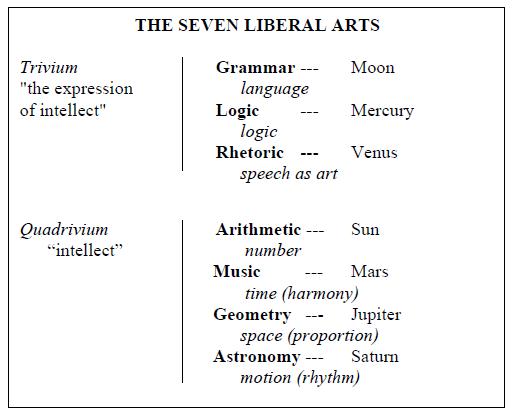
Le 7 arti liberali

Sia come sia, la metafora doveva essere una specie di luogo comune nel Medioevo, se la usa anche Isaia di Trani, un commentatore del Talmud vissuto tra il 1180 e il 1250:

Non ho mai dichiarato arrogantemente “La mia saggezza mi ha servito. Ho invece applicato a me stesso la parabola che ho sentito narrare dei filosofi. Il più saggio dei filosofi chiese: “Ammettiamo che i nostri predecessori erano più saggi di noi. E tuttavia critichiamo i loro commenti, rigettandoli e sostenendo che abbiamo ragione noi. Come è possibile?” Il saggio filosofo rispose: “Chi vede più lontano, un nano o un gigante? Di certo un gigante, perché i suoi occhi sono a un livello più alto di quelli del nano. Ma se il nano è seduto sulle spalle del gigante, che vede più lontano? … Anche noi siamo nani a cavalcioni sulle spalle di giganti. Possediamo tutta la loro saggezza e poi proseguiamo oltre. Diventiamo saggi e siamo in grado di affermare quanto affermiamo grazie alla loro saggezza, non perché siamo più grandi di loro.

Nonostante la popolarità medievale, il detto scompare per qualche centinaio d’anni. Riaffiora nel XVII secolo: Robert Burton, nella sua Anatomia della melancolia del 1621, l’attribuisce al mistico spagnolo Diego de Estella o Didacus Stella (“I say with Didacus Stella, a dwarf standing on the shoulders of a giant may see farther than a giant himself”) e i commentatori più tardi confondono il riferimento di Diego al Vangelo di Luca con un commento alla Pharsalia di Lucano (ma nessuno dei due testi è pertinente).

Il poeta gallese George Herbert, più o meno nello stesso periodo, introduce nella sua raccolta di proverbi Jacula Prudentium del 1651 il detto: “A dwarf on a giant’s shoulders sees farther of the two.”

Dopo la citazione newtoniana, che abbiamo già ricordato, la metafora diventa luogo comune.

  • La riprende Samuel Taylor Coleridge, in The Friend (1828): “The dwarf sees farther than the giant, when he has the giant’s shoulder to mount on.”
  • La contesta (e che altro v’aspettavate) Friedrich Nietzsche, opinando che un nano (cioè un accademico) non può che portare al suo livello di comprensione persino i più elevati pensieri. Nel capitolo di Così parlò Zarathustra intitolato “Della visione e dell’enigma”, Zarathustra scala una montagna con un nano sulle spalle (“Verso l’alto: – sebbene mi stesse addosso, quello spirito, metà nano, metà talpa; storpio, storpiante; facendo gocciolare piombo nelle mie orecchie, e pensieri pesanti come piombo nel mio cervello”). Giunti in vetta, il nano con capisce nulla e Zarathustra si imbufalisce: “O spirito della gravità – dissi con ira. – Non prender con leggerezza la cosa! Se no ti abbandono sul tuo sasso, o sciancato – e pure ti portai ben in alto!” D’altra parte, una decina d’anni prima, ne La filosofia nell’epoca tragica dei Greci (1873) Nietzsche aveva affermato che se nella storia della filosofia c’era qualche cosa che assomigliasse al progresso, non poteva che venire dai rari giganti, ognuno dei quali chiamava il suo fratello attraverso i desolati intervalli del tempo.
  • La usa Umberto Eco ne Il nome della rosa, per la risposta di Guglielmo da Baskerville alla lamentela di Nicola da Morimondo, il vetraio, sulla perdita della sapienza degli antichi e la fine dell’era dei giganti,
  • La parafrasa il Dr. Ian Malcom in Jurassic Park: “I’ll tell you the problem with the scientific power you’re using here: it didn’t require any discipline to attain it. You read what others had done, and you took the next step. You didn’t earn the knowledge for yourselves, so you don’t take any responsibility for it. You stood on the shoulders of geniuses to accomplish something as fast as you could, and before you even knew what you had, you, you’ve patented it, and packaged it, you’ve slapped it on a plastic lunchbox, and now [pounds table with fists] you’re selling it. [pounds table again] You want to sell it, well… […] your scientists were so preoccupied with whether they could that they didn’t stop to think if they should.”
  • È inscritta (STANDING ON THE SHOULDERS OF GIANTS) sul bordo della moneta bimetallica da 2 sterline del 1997, come implicito omaggio a Newton che fu, negli ultimi anni della sua vita, Warden e Master della Royal Mint).
    2 pounds
  • È il titolo di un libro curato da Stephen Hawking: On The Shoulders of Giants. The Great Works of Physics and Astronomy.
  • I R.E.M. usano la frase “Standing on the shoulders of giants leaves me cold” (circa 0:30 nel video) nella canzone King of Birds:

Tutta questa fatica (che mi è costata quasi un’intera domenica di lavoro, in cui però ho imparato molte cose) per dirvi che ho scoperto un blog/rivista online/fiera delle delizie dedicato alla storia della scienza che si chiama The Giant’s Shoulders. Qui di seguito il link al numero più recente, il 45. Buon divertimento.

Le lezioni sulla musica di Leonard Bernstein

Nel 1972, il compositore e direttore d’orchesta Leonard Bernstein tornò alla sua alma mater, l’Università di Harvard come Charles Eliot Norton Professor di Poesia, nell’accezione più vasta del termine.

Leonard Bernstein

wikipedia.org

Le lezioni di Bernstein furono tenute nell’autunno del 1973, portano complessivamente il titolo “La domanda senza risposta” (“The Unanswered Question”) e durano oltre 11 ore.

Per nostra fortuna sono tutte su YouTube e le potete guardare e ascoltare con vostro comodo (ma non siate pigri!).

Potete anche acquistarle, in libro o in DVD.

Leonard Bernstein’s Masterful Lectures on Music (11+ Hours of Video Recorded in 1973) | Open Culture

Hurley-Dennett-Adams – Inside Jokes: Using Humor to Reverse-Engineer the Mind

Hurley, Matthew M., Daniel C. Dennett, Reginald B. Adams Jr. (2011). Inside Jokes: Using Humor to Reverse-Engineer the Mind. Cambridge MA: The MIT Press. 2011. ISBN 9780262015820. Pagine 359. 29.95$

Inside Jokes

amazon.com

Un libro serissimo, naturalmente, anche se spesso capitoli e paragrafi sono introdotti da una barzelletta (ma joke è un po’ più polisemico di barzelletta).

All’origine del libro c’è la tesi di dottorato completata nel 2006 da Matthew Hurley, che può dunque essere considerato l’autore principale del volume. Adams e Dennett sono stati i suoi supervisors alla Tufts University. Inoltre, Dennett si era impegnato, nel suo Consciousness Explained del 1991, a fornire “a proper account of laughter” che andasse al di là della pura fenomenologia: sotto questo profilo si tratta dunque anche di una promessa tardivamente mantenuta.

Gli stessi autori introducono la loro tesi a partire da una nota nursery rhyme e anch’io seguirò le loro tracce:

There was an old woman who lived in a shoe.
She had so many children, she didn’t know what to do;
She gave them some broth without any bread;
Then whipped them all soundly and put them to bed.
[The Oxford Dictionary of Nursery Rhymes]

Old Woman in a Shoe

wikipedia.org

Soltanto che la storiella raccontata dai 3 autori prende una piega diversa:

(Their rooms where piled high with the playthings of boys:
comic books, fishing rods, discarded toys,
model planes, model trains and the dirt that goes with them
and huge piles of laundry that flowed out to the kitchen.
And try as she may to get them to sweep –
she’d scold them, and threaten, implore them, and weep;
she’d given them dust-cloths, and vacuums and brooms –
she just could not get them to clean up their rooms.)

… and, then, one night the old woman got a new idea:

She made them pajamas and bed socks of Swiffer cloth, and the next night while they slept she hid lots of candies around in their rooms, under the beds, under the piles of toys and clothes. In the morning when the children discovered the first of these candies, they went on a gleeful rampage, piling and sorting their belongings in the hunt for all the candies. By noon they were stuffed with candy-and their rooms were as orderly and clean as Martha Stewart’s front parlor. [59-64: il riferimento è come di consueto alle posizioni sul Kindle]

La tesi di fondo del libro è ben illustrata da questa metafora o parabola o filastrocca riveduta e corretta: la selezione naturale (impersonata da quella vecchia signora di Madre Natura) usa un trucco simile per indurre il nostro cervello a occuparsi del noioso debugging assolutamente necessario per sopravvivere (ancorché pericolosamente) all’accumularsi di scoperte ed errori accumulati dai nostri processi euristici. Non potendo semplicemente “comandare” al cervello di mettere in atto subroutine di pulizia (l’evoluzione non funziona così!), ha dovuto “corrompere” il cervello con il piacere: rendendo piacevole un dovere (o meglio una necessità). L’allegrezza che ci dà la scoperta di un errore d’inferenza è il senso dell’umorismo, che – una volta evolutosi – può essere “sfruttato” dagli stimoli supernormali inventati dai comici nel corso dei millenni. Come accade per il nostro gusto smodato per i dolci (e la pornografia).

Humor, we will try to show, evolved out of a computational problem that arose when our ancestors were furnished with open-ended thinking.

Il volume sviluppa questa idea di fondo in modo molto articolato, ponendo e dando risposta a 20 domande sulla “teoria cognitiva ed evoluzionistica dell’umorismo” proposta dagli autori. Ma per avere tutte le risposte dovete per forza leggere il libro.

Resta il dubbio – ma mi potrete dare una mano a scioglierlo soltanto dopo avere letto l’opera – se una teoria così ingegnosa sarebbe potuta venire in mente ad autori non anglosassoni di madrelingua, per i quali l’aggettivo funny ha due accezioni principali (cito dal Merriam-Webster online):

  1. a : affording light mirth and laughter : amusing
    b : seeking or intended to amuse : facetious
  2. : differing from the ordinary in a suspicious, perplexing, quaint, or eccentric way : peculiar — often used as a sentence modifier «funny, things didn’t turn out the way we planned»

Questi gli esempi (sempre dal Merriam-Webster):

  • He told a funny story.
  • He’s a very funny guy.
  • What are you laughing at? There’s nothing funny about it.
  • There’s something funny going on here.
  • She has some funny ideas about how to run a company.
  • “I can’t find my keys.” “That’s funny — they were here a minute ago.”
  • My car has been making a funny noise lately.
  • A funny thing happened to me the other day.
  • It feels funny to be back here again.
  • It’s funny that you should say that — I was just thinking the same thing myself.

* * *

Pignolerie: a un certo punto [1687] si dice che Being There (Oltre il giardino), del 1979, è l’ultimo film di Peter Sellars:

  1. il nome del grandissimo attore è Peter (oddio, Richard Henry detto Peter) Sellers!
  2. il suo ultimo film è il (peraltro non memorabile) Diabolico complotto del Dr. Fu Manchu (The Fiendish Plot of Dr. Fu Manchu), di cui sarebbe anche il regista (uncredited), anche se poi compare anche in Sulle orme della pantera rosa (Trail of the Pink Panther).

Trascuratezza imperdonabile per una casa editrice così importante. E dire che l’agente di Dennett è il leggendario John Brockman. In un libro sull’umorismo, poi!

Clouseau

wikipedia.org

* * *

Come al solito, vi propongo anche una selezione di citazioni – meno noiosa del solito, mi auguro, perché molte sono storielle e barzellette raccontate nel testo.

The most exciting phrase to hear in science, the one that heralds new discoveries, is not “Eureka!” (I found it!) but “That’s funny….” – Isaac Asimov [98]

Q: How do you tell the sex of a chromosome?
A: Pull down its genes. [189]

Circular definition: see Definition, circular.[358]

There are only 10 kinds of people in the world – those who read binary and those who don’t. [483: una delle mie preferite]

Email is the happy medium between male and female. (Hofstadter 2007) [621]

Photons have mass? I didn’t even know they were Catholic. [621]

The face of a child can say it all, especially the mouth part of the face. [622]

An atheist explorer in the deepest Amazon suddenly finds himself surrounded by a bloodthirsty group of natives. Upon surveying the situation, he says quietly to himself “Oh God, I’m screwed!”
There is a ray of light from heaven and a voice booms out: “No, you are not screwed. Pick up that stone at your feet and bash in the head of the chief standing in front of you.”
So the explorer picks up the stone and proceeds to bash the living heck out of the chief.
As he stands above the lifeless body, breathing heavily and surrounded by a hundred natives with a look of shock on their faces, God’s voice booms out again: “Okay … Now you’re screwed.” [730]

We know why we are born curious: We are, as George Miller once said, informavores. Our hunger for novelty drives us to fill our heads with facts we might need some day […] [895: questa è una cosa seria, e un argomento su cui avrei molto da dire. Non qui e non ora: vi prego di avere pazienza …]

If insight is like orgasm as Gopnik’s metaphor declares, then, likewise, curiosity might be the analogue of lust. The epistemic hunger of curiosity – a burning desire to find reason and order – prompts us to fervently advance upon situations that require explanatory exertion (often to exhaustion) that ultimately leads to that religiously adored moment of insight. And just as lust suddenly dissolves into triviality with orgasm, so does the hungry feeling of curiosity hastily retreat upon the achievement of insight. Though it may have killed the cat, curiosity more than compensates for its cost: Without it we mightn’t seek answers or theories at all. [1037]

Epistemic uncertainty – the lack of a persuasive answer to a pressing question – has its own emotional accompaniment, also called uncertainty […] [1048]

Love is like pi – natural, irrational, and very important.
– Lisa Hoffman [1052]

To say that you believe something is to say that that information successfully passed through your mind without triggering the emotions of confusion or humor, but quite possibly having triggered the sense of insight. [1190]

A mental space is a region of working memory where activated concepts and percepts are semantically connected into a holistic situational comprehension model. [1249]

People do generate – ceaselessly – a bounty of pertinent anticipations about the world, but such anticipations are not created through effortful enumeration of all possibilities followed by the comparisons of individual assessments of likelihoods for each possible future. Rather, the expectations we have at hand each are the result of current situation-pertinent thought or recollections of other pertinent-at-the-time thoughts […] [1315]

The answer “I don’t know” is a perfectly reasonable one, though perhaps less likely, empirically, given the social pressure to provide an answer when confronted with an interrogation. [1338]

A belief is a commitment to a fact about the world. [1345]

What gets us into trouble is not what we don’t know; it’s what we know for sure that just ain’t so.
– Mark Twain [1410]

Our brains are for “producing future” (as the poet Valery once put it) […] [1541: non sono riuscito a trovare la citazione esatta. Qualcuno mi può aiutare?]

One might even venture the maxim: The more arduous and even dangerous the job, the more intense the reward system must be to ensure its completion. [1631]

Did you hear about the fellow whose whole left side was cut off? He’s all right now. [1709]

Gravity makes a big difference. [1735: qui è rilevante la nota, ma non sono capace di citare le note con il Kindle. Geoffrey Hinton ha proposto un interessante puzzle sull’argomento. Supponete di prendere una manciata di bastoncini di Shanghai, di lanciarli in aria e di fotografarli mentre cadono. Quanti, grosso modo – decidete voi il grado di approssimazione – sono orizzontali e quanti verticali? più o meno lo stesso numero, vero? No, falso! Ci sono infiniti modi di essere orientati orizzontalmente, N E S W NE SE SW NW eccetera, ma un solo modo di essere verticali. Rifate l’esperimento con una paccata di CD: la risposta è invertita]

We see some traces of an analytic mode of construction in the deliberate editing of jokes, making them more streamlined, punching up the punchline by changing the word order, adding a beat here, a sly misdirecting digression there; but this is, in effect, “postproduction” […] [2010]

[…] in hearing a fiction, we enjoy it for its storytelling value, but we never commit to it as being reality and subsequently discover that it is not […] [2495]

What did the 0 say to the 8?
“Nice belt.” [2626]

When you look at the picture that has no woman in it (in fig. 11.1), you cannot stop yourself from seeing a woman there even if you are told ahead that she is not there. The only power the high-level belief has is in telling you that it’s not really true, after you’ve already seen her. [2944]

Sandro Del Prete. Sunrise in the Nature Reserve

© Sandro Del Prete. Sunrise in the Nature Reserve

Huron (2006) argues persuasively that most if not all excellence in music involves the artful alternation of fulfilled expectations and unexpected (not entirely predictable) variations. [3039: Huron, David (2006). Sweet Anticipation: Music and the Psychology of Expectation. Bradgord Books. 2008]

If you want to tell people the truth, make them laugh, otherwise they’ll kill you.
One should always play fairly when one has the winning cards.
I am not young enough to know everything.
Morality, like art, means drawing a line someplace. [3119. Tutte e 4 di Oscar Wilde]

People often make the mistake of thinking that “humorous” and “serious” are antonyms. They are wrong. “Humorous” and “solemn” are antonyms. I am never more serious than when I am being humorous. [3151. È una citazione di Bertrand Russell]

“It is not enough to succeed. Others must fail.” [3154. È una citazione di Gore Vidal]

Everybody anticipates, in mental spaces, as much of the relevant future as possible, to the best of their ability given the specific knowledge they have already collected. We aspire to decide on the basis of “all things considered,” but of course we must always truncate our considerations in order to meet the deadlines of effective action. So each of us is engaged in a never-ending round of heuristic search, building partial, and risky, structures-mental spaces-that depend on jumping to conclusions-as deftly as possible. [3329]

Both knowledge and ignorance are valuable strategic secrets. [3339]

(A “quidnunc” – from the Latin for “what now?” – is a person obsessed with the very latest news. We all have-and should have-quidnunc tendencies, since the latest news creates an information gradient that may be exploited by others at our expense.) [3343]

The pastime of permeating casual conversation with witticisms not only serves the simple selfish goal of flaunting one’s wit, but is also a method of trade in the currency of social capital. [3401]

[…] “Skinnerian” as opposed to “Darwinian” hard-wired organisms […] [3651: subito dopo introduce i concetti di creature “Popperiane” e “Gregoriane”]

To be precise, you can’t give yourself gargalesis – the laughter-inducing kind of tickling we usually think of as related to humor. But, you can self-induce knismesis, which is the kind of uncomfortable tickling sensation felt when an insect crawls on your skin or even when you drag a feather lightly across your skin (Hall and Allin 1897). [4754]

Roger Shepard

planetperplex.com / Roger Shepard

12-18 marzo: la settimana del cervello

È in corso (12-18 marzo 2012) la Brain Awareness Week. Seguende l’esempio di Cell, la festeggiamo con 10 stupefacenti immagini a colori di tessuti cerebrali.

Ippocampo

cell.com / Tamily Weissman, Harvard University

Retinal Fireworks

cell.com / Josh R. Sanes, Harvard University

L’intero slide show lo trovate qui.

Un modello digitale dell’antica Roma

Rome Reborn è un’iniziativa internazionale volta a creare un modello tridimensionale dell’antica Roma. L’idea è quella di ricostruire lo sviluppo e la decadenza della città dalla fondazione alla caduta dell’Impero romano d’occidente, ma il progetto ha scelto di partire da una data convenzionale, per poi procedere a ricostruire i cambiamenti all’indietro e in avanti, in una sorta di macchina del tempo virtuale. La scelta è caduta sul 320 (anzi, per l’esattezza, sul 21 giugno 320): all’epoca la città aveva raggiunto il massimo della sua dimensione demografica (oltre 1 milione di persone) e della sua estensione territoriale. Dopo quella data furono costruiti ben pochi edifici pubblici, ma all’epoca era già stato realizzato tutto ciò che sopravvive ancora oggi, riducendo al minimo possibile la componente speculativa delle ricostruzioni.

Il progetto è stato avviato nel 1997 e vede la collaborazione dell’Università della Virginia (Virtual World Heritage Laboratory), dell’Università della California-Los Angeles (Experiential Technology Center), del Politecnico di Milano (Laboratorio di Virtual Prototyping e Reverse Modeling del Dipartimento di industrial design, delle arti, della comunicazione e della moda-INDACO), dell’Institut Ausonius (CNRS e Università di Bordeaux-3), e dell’Università di Caen.

Scopo del modello è di rappresentare le informazioni e le teorie disponibili sull’aspetto della città antica, con un’infrastruttura digitale che permetta aggiornamenti, incrementi e correzioni. Le conoscenze disponibili consentono da un lato di rappresentare la topografia e le infrastrutture (strade, ponti, acquedotti, mura, …), dall’altro di dare conto contestualmente della metainformazione sulle fonti archeologiche, documentali e teorico-speculative. In questo modo, il modello è anche una rappresentazione dello stato delle conoscenze sulla topografia della città in vari periodi. Il modello si presta anche allo studio di aspetti altrimenti difficili da approfondire, quali l’allineamento dei diversi edifici, l’esposizione, la ventilazione, l’illuminazione, la circolazione di persone e merci.

Le fonti del modello digitale possono essere ricondotte a due grandi classi:

  1. i dati “archeologici” su edifici specifici, per i quali le fonti sono gli scavi e la relativa documentazione, ma anche monete, iscrizioni, fonti letterarie antiche, immagini dal Rinascimento al secolo scorso, …
  2. dati quantitativi sulla distribuzione di particolari tipologie di edifici nelle 14 regioni in cui era suddivisa la città, per i quali le fonti principali sono due “regionari” del IV secolo (Curiosum e Notitia).

Di conseguenza, il modello digitale comporterà 2 tipi di materiali:

  1. ricostruzione di circa 200 singoli edifici per i quali si dispone di evidenze archeologiche attendibili (i Fori, l’Anfiteatro Flavio, i templi, …);
  2. rappresentazione di edifici e altri “oggetti” (stimati in 7-10.000) di cui sono note soltanto la tipologia e la frequenza nelle diverse zone.

Finora sono stati modellati circa 40 edifici e monumenti della prima classe, inclusi i 22 della parte occidentale del Foro romano: ad esempio, il Tabularium, il Foro di Cesare, le Basiliche di Massenzio e Costantino, il Tempio di Venere e Roma, gli archi di Tito e Costantino, il Colosseo e il Circo Massimo, ricostruiti con l’ausilio di un comitato di esperti. I restanti edifici e monumenti della prima classe sono per il momento rappresentati da “segnaposti” ricostruiti nello stesso modo schematico adottato per quelli della seconda classe.

Il procedimento adottato per la modellazione digitale degli elementi della seconda classe ha comportato le seguenti fasi:

  1. la digitalizzazione del Grande plastico di Roma imperiale a scala 1:250 realizzato tra il 1933 e il 1974 per impulso e sotto la direzione di Italo Gismondi e conservato al Museo della civiltà romana dell’Eur (questa fase è quella realizzata, in particolare, da Politecnico di Milano);
  2. la sostituzione dei dati “scanditi” dal Grande plastico di Roma imperiale con forme geometriche semplificate (porte, finestre, colonne, tegole, …);
  3. il disegno particolareggiato dei dettagli architettonici (porte, finestre, balconi) sulle superfici delle forme geometriche semplificate;
  4. le correzioni degli errori noti del Grande plastico di Roma imperiale (ad esempio, l’altezza dei colli fu incrementato di proposito del 20% per facilitare la visione).

Ho trovato il video e l’accesso alle altre informazioni a partire da questo sito:

Rome Reborn – An Amazing Digital Model of Ancient Rome | Open Culture

Grande plastico di Roma imperiale

museociviltaromana.it

Carisma: Mara Carfagna

Seduce se tace, seduce se dice.

Grazie Makkox:

Idrogeno | Makkox

Mara Carfagna

ilpost.it / makkox

La fine del contante

Tra le misure del Governo Monti c’è il divieto di usare denaro contante per le transazioni economiche al di sopra di una certa soglia, più bassa che in passato. La cosa ha fatto e fa discutere: da una parte, la destra più radicale sostiene che in questo modo si riduce la libertà economica, anzi la libertà tout court e ci si consegna a uno Stato di polizia (mi sembra che l’abbia detto lo stesso Berlusconi, tra i cui primi atti da presidente del consiglio dei ministri, nel 2006, ci fu quello di alzare la soglia al di sopra della quale non si potevano utilizzare i contanti); dall’altra, ci sono i timori che per questa via si aumentino i poteri e i profitti delle banche.

Negli Stati Uniti David Wolman, un giornalista di Wired, ha vissuto per un anno intero senza utilizzare contanti e ne ha tratto un libro uscito da poco: The End of Money: Counterfeiters, Preachers, Techies, Dreamers – and the Coming Cashless Society. Non l’ho ancora letto (benché l’abbia comprato proprio ora), ma la sinossi di Amazon è sufficiente a incuriosire:

For ages, money has meant little metal disks and rectangular slips of paper. Yet the usefulness of physical money—to say nothing of its value—is coming under fire as never before. Intrigued by the distinct possibility that cash will soon disappear, author and Wired contributing editor David Wolman sets out to investigate the future of money … and how it will affect your wallet.
Wolman begins his journey by deciding to shun cash for an entire year—a surprisingly successful experiment (with a couple of notable exceptions). He then ventures forth to find people and technologies that illuminate the road ahead. In Honolulu, he drinks Mai Tais with Bernard von NotHaus, a convicted counterfeiter and alternative-currency evangelist whom government prosecutors have labeled a domestic terrorist. In Tokyo, he sneaks a peek at the latest anti-counterfeiting wizardry, while puzzling over the fact that banknote forgers depend on society’s addiction to cash. In a downtrodden Oregon town, he mingles with obsessive coin collectors—the people who are supposed to love cash the most, yet don’t. And in rural Georgia, he examines why some people feel the end of cash is Armageddon’s warm-up act. After stops at the Digital Money Forum in London and Iceland’s central bank, Wolman flies to Delhi, where he sees first-hand how cash penalizes the poor more than anyone—and how mobile technologies promise to change that.
Told with verve and wit, The End of Money explores an aspect of our daily lives so fundamental that we rarely stop to think about it. You’ll never look at a dollar bill the same again.

The End of Money

amazon.com

Ieri (12 marzo 2012) Davit Sirota, un giornalista di Salon, gli ha fatto una lunga intervista, che trovate per intero al link sottostante. Più sotto, un’anticipazione della parte in  cui affronta le preoccupazioni che hanno accompagnato anche il dibattito italiano sulle scelte del Governo Monti.

Should we fear a cashless society? – U.S. Economy – Salon.com

Should we fear a cashless society?

salon.com / Credit: Repina Valeriya via Shutterstock

One of the arguments against getting rid of cash is that once we become a fully cashless society then basically we have put big corporations even more in the center of our lives. Cash is the one way within our financial architecture to avoid both having our financial transactions skimmed off the top of by credit card companies, and it’s also a way to avoid basic scrutinies of our transactions. How powerful is that argument and will corporate power in a cashless society inevitably be abused?

That’s the central question, and it’s something I address a lot in the book. Some of this has to do with the distinction between what is anonymity and what is privacy. Even though everyone loves cash for the anonymity of it, it’s not really something that goes along with our lives in a modern democracy. There’s nothing that guarantees your anonymity in the Bill of Rights.

So this is the tension between civil liberties and privacy. It’s why we have cameras on subway platforms in case there’s ever a violent crime committed, and I really don’t think there’s a way to dismiss privacy concerns, but most of us think it’s probably okay for law enforcement to have some kind of break-the-glass access to information about who was on that train platform when a crime was committed. It’s the same way we deal with airport securities and on and on it goes.

I’m sensitive to those concerns, but we’ve kind of relinquished so much of our financial lives to the banks and credit card companies already. I don’t say that to say we might as well go the final 2 percent here, I think it’s the other way, that when you talk about cashlesness and finally going 100 percent cashless, you see it kind of brings these fears to the surface in a way that people don’t really think about even though they’re never really using cash.

Though the difference between the train platform metaphor and cashless economy is that you’re making transaction, the train platform is a public piece of property, it is in a place that we acknowledge as public. But lots of people say they don’t want their transactions to be public. Do we have a right to that expectation of privacy?

They say they don’t want transactions to be public, but then when your credit card company calls you to say, “Hey were you in Hong Kong yesterday and did you buy this $12,000 diamond necklace,” and you say, “No, I didn’t.” That intervention is because they were monitoring transactions.

Of course, when we talk about monitoring transactions that’s scary and sort of Big Brothery talk. I’m not excited about that either. But do we want the authorities for example to know that somebody in the mountainous region of Pakistan is suddenly wiring a lot of money to Sacramento? I think that really does matter.

But the bigger question to cashlessness really is the idea that it’s either cash or the credit card companies. I actually think that when we go cashless, people would wake up to this great flowering of payment options that are out there and we’ll be more demanding of the banks and mobile services to lower their fees and provide us with the service we can be confident with. That’s why PayPal was so successful, because they finally convinced people: you can do this securely. It’s not perfect but it’s safe enough that people are game to go along with it or it wouldn’t be the gazillion dollar company that it is today.

So people are seeing options coming. Some are still worried that doing away with cash means enriching the fat cats at Mastercard and Visa, but that’s really a false dichotomy.

Can we ever really get rid of cash in this sense? We call the bills in our wallet cash, but if we immediately eliminated all of that there would still be an economy that existed on other currency — or maybe even bartering.

Cash in this book is rectangular slips of paper and coinage. What you’re talking about is money, and money is an idea.

Titolazione, analita, stechiometria

Secondo il Vocabolario Treccani, titolazione è:

L’operazione di titolare, cioè di determinare il titolo di leghe, filati, filamenti, ecc. In chimica, procedimento, detto anche analisi volumetrica o titrimetrica, mediante il quale si determina la quantità di una sostanza presente in un dato volume di soluzione mediante aggiunta graduale della soluzione titolata (cioè a titolo noto) di un’altra sostanza capace di reagire quantitativamente con essa; il punto finale della reazione (che può essere di neutralizzazione, di ossidoriduzione, di complessazione, ecc.) è individuato in base al brusco cambiamento di colore di un indicatore appositamente aggiunto o in base alla variazione di una qualche grandezza fisica che viene misurata durante la titolazione: potenziale (titolazioni potenziometriche), corrente (titolazioni amperometriche), resistenza elettrica (titolazioni conduttometriche). Completata la reazione, dalla quantità di reattivo aggiunto si risale alla concentrazione della sostanza nella soluzione analizzata.

Titolazione

wikipedia.org

Titolazione deriva dal latino titŭlus, “titolo”, una parola che anche in italiano ha una caterva di accezioni (non ve le trascrivo tutte, potete andare a vedere da soli sul Vocabolario Treccani): quella che ci interessa qui è la settima di nove:

7.Titolo di una lega, di una soluzione, di una miscela, ecc., il rapporto tra la quantità di uno dei suoi componenti e la quantità della soluzione o miscela che lo contiene, espresso usualmente in forma percentuale e riferito al peso o al volume. […]

E in particolare:

b. In chimica, la concentrazione (che si determina mediante la titolazione) di un costituente di una soluzione; può essere espressa in varie maniere: più comunemente in grammi di sostanza (elemento, composto) per litro di soluzione, in grammi equivalenti o in grammomolecole (o frazioni di esse) per litro di soluzione […].

In francese il latino titŭlus diventa titre e per questo in francese e in inglese la titolazione diventa rispettivamente titrage e titration.

Come è abbastanza intuitivo anche per chi non è proprio un chimico esperto (come non sono esperto io, ma qui ci soccorre wikipedia), l’idea dietro la tecnica d’analisi è abbastanza semplice: se io conosco già il titolo di un reagente (titolante) e la proporzione secondo la quale due elementi si combinano (per l’appunto il titolante e il titolando o analita), risalire alla concentrazione del titolando o analita è una questione di semplici calcoli.

Insisto sul termine analita per pura malizia (ho il cervello di un bambino delle elementari): il lemma non compare nel Vocabolario Treccani, ma wikipedia lo spiega:

L’analita è quella sostanza che deve essere determinata durante un’analisi chimica.
L’individuazione dell’analita è una parte fondamentale nella definizione del problema analitico. La sua determinazione può avvenire con metodi assoluti o relativi. Nel caso dei metodi assoluti la quantità di analita viene determinata sfruttando la correlazione con delle costanti fondamentali accuratamente note. Mentre nei metodi relativi (più comuni) si effettua la misurazione di specifici parametri del campione in esame che permettono di stabilire la relazione tra il parametro misurato e la quantità di analita; in questo caso si fa sovente uso di curve di taratura.

La proporzione secondo la quale due elementi si combinano è l’oggetto della stechiometria e ci permette di definire e studiare la 3ª parola curiosa di oggi (ricorro come al solito al Vocabolario Treccani):

[comp. del gr. στοιχεῖον «elemento» e –metria]. – Termine con cui originariamente si indicava la parte della chimica che s’interessa delle leggi secondo le quali gli elementi si uniscono per formare i varî composti, e con cui oggi è indicato il settore che studia le relazioni numeriche fra elementi e composti, le proporzioni secondo le quali gli elementi si combinano, e le quantità di elementi o di composti che prendono parte a una reazione chimica o che si formano in essa.

Il Viagra dell’Himalaya mette a repentaglio l’economia nepalese

Il funghetto che vedete qui sotto, che cresce negli altipiani del Tibet e del Nepal, avrebbe molte proprietà medicinali, ma sarebbe soprattutto un potente afrodisiaco. Quanto basta per provocare una sorta di “corsa all’oro” e mettere in crisi gli equilibri economici e sociali di quelle regioni.

Yarsagumba, il Viagra dell'Himalaya

Salon.com / Credit: Thomas Kelly

La storia la raccontano su Salon Jamie James e il Center for Investigative Reporting:

The boom in “Himalayan Viagra” – Drugs – Salon.com

Fortunes are being made – and lives are being ruined – not over gleaming metal nuggets, but in the reckless pursuit of yarsagumba. A rare hybrid of caterpillar and mushroom that grows only in the high alpine meadows of Tibet, Nepal and India, it has been prescribed by traditional healers in Asia for centuries to treat lung and kidney diseases, build up bone marrow and stop hemorrhaging. But it is prized above all for its reputation as a powerful aphrodisiac, earning it the nickname “Himalayan Viagra.”

Yarsagumba – also known by its scientific name, Cordyceps sinesis – was unknown in the Western world until 1994, when two female Chinese athletes at the Asian Games in Hiroshima, Japan, set new world records for mid- and long-distance running.

The astonishing times they posted gave rise to suspicions that they were using illegal performance enhancers such as anabolic steroids, but post-race drug tests revealed no trace of illegal substances. The runners’ controversial coach, Ma Junren, told foreign reporters that the women got their championship edge from daily doses of Cordyceps.

Thus began the yarsagumba boom. It is difficult to find an accurate estimate of the total production of yarsagumba, owing to the high degree of cross-border smuggling to avoid paying taxes and bribes. But according to Daniel Winkler, a botanist specializing in the fungus, it quickly has become the most expensive herbal remedy in traditional Chinese medicine.

Winkler estimates the annual yarsagumba harvest at between 85 and 185 tons, and in some areas, the crop represents the most significant source of income for residents, even greater than mining and industrial production. One official in Tibet’s Dengqen County estimated that 37,000 of the area’s 60,000 inhabitants had participated in fungus collection, Winkler reported in a recent scholarly journal.

“Among the wealthy and powerful in China,” Winkler wrote, “Cordyceps has come to rival French champagne as a status symbol at dinner parties or as a prestigious gift.”

The explosive growth in the yarsagumba market beggars the most extravagant superlatives: In 1992, a pound of the stuff sold for $3; today, the same quantity retails for around $9,400.

Nathan Lee, an apothecary in Hong Kong, said he has customers who spend thousands of dollars a month for daily doses of yarsagumba. “They give their children three to seven pieces a day, to promote good health and help them study,” he said. “They mix it with their breakfast cereal.”

The lucrative trade in the mushroom has transformed the economy of the Himalaya region. An ancient, yak-based culture that survived for centuries in one of the most extreme environments on earth is now unraveling in a tragic collision with the global marketplace.

Tibet is the main source of Cordyceps, but the trade may be having its most profound impact on Nepal, where extreme poverty and decades of political instability have led to deepening social entropy.

Jonathan Ive, il designer della Apple

Il Financial Times del 9 marzo 2012 ha dedicato un articolo di April Dembosky a Jonathan Ive, vice-presidente della Apple e responsabile del suo (fantastico) design industriale.

Apple’s invisible aesthete emerging from Jobs’ shadow – FT.com

The value of an iPhone or an iPad is not the object itself, despite the price tag. The value is the information held within it: the photos, the friend updates, the news articles, all accessible with the swipe of a finger. The object itself is designed with that in mind: sleek, smooth, and above all simple, so that what’s inside defines the experience.

The device’s architect is much like that himself: introverted and, to the vast majority of people who carry one of his creations, all but invisible. But inside Apple’s tightly guarded design studios, Jonathan Ive is complex and powerful, much like the inner workings of an iPhone.

Jonathan Ive

ft.com / Cummings

Ive è anche uno dei protagonisti di Objectified, un documentario di Gary Hustwit, presentato nel marzo del 2009 al festival del cinema di South by Southwest (SxSW per gli amici).

Qui potete vedere la parte dedicata ad Ive: