Marco Di Domenico – Italiani pericolosi: Leggende e verità sugli animali di casa nostra

Di Domenico, Marco (2012). Italiani pericolosi: Leggende e verità sugli animali di casa nostra. Torino: Bollati Boringhieri. 2012. ISBN 9788833971537. Pagine 260. 13,99 €

Italiani pericolosi

amazon.com

Superfluo spiegare perché ho letto questo libro: l’ho fatto da poco.

Il libro non è sgradevole e si legge volentieri, ma mi aspettavo sinceramente di più. Il problema principale è che Di Domenico non sa che registro scegliere: il racconto aneddotico, tipico della divulgazione alla famiglia Angela, per capirsi? E allora andavano evitate le lunghe parti enciclopediche. Il manuale da consultazione? E allora ci sono troppe assenze ingiustificate.

Io – non prendetemi troppo in giro – un manuale da consultazione nella mia biblioteca ce l’ho già: si chiama Animali pericolosi al mare, ai monti, in casa, è pubblicato dalla gloriosa casa editrice Edagricole ed è scritto da 2 competenti zoologi, Giuseppe Gradenghi e Maurizio Bigazzi. Al momento il volume è purtroppo introvabile (almeno su Amazon); altrettanto introvabile è il corrispondente volume marino, Animali pericolosi del Mediterraneo, curato da Maurizio Bigazzi con Ida Fellegara. Entrambi i volumi sono noti a Di Domenico, che li cita in bibliografia e che utilizza ampiamente il secondo per il corredo iconografico della sua opera.

Un’altra cosa che manca al libro (non del tutto, devo ammetterlo) è un approccio sistematicamente quantitativo. Senza questo passaggio, è difficile passare dalla pericolosità di un animale al rischio di venirci in contatto e subirne le conseguenze negative.

Ma la cosa che mi ha irritato di più è la scarsissima cura editoriale, che non mi sarei mai aspettato da una casa editrice della reputazione di Bollati Boringhieri. Qualche esempio:

  • alla posizione 2505 troviamo al posto di po’ (ormai è onnipresente, lo troviamo un pò ovunque);
  • alla posizione 3322 troviamo ripetutamente se si, quando l’autore intendeva se sì;
  • alla posizione 1586 troviamo confidenti nell’accezione di fiduciosi (noi ne avevamo parlato qui);
  • alla posizione 239 troviamo di cui si accennerà, ma si accenna a (anche se accennare di è attestato, anche se più raramente, secondo il Vocabolario Treccani).

Alle stesse manchevolezze nella cura editoriale attribuirei anche la svista di fare riferimento a un’intervista ISTAT quando invece (suppongo) si intendeva parlare di una statistica diffusa dall’Istat (posizione 233).

* * *

Qualche citazione interessante:

Tipici degli oloturoidei sono i tubi di Cuvier, lunghi filamenti biancastri e vischiosi che vengono espulsi dall’ano a scopo difensivo; i tubi di Cuvier sono tossici, e possono causare infiammazioni cutanee se entrano in contatto con la pelle. [963]

Nel Mediterraneo, mare privo di pinnipedi, gli squali potrebbero non avere quella che si dice immagine di ricerca […] [1152]

[… il] consumo diretto di erbe selvatiche come il crescione d’acqua (Nasturtium officinale), sempre più ricercato per il sapore piccante e le proprietà aromatiche, terapeutiche e – pare – afrodisiache. Il crescione perde qualsiasi proprietà e gusto con la cottura, per cui è consumato invariabilmente crudo. Può però contenere metacercarie di Fasciola, e va lavato molto bene, altrimenti si rischia di ingerire il parassita. [1565]

Le uova infatti possono occasionalmente contaminare il pelo degli animali, e da qui le mani e quindi la bocca, cosa che può accadere dopo aver accarezzato il cane […] [1728: si sta parlando dell’echinococcosi cistica]

Ai soliti e strutturali problemi di collegamento tra i vari enti preposti a produrre e pubblicare statistiche (ospedali, ASL, veterinari, ISTAT, ISS ecc.), esiste anche un problema di corretta diagnosi post mortem. [3079]

In Europa serebbero oggi presenti due sottospecie distinte: a ovest, Italia compresa, il Mus musculus domesticus, a est il Mus musculus musculus; la genetica suggerisce che le due sottospecie si incontrino, ibridandosi, lungo il fiume Elba. [3370]

Cloud Atlas, il film

Il libro lo avevo recensito qui.

Cloud Atlas, il film

salon.com

Ora negli Stati Uniti è uscito l’atteso film. Questo l’incipit della recensione di Salon:

I will tell you in the same breath that “Cloud Atlas” is a flawed and potentially ridiculous work and that I loved it, and can’t wait to see it a second time (and then a third). Indeed, all of that is connected, as the movie itself reminds us — perhaps too many times.

Se vi ho incuriosito e volete leggere il resto, lo trovate qui: Pick of the week: The overblown, funny, romantic “Cloud Atlas” – Salon.com.

Aldous Huxley – Ape and Essence

Aldous Huxley (1949). Ape and Essence. London: Vintage. 2005. ISBN 9781409079668. Pagine 176. 6,01 €

Ape and Essence

amazon.com

Aldous Huxley è un autore che mi piace molto: Brave New World è e resta la mia distopia preferita, ho molto amato Chrome Yellow (se non l’avete letto, attualmente è gratis su Kindle) ma soprattutto Point Counter Point è stato il libro per eccellenza di un periodo (burrascoso) della mia vita. Naturale, quindi, che potessi essere tentato da un libro di Huxley, pur sapendo che correvo qualche rischio (Huxley è un autore discontinuo, che ha scritto anche delle solenni porcate), soprattutto dopo averne sentito parlare 2 volte a poche settimane di distanza.

La prima volta mi ero imbattuto in quest’opera minore di Huxley a partire dalla scoperta della lettera inviata da Huxley a Orwell nell’ottobre del 1949 (trovata su Letters of Note e da me riportata nel già citato post sulla distopia). La seconda nel libro di George Dyson Turing’s Cathedral, che non ho ancora terminato di leggere, e che fa iniziare così (un po’ a sproposito per la verità):

“THE CAMERA MOVES across the sky, and now the black serrated shape of a rocky island breaks the line of the horizon. Sailing past the island is a large, four-masted schooner. We approach, we see that the ship flies the flag of New Zealand and is named the Canterbury. Her captain and a group of passengers are at the rail, staring intently toward the east. We look through their binoculars and discover a line of barren coast.”
Thus begins Ape and Essence, Aldous Huxley’s lesser-known masterpiece, set in the Los Angeles of 2108, after a nuclear war (in the year 2008) has devastated humanity’s ability to reproduce high-fidelity copies of itself. On the twentieth of February 2108, the New Zealand Rediscovery Expedition North America arrives among the Channel Islands off the California coast. The story is presented, in keeping with the Hollywood location, in the form of a film script. “New Zealand survived and even modestly flourished in an isolation which, because of the dangerously radioactive condition of the rest of the world, remained for more than a century almost absolute. Now that the danger is over, here come its first explorers, rediscovering America from the West.” [6369-6429]

Lesser-known masterpiece! Non direi proprio, dopo averlo letto, ingannato dal giudizio di George Dyson. A dirla tutta, adesso, ho il sospetto che Dyson il libro di Huxley non l’abbia neppure letto per intero.

Anche se il libro nel complesso è mal riuscito e indisponente, Huxley è pur sempre un autore intelligente e raffinato, e qualche perla ce la dispensa:

Tragedy is the farce that involves our sympathies; farce, the tragedy that happens to outsiders. [1080]

[…] Copulation resulted in population—with a vengeance!’ [2004]

[…] Fouling the rivers, killing off the wild animals, destroying the forests, washing the topsoil into the sea, burning up an ocean of petroleum, squandering the minerals it had taken the whole of geological time to deposit. An orgy of criminal imbecility. And they called it Progress. Progress,’ he repeats, ‘Progress!
[…]
Progress — the theory that you can get something for nothing; the theory that you can gain in one field without paying for your gain in another; the theory that you alone understand the meaning of history; the theory that you know what’s going to happen fifty years from now; the theory that, in the teeth of all experience, you can foresee all the consequences of your present actions; the theory that Utopia lies just ahead and that, since ideal ends justify the most abominable means, it is your privilege and duty to rob, swindle, torture, enslave and murder all those who, in your opinion (which is, by definition, infallible), obstruct the onward march to the earthly paradise. Remember that phrase of Karl Marx’s: “Force is the midwife of Progress”? He might have added—but, of course, Belial didn’t want to let the cat out of the bag at that early stage of the proceedings — that Progress is the midwife of Force. [2031-2039]

For a moment Dr. Poole hesitates between the inhibitory recollection of his Mother, the fidelity to Loola prescribed by all the poets and novelists, and the warm, elastic Facts of Life. After about four seconds of moral conflict, he chooses, as we might expect, the Facts of Life. [2368]

Wasik & Murphy – Rabid: A Cultural History of the World’s Most Diabolical Virus

Wasik, Bill & Monica Murphy (2012). Rabid: A Cultural History of the World’s Most Diabolical Virus. London: Viking Penguin. 2012. ISBN 9781101583746. Pagine 287. 14,41 €

Rabid

amazon.com

Ci sono libri che leggo, e cose che faccio, come una forma di cura violenta a mie paure e fobie. Sono stato nella selva amazzonica non soltanto per la curiosità di vedere un ambiente così interessante e così citato da molti libri e resoconti scientifici che avevo letto, da Claude Lévi-Strauss a Fitzcarraldo, ma anche per il terrore che leggendo quei libri e quei resoconti mi aveva ispirato quella natura così insidiosa e misteriosa (e vi assicuro che, per quanto ospite di un resort di lusso, la fauna di artropodi che ogni giorno e soprattutto ogni notte riusciva a entrare in camera era abbastanza impressionante). Lo stesso vale per la mia fascinazione per i libri e i film dell’orrore, anche se in quel caso sono abbastanza razionale da non avere realmente paura.

Ho sempre avuto un sacro terrore dei cani – anche se crescendo ho imparato a far buon viso a cattivo gioco e sono perfino capace di accarezzarli sulla testa, se la situazione sociale me lo impone – e ho anche sempre pensato che questa paura fosse giustificata: nella mia infanzia (parzialmente) campagnola i cani erano feroci cani da guardia, legati a una lunga catena; quando ti avvicinavi cominciavano a latrare come forsennati, correvano aggressivi verso di te per quanto la lunghezza della catena glielo consentiva e poi restavano lì, eretti sulle sole zampe posteriori, con il muso paonazzo e gli aguzzi denti in mostra, con un latrato se possibile ancora più terrificante per l’effetto strangolante della catena. Quelli un po’ più piccoli di taglia, che non erano considerati “da guardia” erano lasciati liberi di inseguirti per strada, quando passavi in bici, sempre abbaiando come ossessi e quei dentini bianchi pericolosamente vicini ai tuoi malleoli. Io pedalavo a più non posso con il cuore che batteva all’impazzata. E vi giuro che se ci fosse stato l’EPO e ne avessi conosciuto l’esistenza l’avrei assunto per scappare ancora più in fretta.

Della rabbia sapevo, ma non era al primo posto nelle mie paure. Le mie paure erano molto più elementari e primordiali: erano la paura del morso. Anzi, erano la paura della prospettiva, della possibilità stessa del morso. [Ma non è poi così per tutte le paure, anche per quella – la Ur-paura – della morte? Nonostante gli stupidi filosofi ti dicano che non la devi temere perché quando c’è lei tu non ci sei più, e quando ci sei tu lei non c’è ancora: ma c’è la sua prospettiva, la sua possibilità; ed è quella che ti terrorizza.]

Della rabbia sapevo anche che, se eri morso, dovevi fare una vaccinazione che – a differenza di quelle che si esaurivano in una pastiglia o uno zuccherino, o persino in un’iniezione o un taglietto – era lunga e dolorosa: una serie di iniezioni nella pancia.

Non sapevo, per fortuna, che se dopo il morso non vieni vaccinato o lo sei troppo tardi, la rabbia ti uccide tra atroci dolori, e soprattutto ti uccide sempre (i sopravvissuti sono così pochi e così discussi che questo è uno dei pochi casi in cui la terribile parola sempre significa inesorabilmente sempre).

Sapevo che altri animali, oltre ai cani, possono ammalarsi di rabbia e vivere abbastanza a lungo da trasmettertela (questo è uno degli sporchi segreti del simpatico virus, che altrimenti sarebbe condannato all’estinzione proprio dalla sua efficienza nell’uccidere i suoi ospiti). Ma pensavo che si limitassero ad altri canidi: i lupi, le volpi, i coyote, gli sciacalli, i dingo australiani… Non sapevo dei procioni, dei gatti (aaargh!) e persino degli asini, dei maiali e delle miti pecorelle. Soprattutto, non sapevo nulla degli insidiosi pipistrelli, il cui morso è così lieve che possono infliggertelo nel sonno (spesso sul naso!) senza che tu ti svegli e senza che tu, la mattina dopo, dia importanza a quella feritina che nel giro di qualche settimana ti ucciderà, e malamente.

Sì, perché – dimenticavo – tutti gli orrori associati alla rabbia, inclusa l’idrofobia e la schiuma alla bocca, la follia furiosa e gli spasmi incontrollabili, sono reali e non esagerazioni. Così, adesso che ho letto questo libro, ho anche più paura di prima.

* * *

Un altro motivo d’interesse, per me, scaturisce proprio dalla circostanza che le due specie più soggette alla rabbia siano in canidi e i pipistrelli. La rabbia, dunque, è la naturale candidata a rappresentare l’anello mancante tra vampiri e lupi mannari, miti che (come dovrebbe ormai essere noto ai miei lettori) mi affascinano entrambi e cui ho dedicato molti post (da ultimi, per esempio, questo e questo).

* * *

La lettura mi ha fatto tornare alla mente un film dei fratelli Taviani della fine degli anni Settanta, Il prato. Il Morandini ne parla così:

Giovanni (Marconi), avvocato che s’avvia a fare il magistrato, s’innamora a San Gimignano (Siena) di Eugenia (Rossellini), antropologa che s’occupa di teatro di animazione, già legata sentimentalmente a Enzo (Placido), intento al progetto di una comune agricola su terre abbandonate. Si ritrovano anni dopo. Tolti pochi momenti di grazia (l’intermezzo fantastico del pifferaio di Hammelin; la notte sull’aia dopo la caccia; il ritorno dalle terre occupate), è tormentoso e opaco, persino qua e là banale, come non era mai successo in un film dei Taviani. In questo film poco rosselliniano, la presenza di Rossellini incombe con la citazione del finale di Germania anno zero, mediata sul volto della Rossellini che, a sua volta, e non soltanto per la somiglianza fisica, evoca il ricordo di sua madre Ingrid Bergman.

ComingSoon racconta un po’ di più la trama:

Avendo appena concluso gli studi e attendendo l’assegnazione di un posto come magistrato, Giovanni, che vive a Milano, viene mandato da suo padre Sergio a San Gimignano dove potrà seguire il passaggio di proprietà di una vecchia casa colonica e nello stesso tempo godersi una meritata vacanza. Il giovanotto incontra casualmente Eugenia, una laureata in antropologia che si è dovuta accontentare di un impiego burocratico presso il municipio di Firenze ma che cerca ugualmente una realizzazione personale dedicando il tempo libero al teatro nelle strade e nelle piazze della cittadina toscana. L’amore che nasce immediatamente tra i due non cancella quello della ragazza verso Enzo, al quale è legata già da quattro anni. Enzo, un perito agrario disoccupato, giunge poco dopo a San Gimignano per tentare una “comune” agricola che fallirà per le reazioni dei padroni. Il triangolo che così si è formato si dimostra precario dal punto di vista sentimentale e anche dal punto di vista professionale: Giovanni ha ottenuto il posto presso il Palazzo di Giustizia di Milano, ma vi annaspa irrequieto; Eugenia; viene osteggiata nel suo innocente lavoro di teatrante; Enzo; coinvolto in una sparatoria, vive nel timore di un arresto. Eugenia, allora, decide di andare in Algeria come insegnante presso la colonia degli Italiani; ed Enzo la seguirà per evitare le persecuzioni politiche. Giovanni, accorso in Toscana, si sente smarrito per le due partenze e, morso dal cane idrofobo di Eugenia, rifiuta le cure del padre e della madre Giuliana, accorsa al suo letto, e si lascia morire.

In effetti, la parabola del film è fin troppo elementare e non mi era certo sfuggita quando l’avevo visto a suo tempo: la fine delle speranze – pubbliche e private – di una generazione (Saverio Marconi e Michele Placido avevano entrambi 30 anni, l’intensa Isabella Rossellini 26), “il personale è politico” che ti si ritorce contro, il famigerato riflusso, la rabbia che – impossibilitata a diventare motore del cambiamento – ti consuma e ti soffoca.

La scena della morte di Giovanni però era intensissima, ed è un peccato che su YouTube non si trovi. Godetevi il trailer con la medievale scena del pifferaio nelle strade e nei prati di San Gimignano.

E un’interessante (anche se poco pertinente) intervista dell’indimenticato Beniamino Placido ai 3 giovani protagonisti (si scopre anche che Michele Placido era un insopportabile presuntuoso già da giovane):

* * *

Nonostante questi miei interessi specifici e fin troppo reali, mi sono chiesto, apprestandomi a leggere il libro di Wasik e Murphy: ma come si fa a scrivere un libro di quasi 300 pagine su un argomento tutto considerato così limitato e specifico?

Menando il can per l’aia, naturalmente e letteralmente.

Ecco alcuni esempi, tratti dalle mie annotazioni, con i riferimenti numerici all’edizione Kindle.

With most zoonotic leaps in disease, animal contact is the spark, but urbanization is the bone-dry tinder; a newly evolved pathogen can’t spread from person to person, after all, unless people run across one another in the first place. [491]

His best-known cure — to “insert in the wound ashes of hairs from the tail of the dog that inflicted the bite” — lives on today in our expression “hair of the dog,” referring to a not-quite-so-dubious hangover remedy. [514: la cura è proposta da Plinio il Vecchio]

The French aristocrat Gaston III, Count of Foix, writes in his widely read (and imitated) hunting book Livre de chasse — written circa 1388 — about the ideal running hound, the chien baut, in which commingle all the finest canine attributes: not just beauty and obedience, but a nearly supernatural ability to track prey and to communicate with human masters. “The chien baut must not give up on its beast, not for rain nor wind nor heat nor any other weather,” writes Gaston, “and it must hunt its beast all day without the aid of man, just as if man were with it always.” (Gaston said he had encountered only three chiens bauts during his long life of hunting.) [667: questo Gastone III di Foix-Béarn è parente ma non antenato in linea diretta del Gastone di Foix-Nemours eroe della battaglia di Ravenna dell’11 aprile 1512, sepolto nel Castello sforzesco di Milano]

[…] the expression “six feet under” originated from a London health ordinance during the plague of 1665 there, with the famous prescription intended to keep men from being unearthed by man’s best friend. [707]

A tractate from the medical faculty of the University of Paris held that the air had been corrupted by noxious vapors, brought on by the movement of the planets but exacerbated by the southerly winds of late. Alfonso of Córdoba likewise blamed astronomic happenings for the plague’s onset […] [727: si sta parlando della peste, e non possono non tornare a mente le teorie del Don Ferrante dei Promessi sposi, che  «su questi bei fondamenti, non prese nessuna precauzione contro la peste; gli s’attaccò; andò a letto, a morire, come un eroe di Metastasio, prendendosela con le stelle.»]

In practice, the Inquisition in Spain took a stance toward the saludadores that one might call benign neglect. One intriguing reason for this, as the Spanish historian Marí Tausiet has documented, is that saludadores also had a reputation as crackerjack witch-hunters. [897: vengono in mente i benandanti di Carlo Ginzburg]

Immediately upon the creation of vaccine came the birth of the antivaccine movement, scientists and laypeople who claimed (much as in our present day) that vaccine was “poison.” […]
Pasteur’s new vaccine soon attracted naysayers on several fronts: those who fought against all science based upon the germ theory; the anti-vaccinists (who had already honed their rhetoric against the Jennerian vaccine); and those scientific rivals who would have invented the chicken-cholera vaccine themselves if their own methodology had been more sound. Pasteur was in the midst of preparing his findings for the Académie Nationale de Médecine when his arguments with his rivals in that body became so heated that he received an invitation to duel from the aging surgeon Jules Guérin. (The sixty-year-old, hemiplegic Pasteur was delicately extricated from the challenge by friends in the Académie.) […]
Meanwhile, the researchers were forced to weather the public fury of the antivivisectionists, who denounced their work as senseless torture of innocent creatures. [1788-1808-1911: niente di nuovo sotto il sole, poveri mentecatti]

[…] Joseph Meister, who, years after being the first to be vaccinated successfully against the horror of rabies, became the concierge of the institute. When the Nazis, on occupying Paris, attempted to visit the Pasteur crypt in 1940, Meister bravely refused to unlock the gate for them. Soon after this discouraging event, he took his own life. [2134]

In Democratic-leaning times, when (so the theory ran) popular rhetoric tends to demonize bloodsucking plutocrats, the Byronic vampire will find himself ascendant; in conservative periods, by contrast, the fear is heaped on mobs of shadowy masses—whether they be criminals or welfare recipients or Muslims—and so zombies naturally rise again to become the undead bugbear of choice. This theory, too, fails to convince […] [2314]

Jerry Brotton – A History of the World in Twelve Maps

Brotton, Jerry (2012). A History of the World in Twelve Maps. London: Penguin. 2012. ISBN 9781846145704. Pagine 492. 23,04 €

A History of the World in Twelve Maps

penguin.co.uk

Jerry Brotton è un giornalista dalla BBC e il libro (se capisco bene) è figlio di una serie televisiva, Maps: Power, Plunder and Possession.

Il libro mantiene esattamente quello che promette: i suoi dodici capitoli illustrano ciascuno una tappa nella storia della cartografia e un problema nella rappresentazione dello spazio (e del tempo). Il tutto scritto in modo piano e convincente e ricco di informazioni curiose (di una ho già parlato qui). Non resta che augurarsi che sia rapidamente tradotto in italiano.

Ecco le 12 mappe:

  1. La scienza e la Geografia di Tolomeo

    Tolomeo

    wikipedia.org

  2. Lo scambio e il Sollazzo di Al-Idrisi

    Al-Idrisi

    wikipedia.org

  3. La fede e il Mappamondo di Hereford

    Hereford

    wikipedia.org

  4. La mappa del mondo di Kangnido

    Kangnido

    wikipedia.org

  5. La scoperta e la mappa di Waldseemüller

    America!

    wikipedia.org

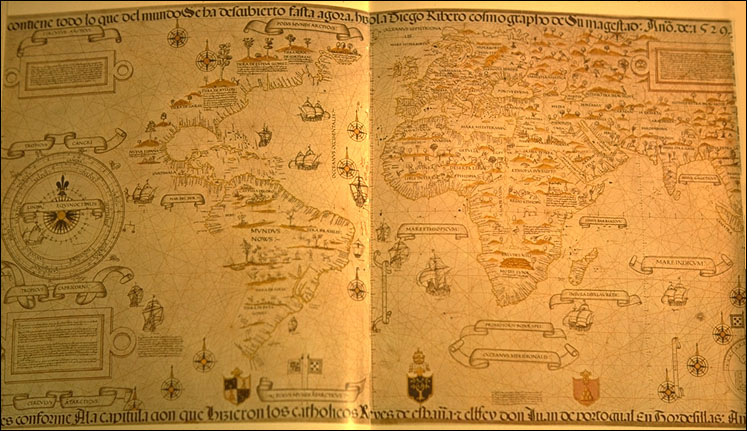
  6. La globalizzazione e la mappa di Diogo Ribeiro

    Diogo Ribeiro

    wikipedia.org

  7. La tolleranza e la mappa di Mercatore

    Mercatore

    wikipedia.org

  8. Il danaro e l’atlante di Blaeu

    Blaeu

    wikipedia.org

  9. La nazione e la carta di Francia della famiglia Cassini

    Cassini

    davidrumsey.com

  10. La geopolitica e Halford Mackinder

    Mackinder

    wikipedia.org

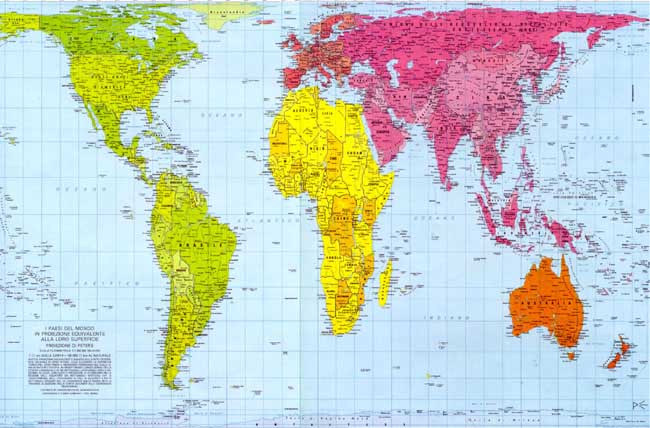
  11. L’eguaglianza e la proiezione di Peters

    Peters

    digilander.libero.it

  12. L’informazione e Google Earth

* * *

Ecco le mie annotazioni, con i riferimenti numerici all’edizione Kindle.

Where would we be without maps? The obvious answer is, of course, ‘lost’ […] [238]

[…] ‘the map is not the territory’. [306: la citazione è del filosofo americano Alfred Korzybski, ‘General Semantics, Psychiatry, Psychotherapy and Prevention’ (1941), in Korzybski, Collected Writings, 1920–1950 (Fort Worth, Tex., 1990), p. 205]

In Lewis Carroll’s Sylvie and Bruno Concluded (1893), the other-worldly character Mein Herr announces that ‘[w]e actually made a map of the country, on a scale of a mile to the mile!’ When asked if the map has been used much, Mein Herr admits, ‘It has never been spread out’, and that ‘the farmers objected: they said it would cover the whole country, and shut out the sunlight! So we now use the county itself, as its own map, and I assure you it does nearly as well.’ [315]

‘Far away is close at hand in images of elsewhere.’ [446: graffito su un muro della stazione di Paddington]

‘Look on my works, ye mighty, and despair’ [1126, da Ozymandias di Shelley]

The Geography was the first book that, either by accident or design, showed the potential of transmitting geographical data digitally. Rather than reproducing unreliable graphic, analogue elements to describe geographical information, the surviving copies of the Geography used the discrete, discontinuous signs of numbers and shapes – from the coordinates of places across the inhabited world to the geometry required to draw Ptolemy’s projections – to transmit its methods. [1135]

[…] Septemptrio (north, from the Latin for seven, referring to the seven stars of the Plough in the Great Bear, by which the direction of north was calculated). [1753: ne ho già parlato qui]

A nonary square is divided into nine equal squares, creating a three-by-three grid. Its origins remain obscure, ranging from the archaic observation of the shape of a turtle shell (with its round carapace covering the square plastron), to the more convincing explanation that the vast plains of northern China inspired a rectilinear way of understanding and dividing space. [2436]

By the end of the sixteenth century the name finally acquired universal geographical and toponymical status, thanks to German and Dutch mapmakers who needed a name to describe the continent and one which avoided ascribing it to a particular empire (some maps referred to it as ‘New Spain’) or religion (other maps labelled it ‘Land of the Holy Cross’). In the end, the name ‘America’ endured, not because of any agreement as to who discovered it, but because it was the most politically acceptable term available. [3377]

[…] ‘devotion to truth and the precision of scientific methods arose from the passion of scholars, their reciprocal hatred, their fanatical and unending discussions, and their spirit of competition.’ [3485: è una citazione di Michel Foucault]

Flirting with religion on maps was a dangerous business, with potentially fatal consequences. [4294]

To make a heart-shaped map in the first half of the sixteenth century was a clear statement of religious dissent. It invited its viewer to look to their conscience, and to see it within the wider context of a Stoic universe. But such flirtations with ‘pagan’ philosophy were not always welcomed by Catholic or Protestant authorities. [4374]

The result still caused distortion of land masses at the northern and southern extremities, but if Mercator could accurately calculate how far apart to space his parallels he could achieve something unique: what cartographers call ‘conformality’, defined as the maintenance of accurate angular relations at any point on a map. [4625]

Born into the Mennonite movement, an offshoot of the sixteenth-century Anabaptists, with their strong tradition of personal spiritual responsibility and pacificism, his sympathies were decidedly libertarian, and many of his friends were Remonstrants or ‘Gomarists’ (named after the Dutch theologian Franciscus Gomarus, 1563–1641). [5005]

In 1636, following Galileo Galilei’s condemnation by the Catholic Inquisition for his heretical heliocentric beliefs, a group of Dutch scholars hatched a plan to offer the Italian astronomer asylum in the Dutch Republic. The plan was floated by the great jurist, diplomat (and Remonstrant sympathizer) Hugo Grotius – whose books were published by Blaeu – and was enthusiastically supported by Laurens Reael and Willem Blaeu. Beyond their intellectual belief in a heliocentric universe, all three men also had vested commercial interests in offering such an invitation. Grotius, having already written on the subject of navigation, was hoping to lure Galileo to Amsterdam so that he would offer the VOC a new method of determining longitude which, if successful, would give the Dutch complete domination of international navigation.32 Blaeu’s somewhat nonconformist intellectual beliefs coincided with his eye for a novel commercial opportunity: Galileo represented a new way of looking at the world, but it was also one that Blaeu might have calculated would give him a decisive edge in cartographic publishing in the 1630s. Ultimately, the plans to invite Galileo came to nothing, as the astronomer pleaded that ill health (and undoubtedly the terms of his house arrest by the Inquisition) prevented him from making what would have been a sensational defection to Europe’s leading Calvinist republic. [5099: è la storia che ho raccontato qui]

It was the product of a Dutch Republic that, following its violent struggle to break free of the Spanish Empire, created a global marketplace that preferred the accumulation of wealth over the acquisition of territory. Blaeu produced an atlas that was ultimately driven by the same imperatives. For him, it was not even necessary to place Amsterdam at the centre of such a world; Dutch financial power was increasingly pervasive but it was also invisible, seeping into every corner of the globe. In the seventeenth century as today, financial markets make little acknowledgement of political boundaries and centres when it comes to the accumulation of riches. [5359]

One toise was 6 French feet, or just under 2 metres […] [5532]

Newton concluded that the earth was not a perfect sphere but an oblate spheroid, slightly bulging at the equator and flattened at the poles. Cassini I and his son Jacques (Cassini II) were unconvinced, and followed the theories of René Descartes (1596–1650). Revered across Europe as the great philosopher of the mind, Descartes was also renowned as a ‘geometer’, or applied mathematician, who put forward the argument that the earth was a prolate ellipsoid, bulging at the poles but flatter at the equator, like an egg. His theory was widely accepted by the Académie, and the resolution of the controversy soon became a matter of national pride on both sides of the English Channel. [5589]

Ultimately, the Carte de Cassini was more than just a national survey. It enabled individuals to understand themselves as part of a nation. Today, in a world almost exclusively defined by the nation state, to say that people saw a place called ‘France’ when they looked at Cassini’s map of the country, and identified themselves as ‘French’ citizens living within its space seems patently obvious, but this was not the case at the end of the eighteenth century. Contrary to the rhetoric of nationalism, nations are not born naturally. They are invented at certain moments in history by the exigencies of political ideology. It is no coincidence that the dawn of the age of nationalism in the eighteenth century coincides almost exactly with the Cassini surveys and that ‘nationalism’ as a term was coined in the 1790s, just as the Cassini maps were nationalized in the name of the French Republic.
In his classic study of the origins of nationalism, Imagined Communities, Benedict Anderson argues that the roots of national consciousness grew out of the long historical erosion of religious belief and imperial dynasties. As the certainty of religious salvation waned, the empires of the ancien régime in Europe slowly disintegrated. In the realm of personal belief, nationalism provided the compelling consolation of what Anderson calls ‘a secular transformation of fatality into continuity, contingency into meaning’. [6046]

The consequence of all these changes was the emergence of a new genre, thematic mapping. A thematic map portrays the geographical nature of a variety of physical, and social, phenomena, and depicts the spatial distribution and variation of a chosen subject or theme which is usually invisible, such as crime, disease or poverty. Although used as early as the 1680s in meteorological charts drawn by Edmund Halley, thematic maps developed rapidly from the early 1800s with the growth in quantitative statistical methods and public censuses. The development of probability theory and the ability to regulate error in statistical analysis allowed the social sciences to compile vast amounts of data, including national censuses. In 1801 France and England conducted censuses to measure and classify their populations. [6169]

When Joseph Conrad’s protagonist Marlow peers at an imperial map in Heart of Darkness (1899), ‘marked with all the colours of the rainbow’, he is pleased to see ‘a vast amount of red – good to see at any time, because one knows that some real work is done in there’. [6205]

One of the society’s councillors, the distinguished explorer and pioneering eugenicist Sir Francis Galton, responded with concerns about Mackinder’s attempt to claim geography as a science. Nevertheless, he was sympathetic to the moves to adopt geography as an academic discipline, and remarked that, whatever the limitations of his paper, he was sure Mackinder ‘was destined to leave his mark on geographical education’. Galton knew more than he admitted: he was already in talks with the authorities at both Oxford and Cambridge universities to appoint an RGS-funded reader in the subject, a society aspiration that stretched back to the early 1870s, and had stage-managed Mackinder’s invitation so that he would emerge as the most obvious candidate for any new post. On 24 May 1887, less than four months after Mackinder’s talk, Oxford University agreed to establish a five-year Readership in Geography, supported by RGS funds. The following month Mackinder was formally appointed, on a yearly salary of £300. [6321: anche Galton è un nostro vecchio amico, come si illustra qui]

[…] the disastrous Boer War (1899–1902), which had cost Britain more than £220 million, as well as the loss of 8,000 troops killed in action and a further 13,000 to disease. Of the estimated 32,000 Boers who died, the vast majority were women and children who died in British ‘concentration camps’, the first time such methods had been used in modern warfare. [6475]

Such criticisms suggested the need for a debate (not pursued for several years) as to how any world map could meaningfully address statistically derived social inequalities in graphic form. [6916]

For Google, one justification of its geospatial applications is that the digital image of the earth becomes the medium through which all information is accessed; writing in 2007, Michael T. Jones claimed that Google ‘inverts the roles of Web browser as application and map as content, resulting in an experience where the planet itself is the browser’. The Earth application – according to Google – is the first place a viewer goes to access and view information. This seems, for the moment at least, to be a completely pure definition of a world map made up from its own cultural beliefs and assumptions, all of which are now potentially available at the click of a computer mouse. [7733]

In 1970, the American geographer Waldo Tobler famously invoked what he called ‘the first law of geography: everything is related to everything else, but near things are more related than distant things’. [7747]

Doctorow-Stross – The Rapture of the Nerds

Doctorow, Cory e Charles Stross (2012). The Rapture of the Nerds. A Tale of the Singularity, Posthumanity, and Awkward Social Situations. New York: Tom Doherty Associates. 2012. ISBN 9781429944915. Pagine 352. 13,77 €

The Rapture of the Nerds

amazon.com

Il primo romanzo (o uno dei primi, e comunque il primo che ho letto io) sulla Singularity, o meglio – come recita il sottotitolo – sull’umanità della post-singularity.

La Singularity, o Singolarità tecnologica come la traduce in italiano Wikipedia, è legata all’idea che il progresso tecnologico acceleri fino a raggiungere un punto oltre la capacità di comprendere e prevedere degli esseri umani, aprendo il campo all’avvento di una intelligenza superiore a quella umana biologica e all’incremento artificiale e sintetico delle facoltà intellettive e delle capacità vitali di ciascuno. Se volete saperne di più, vi consiglio di leggere la voce di Wikipedia Singolarità tecnologica e i link che vi trovate. Quello che so io sull’argomento, che non è moltissimo ma nemmeno poco, l’ho imparato leggendo un imponente librone di Ray Kurzweil, famoso soprattutto per i suoi sintetizzatori ma in realtà inventore dall’ingegno quasi rinascimentale, The Singularity Is Near: When Humans Transcend Biology.

Kurzweil, un visionario al limite della follia che fa più soldi di quelli che riesce a sperperare, ne ha fatto anche un film, che però non ho visto. Questo il trailer:

Naturalmente, tentare di immaginare come saranno la vita, la società, i rapporti e le dinamiche interpersonali dopo un cambiamento così radicale, su cui ovviamente neppure i futurologi sono d’accordo non è per niente facile. È la freccia del tempo, ricordate? anche se il passato è uno solo  i futuri sono infiniti:

There are many futures and only one status quo. This is why conservatives mostly agree and radicals always argue. [Brian Eno, A Year with Swollen Appendices. London Faber & Faber. 1996, p. 133]

Inventarsi una storia che sia altrettanto fantasticamente strana come la prospettiva stessa della singolarità, poi, è impresa quasi impossibile. Ma è quello che si aspettano gli acquirenti e i lettori del vostro romanzo, cari autori. We won’t settle for less.

Purtroppo non ce l’avete fatta. A meno che vogliate proprio farci credere che l’incredibile attesa per la singolarità, che io per parte mia aspetto con più ansietà del ritorno di Cristo in terra, sfocerà in dopo in cui non solo la natura umana resterà sostanzialmente immutata (e questo non faccio troppa fatica ad accettarlo, anche se mi sembra che i grandi cambiamenti tecnologici abbiano anche cambiato radicalmente il nostro modo di pensare e di agire, come argomenta efficacemente Steven Pinker a proposito della violenza: The Better Angels of Our Nature), ma si porterà dietro tutti i guai di un American way of life da satira se non da barzelletta: un sistema giudiziario capriccioso e incomprensibile, i fondamentalisti cristiani, i padri assenti e le madri invadenti. Tutto troppo già letto e già visto.

Un’altra cosa, come diceva il compianto Steve Jobs: non è un romanzo solo, sono tre tenuti insieme da una tenue cornice, come i Classici di Topolino o più nobilmente, il Decamerone o i Racconti di Canterbury. O come una commedia all’italiana degli anni Settanta.

* * *

Però gli autori hanno intelligenza e arguzia da vendere, e il romanzo ha più di un passo memorabile. Di seguito le mie annotazioni, con i riferimenti numerici all’edizione Kindle.

“Of course it’s organic—nothing but carbon, hydrogen, nitrogen, oxygen, and a bit of phosphorous and sulfur.” [66]

“’Ello!” he says around a mouthful of Huw’s sandwich. “You look interesting. Let’s have a conversation!”
“You don’t look interesting to me,” Huw says, plunking the rest of his food in the backpacker’s lap. “Let’s not.” [190]

[…] a twenty-first-century situationist artist or politician called Sarah Palin. [761]

Boy, you can snap your fingers and before you know what’s happening, there’s a flash conspiracy in action—not your real good old-fashioned secret new world order, nobody can be arsed tracking those things these days, but the next best thing. A self-propagating teleology meme. Goal-seeking Neat Ideas are the most dangerous kind. [955]

[…] Don’t get up to anything I wouldn’t.” [985]

[…] thick gubernatorial Austro-Californian accent. [1172]

[…] neverglades […] [1259]

[…] a very Grimm fairy tale […] [1311]

[…] trash-transcential-transcendental […] [1454]

Yesterday, all his troubles, so far away. [1469]

[…] “It’s the gnostic sexual underground,” […] [1521]

[…] First Church of the Teledildonic […] [1568]

[…] No skin, no sin […] [1582]

“You don’t need to know,” Sam says calmly, “’cuz if you knew, I’d have to edit your memories, and the only way I know to do that these days is by killing you.” [1760]

He’s Asperger’s. Me, I’m just poorly socialized with a recursive introspective agnosia and a deficient situational relationship model. [1788]

[…] from sodomy to simony by way of barratry and antimony. [1904]

Hyperspace bypasses, Vogon poetry, the heat death of the universe: none of these things feature in the extraordinary situation now pertaining to the end of the world as Huw knows it. [2458]

But love is blind, and love that mourns for loss is blinder still, and Huw loved Bonnie, and nothing would change that. [2498]

There is no invisible sky daddy to give us immortal life and a harp and wings when we die. If we want an afterlife, we have to work hard and make it for ourselves. [2684]

“Conspiracy theories are even more tedious than identity politics. You have beliefs and I have logfiles. Which one of us is more likely to be right?” [2744]

“You are the reductionist in this particular moment, I’m afraid. You wanted to feel happy, so you took steps that you correctly predicted would change your mental state to approach this feeling. How is that any different from wanting to be happy and eating a pint of ice cream to attain it? Apart from the calories and the reliability, that is. If you had practiced meditation for decades, you would have acquired the same capacity, only you would have smugly congratulated yourself for achieving emotional mastery. Ascribing virtue to doing things the hard, unsystematic, inefficient way is self-rationalizing bullshit that lets stupid people feel superior to the rest of the world. Trust me, I’m a djinni: There’s no shame in taking a shortcut or two in life.” [2889]

Different governments all tended to blur at the edges anyway, into a weird molten glob of Trilateralist Davos Bilderberger paranoia, feuding and backbiting in pursuit of the biggest office and the flashiest VIP jet. [2945]

“You just don’t want me to put metal in the microwave, because then I’d have as much power as you,” Huw says, quoting a memorable bit of propaganda from the contentious era of the uplifting, a quote from Saint Larson, one of the period’s many canonized funnybeings. [3005]

[…] there but for random luck go I […] [3241]

[…] “On the basis of a sample size of one,” […] [3829]

[…] borderline-aspie nerd  […] [3837]

He’s a really smart high-functioning Asperger’s case who deals with social interaction by emulating it in his head, running a set of social heuristics, and looking for positive-sum outcomes. [3911]

[…] when confronted with limitless possibility and potential, the only legitimate response is to voluntarily assume constraint. Free jazz has its place, but it’s interesting only in contrast to the rigid structures in which it is embedded. [4115]

There’s an old saying about never attributing to a conspiracy that which can be explained by incompetence. [4323: la massima sarebbe addirittura di origine napoleonica: Hanlon’s razor]

Diamond-Robinson (eds.) – Natural Experiments of History

Diamond, Jared & James A. Robinson (eds.) (2010). Natural Experiments of History. Cambridge (MA): Belknap. 2010. ISBN 9780674035577. Pagine 288. 29,95 $

Natural Experiments of History

amazon.com

Un libro prezioso. La questione da cui muove è apparentemente semplice: non è possibile applicare il metodo canonico dell’esperimento scientifico nelle scienze sociali, e per la verità nemmeno nelle scienze naturali, in situazioni caratterizzate da uno statuto etico particolare – il celebre esperimento di Milgram del 1961 non potrebbe essere ripetuto oggi in nessuna università – o quando le circostanze storiche sono irripetibili – nonostante Jurassic Park non è possibile fare esperimenti sui dinosauri. Si deve allora ricorrere a qualche cosa di diverso, che conserva dell’esperimento scientifico alcuni assunti, e in particolare il metodo comparativo e il ricorso massiccio a dati quantitativi.

Gli 8 casi di studio presentati sono riferiti a diverse discipline (storia, archeologia, economia, storia economica, geografia e scienze politiche), coprono differenti epoche storiche (da società illetterate e preistoriche, a società letterate del passato, a società contemporanee) e diverse aree geografiche (dagli Stati Uniti al Messico, al Brasile, all’Europa occidentale, all’Africa tropicale, all’India, alla Siberia, all’Australia, alla Nuova Zelanda alle isole del Pacifico) e spaziano da semplici comparazioni a coppie prevalentemente qualitative (ad esempio, tra Haiti e la Repubblica dominicana) a complesse analisi quantitative come quelle riferite a 81 isole del Pacifico o a 233 regioni dell’India.

Ognuno dei saggi che compongono il volume ha motivi d’interesse suoi propri.

Dal primo, quello di Patrick Kirch sull’evoluzione culturale polinesiana, ho imparato a estendere la distinzione tra omologo e analogo (di cui ho parlato su questo blog) al concetto di sinologia:

Homologous traits are retentions from a common ancestral condition, whereas analogous traits have arisen after the breakup of an ancestral culture into descent groups, usually in response to similar conditions or challenges. Synologous traits are those that have been borrowed across cultural boundaries. [p. 48: cfr. anche di Boyd et al. Are Cultural Phylogenies Possible?]

Del secondo saggio, quello di James Belich su Exploding Wests: Boom and Busts in Nineteenth-Century Settler Societies, ho apprezzato la considerazione che «economic history is in fact too important to be left solely to economists» [p. 67] e, più in generale, l’attenzione al ritmo degli insediamenti e degli eventi storici (per esempio, Belich sostiene che i popoli indigeni – dai Sioux e i Comanci del Nord-America ai Maori della Nuova Zelanda – sono stati in genere capaci di adattarsi al contatto con gli Europei, ma non all’esplosione dell’insediamento).

Nel suo saggio su Intra-Island and Inter-Island Comparison, Jared Diamond riprende in modo più tecnico argomenti di cui ci aveva già parlato in Collapse: How Societies Choose to Fail or Succeed. In particolare, affronta il tema della deforestazione in alcune isole polinesiane prendendo in considerazione un dataset di 9 variabili (precipitazioni, temperatura, età geologica, ricaduta di ceneri vulcaniche, ricaduta di polvere e sabbia dall’Asia centrale, presenza di makatea – un detrito corallino vetroso e tagliente – superficie, altitudine e isolamento geografico), capaci di spiegare gran parte della variazione nella variabile dipendente (la deforestazione):

Thus Easter became deforested not because its inhabitants were especially shortsighted or did especially strange things, but because they had the bad luck to find themselves living on one of the Pacific’s most environmentally fragile islands, with the lowest regrowth rates of trees. We could never have teased apart this complex multicausal problem without a quantitative statistical analysis of a big database. For example, if we had studied just one island, or even if we had compared one wet island with one dry island, the effect of rainfall alone would have been confounded or obscured by the effect of the eight other variables. Similarly, epidemiologists could have never identified the many risk factors, or even a single risk factor, for cancer just by publishing a single case study of one smoker. Easter constitutes just one piece of a massive natural experiment on Pacific islands. By comparing many islands, one can confidently extract many conclusions, whereas by studying just a single island, it would be difficult to extract even a single conclusion [p. 133]

Del capitolo di Nathan Nunn, Shackled to the Past: The Causes and Consequences of Africa’s Slave Trades, ho trovato interessante la conferma, a partire da una prospettiva diversa, della tesi esposta da Easterly e Levine in un articolo del 1997 pubblicato da The Quarterly Journal of Economics (Africa’s Growth Tragedy : Policies and Ethnic Divisions):

For economists, Africa’s ethnic diversity has been a leading explanation for Africa’s poor economic performance. The explanation and supporting statistical evidence were first proposed in a 1997 article published in the Quarterly Journal of Economics by William Easterly and Ross Levine. The authors argue that ethnically diverse societies are less likely to agree on the specific public goods and policies the government should implement. Because of these disagreements, there will be less provision of public goods, such as schooling, health, and infrastructure. Easterly and Levine show that across countries, higher ethnic diversity is associated with lower levels of education, infrastructure, financial development, and with less political stability.
It is possible that part of the adverse effects of the slave trades stems from the fact that they impeded the formation of larger ethnic groups and therefore resulted in more ethnic diversity today. Using the constructed slave export data, one can examine whether the data are consistent with this theory by testing whether countries that had more slaves taken in the past are more ethnically diverse today. […] Figure 5.5 shows a clear positive relationship between the two measures. The more slaves a country exported during the slave trades, the more ethnically diverse the country is today. The statistical estimates of the relationship show that as much as 50% of the differences in countries’ ethnic diversity within Africa can be explained by the number of slaves exported during the slave trades. [173: per un aggiornamento delle misure di diversità proposte originariamente da Easterly e Levine si può vedere: Alesina et al. Fractionalization]

Il saggio che – forse anche per motivi professionali – a me è piaciuto più di tutti è From Ancien Régime to Capitalism: The Spread of the French Revolution as a Natural Experiment, di Daron Acemoglu, Davide Cantoni, Simon Johnson e James A. Robinson. La tesi, sostenuta e corroborata con grande eleganza, è che la diffusione del Codice napoleonico, portato in alcune parti della Germania ma non in tutte dalle armate francesi, ha avuto un effetto duraturo sui livelli di reddito e di crescita delle regioni e delle popolazioni che vi sono entrate in contatto. Oltre che per il merito storico-economico, l’articolo è anche particolarmente acuto sotto il profilo del metodo. Si discutono, tra le difficoltà incontrate, quella della reverse causality (è stata la caduta dell’ancien régime a favorire lo sviluppo economico, o piuttosto il progresso capitalistico ad aver minato il sistema feudale?) e dell’omitted variable bias, illustrato elegantemente con una citazione di Max Weber:

“Montesquieu says (Esprit des Lois, book XX, chapter 7) of the English that they ‘had progressed the farthest of all peoples of the world in three important things: in piety, in commerce, and in freedom’. Is it not possible that their commercial superiority and their adaptation to free political institutions are connected in some way with that record of piety which Montesquieu ascribes to them?” Hence Max Weber directly argued that an omitted factor, here religion, explained both democracy and capitalism in England. [p. 224]

La parte più importante del libro è certamente l’Afterword scritto dai due curatori (Afterword: Using Comparative Methods in Studies of Human History): se disponessi della versione elettronica del testo, a costo di sfiorare la violazione del copyright (ma senza malizia, ma anzi per incentivarne la conoscenza), lo riprodurrei pressoché integralmente. Ma questo è un libro che ho letto nel volume cartaceo, e non mi resta che invitarvi vivamente a cercarlo e leggere almeno quelle pagine. Soprattutto se siete economisti o scienziati sociali di qualche altra varietà. L’altra cosa che posso fare è – nel caso non vi fidiate del mio giudizio, posizione scettica che vi suggerisco di assumere – indirizzarvi alla lettura della recensione fa Thad Dunning dell’Università di Yale (Review of Natural Experiments of History).

Robert Hughes – Rome

Hughes, Robert (2011). Rome: A Cultural History. London: Weidenfeld & Nicolson. 2012. ISBN 9780297857853. Pagine 624. 7,49 €

Rome

amazon.com

L’anno prima della maturità uno dei miei figli andò per 6 settimane a Melbourne per uno scambio culturale organizzato dalla scuola. A cavallo delle vacanze invernali, per ricambiare, ospitammo per 6 settimane il ragazzo, suo coetaneo, della famiglia dove era stato mio figlio. Fu subito ribattezzato «’a mumma», come il protagonista di uno dei film de paura di Corrado Guzzanti. La mummia era infatti di una passività impressionante e faceva venire in mente un famoso passaggio dell’Apocalisse (3,16): «Ma poiché sei tiepido, non sei cioè né freddo né caldo, sto per vomitarti dalla mia bocca.» Non che fosse del tutto privo di interessi: gli piaceva mangiare, preferibilmente la carne, ma dopo un po’ anche la pasta (aveva imparato a dire: «So’ un botto pieno») e gli piacevano le compagne di scuola, soprattutto una. Noi genitori ci preoccupavamo di fargli amare o almeno vedere l’Italia, e volevamo ricambiare l’ospitalità di cui aveva goduto nostro figlio. Lo portammo a Milano, a Venezia, a Mantova. E poi, un giro di alcuni giorni in macchina da Roma: Viterbo, la Cassia, la val d’Orcia (a Bagno Vignoni apprezzò la tagliata di manzo, a Pienza la cioccolata calda), Siena, San Gimignano, Firenze, Pisa. Mia moglie, laureata in lettere con una tesi d’archeologia, spiegava l’epoca romana, il medioevo, il rinascimento. Scendendo dalla torre di Pisa, la mummia uscì dal suo consueto indifferente silenzio e chiese: «But what do you mean, exactly, by the middle ages?».

Alcuni fili tenui, ma non insignificanti, legano la mummia con Robert Hughes, l’autore di questo libro: il primo è che entrambi sono australiani di nascita; il secondo, che entrambi hanno studiato dai gesuiti, anche se il primo a Melbourne e il secondo a Sydney; il terzo è che entrambi sono venuti a Roma da giovani, ma a sua giustificazione la mummia può addurre di aver avuto 5 anni di meno dei 21 che aveva Hughes quando restò folgorato dalla bellezza della città eterna. Tanto da risiedervi per alcuni anni, e intraprendere poi una fortunata carriera da critico d’arte che lo avrebbe portato prima sulle colonne della stampa inglese ((The Spectator, The Daily Telegraph, The Times e The Observer, tra gli altri) e dal ultimo su quelle della rivista americana Time, fino alla precoce morte, all’inizio di agosto di quest’anno.

[…] for the new and uninstructed arrival, such as I was in 1959, it is naturally the very big and rather obvious ones that strike first, and for me the most decisive and revelatory of these first encounters was not in Piazza S. Pietro, that mythic centre of faith, but on the other side of the Tiber, up on the Capitol above Piazza Venezia. Its messenger was not a religious work of art, but a pagan one: the ancient bronze statue of the emperor Marcus Aurelius (reg. 161–80 CE) riding his horse, in the most noble silence and stillness, on a pedestal which rose from the centre of a twelve-pointed star, in the trapezoidal piazza Michelangelo designed for the Campidoglio. I had seen photographs of it, of course; who hadn’t? But nothing really prepared me for the impact of that sculpture, both in its mass and in its detail. It is by far the greatest and, indeed, a rare surviving example of a type of sculpture that was widely known and made in the ancient pagan world: the hero, the authority figure, the demigod on horseback; human intelligence and power controlling the animal kingdom, striding victoriously forward. There used to be twenty or so such bronze equestrian statues in Rome, and yet more throughout Italy, such as the Regisole or ‘Sun-King’ in Pavia, which was so thoroughly destroyed in 1796 that not a skerrick remains and the only surviving trace of it is a mere woodcut on paper. All were toppled, broken up and melted down by pious, ignorant Catholics in the early Middle Ages, who believed that their vandalism was an act of faith, an exorcism of the authority of the pagan world. Only Marcus Aurelius survived, and by mistake. The good Catholics mistook the statue for a horseback portrait of the first Christian emperor of Rome, Constantine the Great. But for that sublimely lucky error, Marcus Aurelius would have joined all the other bronze emperors in history’s indifferent melting-pot. [279-281]

Il lungo viaggio che Hughes compie e ci fa compiere con lui – oltre 600 pagine che si leggono d’un fiato, o quasi – inizia e si chiude su questo momento. Ed è un viaggio sempre tenuto a livello alto, e spesso altissimo, che parte dalle origini della città e si chiude ai giorni nostri, con un lamento per il declino che Roma, e l’Italia intera, stanno attraversando. E che, come spesso accade, è particolarmente evidente anche a noi, quando la osserviamo con gli occhi più disincantati di un osservatore straniero.

* * *

Io penso di essere un conoscitore passabilmente istruito di Roma, che è la mia città d’adozione ma non di nascita. E penso anche di aver letto un numero non piccolo sia delle fonti classiche sia degli studi successivi. Eppure ho trovato nel libro di Hughes molte cose che ignoravo. Qualche esempio? Questo spassoso aneddoto su Publio Claudio Pulcro, ammiraglio romano della prima guerra punica:

The aim of augury was not simply to foretell the future. It was to find out whether a proposed course of important action was likely to have the approval of the gods. A common way of doing this was by consulting the sacred chickens. These otherwise ordinary fowls (there seem to have been no criteria for telling a sacred chicken from a non-sacred one) were carried in a cage to the field by Roman armies. Before the battle, they would be given chicken-feed. If they pecked at it with gusto, letting bits of food fall from their beaks, it was greeted by the augurs as an excellent omen. If they ignored the offering, it was a very bad sign. If they ate half-heartedly or seemed choosy, that too had its meaning for the augurs. Many Romans of the highest rank took this charade perfectly seriously. One who did not was Publius Claudius Pulcher, an admiral of the Roman navy who, just before an engagement between the Roman and Carthaginian fleets off Drepanum during the First Punic War in 249 BCE, cast the grain before the fowl and was told, by the ship’s augur, that the birds would not eat. ‘Then let them drink,’ Pulcher exclaimed rashly, as he grabbed the chickens and threw them overboard. Alas, he lost the ensuing battle. [612]

Alcune etimologie:

Luna marble was the finest available if you wanted perfect whiteness, which Augustus and his builders did. Its whiteness rivalled that of the moon, from which it took its name. [1846]

If your vehicle, of which the most common type was known as a carpentum (whence, ‘car’), threw a wheel or broke an axle along the way, you could call for a mechanic or carpentarius (whence, ‘carpenter’) to repair it. [1970]

Le gloriose gesta del vituperato, ma simpaticissimo, Giuliano l’Apostata, per “educare” i cristiani:

‘Since by their most admirable law they are bidden to sell all they have and give it to the poor so that they may attain more easily to the kingdom of the skies . . . I have ordered that all their funds that belong to the church of Edessa . . . be confiscated; this in order that poverty may teach them to behave properly and that they may not be deprived of the heavenly kingdom for which they still hope.’ [3259]

Il fatto che la Scala Santa fosse stata portata a Roma da Elena, madre di Costantino:

Her other large souvenir of the Holy Land was brought back in pieces and reconstructed in Rome – the flight of twenty-eight marble steps from the residence of Pontius Pilate in Jerusalem. Jesus Christ was believed to have walked up these steps on the way to trial and judgement by the Roman procurator, and the Scala Santa or Holy Staircase, as it is known, was reconstructed in Rome in its former papal residence, the Lateran Palace. [3620]

Il fatto che bugger, che ora in inglese sta per sodomita, fosse originariamente riferito agli eretici catari originari della Bulgaria; e che i Catari fossero fondamentalmente vegani:

Where did the Catharist faith come from? Because nearly all its ‘scriptures’ and holy books were destroyed, burned along with the Cathars themselves, it is difficult to be certain about this, but most scholars seem to agree that it was an eastern import whose roots lay in the Balkans and the Byzantine Empire. It was related to the beliefs of the Bogomils or ‘friends of God’ who, being particularly strong in Bulgaria, were also known as the Bougres – whence our durable term of extreme disparagement, ‘buggers’. [3828]

The majority, the rest of the Cathars, the credentes or simply ‘believers’, led relatively normal lives in a normal world, farming and trading, but abstaining from meat, milk, cheese and other animal products, not swearing oaths or engaging in acts of violence. [3844]

Il ruolo delle miniere di Tolfa e Allumiere nella crescita economica della Roma di Papa Giulio II:

Much of the money for his military enterprises came from Italy’s textile industry. The dyeing of cloth requires a fixative, which in the sixteenth century was a mineral, alum. Most alum had come from Turkey, but large deposits of it were to be found north of Rome in an otherwise unremarkable spot named Tolfa. The fortunes of the mines of Tolfa, with their virtual monopoly on the mineral, rose with the textile trade and so were a large source of income for the Papacy. [4308]

L’etimologia di Vaticano:

Another part of its mythic history was that Etruscan priests used to watch for auguries and make prophecies (vaticinia) from this spot. Hence the name ‘Vatican’ for the general area. [4350]

La battuta anti-gesuitica di un Granduca di Toscana:

It was for this reason that the Grand Duke of Tuscany suggested that the Jesuits’ motto, whose initials are IHS, ought to be rendered Iesuiti Habent Satis, ‘The Jesuits have got enough’. [6161]

Che anche Filippo Tommaso Marinetti fosse un ex alunno dei Gesuiti:

He had been schooled by Jesuits, which may well have contributed to his sense of confident exception. This was confirmed when his Jesuit teachers expelled him for cultural rowdiness: he had been passing around copies of Zola’s realist novels. [7776]

Perché il famoso mercato della Vucciria di Palermo si chiami così:

The name of the place derives from the French boucherie […] [8865]

E naturalmente, last but not least, la Bolla Papale che proibiva il tabacco per la sovrapposizione tra sternuto e orgasmo, di cui ho parlato qui:

He also – to descend from the serious to the absurd – issued a Papal Bull, in 1624, that made smoking tobacco punishable by excommunication. The reason was that when smokers sneezed, their convulsion resembled orgasm, and this struck Urban as a mortal sin of the flesh. [5738]

* * *

Hughes ha evidentemente una cultura enciclopedica, e altrettanto evidentemente conosce l’italiano piuttosto approfonditamente (c’è qualche errore e qualche accento mancante, ma nel complesso se la cava bene). Eppure ci sono nel testo alcuni errori pacchiani, che persino un buon editor o un buon correttore di bozze avrebbe potuto scovare: come l’attribuzione a Verdi della Tosca [6689] o l’affermazione che Vittorio Emanuele II fosse figlio (invece che nipote) di Vittorio Emanuele II [8314] o il far seguire temporalmente il bombardamento americano di San Lorenzo a Roma (19 luglio 1943) a quello infernale di Dresda (13-14 febbraio 1945) [8777].

* * *

Ho anche imparato una parola nuova, proleptic: pertaining to prolepsis or anticipation; previous; antecedent.

* * *

Di seguito altre annotazioni sparse, prese durante la lettura, che spaziano dal meditato giudizio estetico all’invettiva al motto di spirito. Vi troverete certamente qualche cosa che v’invoglierà a leggere il libro. Riferimenti numerici all’edizione Kindle.

Here a tangled story begins, with many variants, which tend to circle back to the same themes we will see again and again throughout Rome’s long history: ambition, parricide, fratricide, betrayal and obsessive ambition. Especially the last. No more ambitious city than Rome had ever existed, or conceivably ever will, although New York offers it competition. [331]

The ideal was askesis, ‘inner calm’; the Stoic did not preach indifference or anaesthesia, far from it, but rather a reasoned concentration on the truths of life. [895]

Graecia capta ferum victorem cepit, wrote Horace, et artes intulit agresti Latio: ‘When Greece was taken she enslaved her rough conqueror, and introduced the arts to cloddish Latium.’ [1404: è sempre stata una delle mie frasi latine preferite]

O lente, lente currite, noctis equi [1832: anche questa, che però è di Ovidio]

The Drunkenness of Noah, complete with the ancient patriarch’s eldest son committing what had become known as the Sin of Ham – not overindulgence in prosciutto crudo, but gazing upon his inebriated father’s nakedness. [4628]

[…] art itself is a lie – a lie told in the service of truth. [5625]

It is a horse made by committee. [5836: è una nota definizione del cammello, di incerta attribuzione]

It is a fabolous concetto, scarcely diminished even by the parked cars that cluster around it, the avvocato Agnelli’s hogs at a trough. [5920: a proposito della fontana del Tritone]

[…] tempus edax. [6582: è l’Ovidio delle Metamorfosi, tempus edax rerum]

This was in imitation of the Roman Senate, which after 212 CE had erased the once honoured but now disgraced name of Geta from a dedicatory inscription on the Arch of Septimius Severus in the Forum Romanum. [6673]

Inevitably, one’s feelings about the singularity of Canova are increased by his isolation within his moment in Italian cultural history; aside from him, that history, at the start of the nineteenth century, was at a low ebb – the lowest it had ever reached, though not as debased as it would be by the start of the twenty-first. [7029]

It is not often that one can say an official document gets everything wrong, but the Syllabus of Errors came as close to that exalted state as anything set forth by the Catholic Church since the death of Luther. [7530]

The modern Catholic theologian Hans Kung, who was appointed official theologian for the Second Vatican Council in 1962, thought that the First Council ‘was so severely compromised’ that its infallibility doctrine was null. ‘Painful and embarrassing as it may be to admit, this council resembled a well-organized and manipulated party congress rather than a free gathering of Christian people.’ Kung would argue that the pope got infallibility translated into dogma for four reasons. ‘Pius IX had a sense of divine mission which he carried to extremes; he engaged in double dealing; he was mentally disturbed; and he misused his office.’ Ludicrously but unsurprisingly, the Church in 1979 banned the impeccably scholarly Kung from ever teaching theology in its name. [7575]

One can have a certain sympathy with the annoyed Italian writer who, when asked if he didn’t agree that Marinetti was a genius, retorted ‘No, he’s a phosphorescent cretin’, but in fact he was less than the first but a good deal more than the second. [7825: il giudizio è di Gabriele D’Annunzio, che peraltro reagiva a Marinetti che l’aveva definito “un cretino con lampi di imbecillità”]

[…] a host of others whose names can never be known because they died too soon for their talent to have a chance to make a mark. [7926: a proposito dei potenziali artisti uccisi nella I guerra mondiale prima che il loro talento si manifestasse]

What he and Marinetti had in common was an ecstatic sense of the possibilities of the modern city – a mighty switchboard of information, manufacture and perception, a social turbine hall, humming away, almost without human interference. [7942: si sta ovviamente parlando di Sant’Elia]
We must invent and rebuild the Futurist city like an immense, tumultuous construction yard, agile, mobile and dynamic in every detail; and the Futurist house must be like a gigantic machine. The lifts must no longer be hidden away like tapeworms in the niches of stairwells; the stairs themselves, rendered useless, must be abolished, and the lifts must scale the heights of the façades like serpents of iron and glass. Houses of concrete, glass and iron, stripped of paintings and sculpture, rich only in the innate beauty of their lines and relief, extraordinarily ugly in their mechanical simplicity … must rise on the brink of a tumultuous abyss: the street will no longer lie like a doormat at ground level, but plunge down into the earth, with multiple levels … linked up for necessary interconnections by metal gangways and fast, moving pavements. The decorative must be abolished … [7945: forse qui si radica la visione del Centre Pompidou]

[…] ruthless and staggeringly narcissistic Mussolini […] [8071]

Se Rosa, illuminata di alma luce,
La notte in cui fu concepito il Duce,
Avesse al fabbro predappiano,
Invece della fica, presentato l’ano,
L’avrebbe preso in culo quella sera
Rosa soltanto, ma non l’Italia intera.

[8079: l’oscena poesiola è detta in diverse versioni; questa di Hughes ha qualche evidente errore, che ho poco filologicamente corretto]

The sorry truth is that whole cultures, like individual people, do run down; with age, their energies gutter out. They have a collective life, but that life depends entirely on the renewal of individual talent from decade to decade. […] This was not a sudden implosion, but a slow leakage. [8803]

[…] Mario Schifano (1934–98), an ‘Italian Pop’ artist who briefly enjoyed the reputation of being Italy’s answer to Andy Warhol as if an answer were needed! [8901]

[…] the Italian talent for obfuscatory theory. [8910]

[…] the last can of Manzoni’s Merda d’Artista to go on the market fetched the imposing sum of $80,000 – no shit, one is tempted to add. [8934]

What makes it worse is that whoever installed the great sculpture inside the Capitoline deprived it of its base and placed it slantwise, cantilevered out on an inclined ramp. This is vandalism. It is absolutely intrinsic to the meaning of the Marcus Aurelius that the horse and rider should be level and horizontal; otherwise their firm authority is lost. In its new installation, slanting meaninglessly upwards in a way Michelangelo would never have countenanced for an instant, the sculpture becomes a parody of the huge bronze of Peter the Great by the French sculptor Étienne Maurice Falconet (1716–91), the ‘bronze horseman’ of Pushkin’s poem, riding up his rock in St Petersburg. It would be very hard to imagine a more stupid treatment of a great sculpture than this: ‘design’ run amok, vulgarizing the work it was meant to clarify, ignoring all ancient meanings for the sake of an illusion of ‘relevance’ (to what?) and ‘originality’ (if you don’t know the Falconet). But sadly, that’s Rome now – a city which, to a startling extent, seems to be losing touch with its own nature, and in some respects has surrendered to its own iconic popularity among visitors. [9141]

Many of them see the past as a profitable encumbrance. [9208]

Ben Macintyre – Operation Mincemeat

Macintyre, Ben (2010). Operation Mincemeat. London: Bloomsbury. 2010. ISBN 9781408808542. Pagine 337. 12,65 $

images-amazon.com

Non ho molto da aggiungere rispetto a quello che ho detto di questo libro nella recensione al romanzo Sweet Tooth di Ian McEwan. Per vostra comodità riporto l’estratto saliente.

[La] ricostruzione che  Ben Macintyre fa di Operation Mincemeat, una vicenda di spionaggio culminata nel 1943. Ma lasciamo raccontare a Tom/Ian e poi commentiamo:

[L]et me tell you my favourite spy story. MI5 had a hand in it, as well as Six. 1943. The struggle was starker and more consequential than it is now. In April that year the decomposing body of an officer of the Royal Marines washed up on the coast of Andalucia. Attached to the dead man’s wrist by a chain was a briefcase containing documents referring to plans for the invasion of southern Europe through Greece and Sardinia. The local authorities contacted the British attaché, who at first seemed to take little interest in the corpse or its luggage. Then he appeared to change his mind and worked frantically to get both returned. Too late. The Spanish were neutral in the war, but generally more favourable to the Nazi cause. The German intelligence community was on to the matter, the documents in the briefcase found their way to Berlin. German High Command studied the contents of the briefcase, learned of the Allies’ intentions and altered their defences accordingly. But as you probably know from The Man Who Never Was, the body and the plans were fake, a plant devised by British intelligence. The officer was actually a Welsh tramp, retrieved from a morgue and, with thorough attention to detail, dressed up in a fictional identity, complete with love letters and tickets to a London show. The Allied invasion of southern Europe came through the more obvious route, Sicily, which was poorly defended. At least some of Hitler’s divisions were guarding the wrong portals.
Operation Mincemeat was one of scores of wartime deception exercises, but my theory is that what produced its particular brilliance and success was the manner of its inception. The original idea came from a novel published in 1937 called The Milliner’s Hat Mystery. The young naval commander who spotted the episode would one day be a famous novelist himself. He was Ian Fleming, and he included the idea along with other ruses in a memo which appeared before a secret committee chaired by an Oxford don, who wrote detective novels. Providing an identity, a background and a plausible life to a cadaver was done with novelistic flair. The naval attaché who orchestrated the reception of the drowned officer in Spain was also a novelist. Who says that poetry makes nothing happen? Mincemeat succeeded because invention, the imagination, drove the intelligence. [4636-4647]

Ecco nelle sue tappe principali la sequenza di intervento romanzesco/azione di spionaggio ricostruita da McEwan (e da Macintyre, che McEwan non può citare senza commettere un anacronismo, dal momento che la sua “definitiva” ricostruzione storica è stata pubblicata nel 2010):

  1. Sir Basil Home Thomson, agente segreto britannico, ufficiale di polizia, direttore di carcere, amministratore coloniale della Nuova Guinea e scrittore, pubblica nel 1937 un romanzo, della serie dell’Ispettore Richardson, in cui a un morto viene erroneamente attribuita una diversa identità, sulla base delle carte e dei documenti falsi trovati (ma in precedenza impiantati) sul cadavere.
  2. Il romanzo non ha alcun successo, ma viene letto da un giovane ufficiale della marina inglese che amava la serie: Ian Fleming, il futuro “padre” di James Bond.
  3. Allo scoppio della guerra, Fleming manda ai suoi superiori un memo riservato in cui suggerisce 51 azioni di controinformazione per ingannare i servizi segreti tedeschi.
  4. Il suggerimento n. 28 è il seguente:
    A suggestion (not a very nice one). The following suggestion is used in a book by Basil Thomson: a corpse dressed as an airman, with dispatches in his pockets, could be dropped on the coast, supposedly from a parachute that had failed. I understand there is no difficulty in obtaining corpses at the Naval Hospital, but, of course, it would have to be a fresh one.
  5. L’azione viene realizzata nel 1943, in forma leggermente diversa, e ha successo.
  6. Nel 1950, Duff Cooper, diplomatico britannico che aveva occupato posti di responsabilità durante la guerra, pubblica un romanzo di spionaggio, Operation Heartbreak; al centro della trama, un cadavere galleggiante sulle coste spagnole con documenti tesi a ingannare i tedeschi.
  7. Benché Cooper abbia probabilmente inventato autonomamente la trama, i servizi inglesi decidono di correre ai ripari e autorizzano Ewen Montagu, che aveva guidato l’operazione Mincemeat, a raccontarne i tratti principali in The Man Who Never Was (il testo citato da Tom/Ian a Serena).
  8. Dopo l’apertura degli archivi del controspionaggio per prescrizione dei termini, Ben Macintyre ricostruisce Operation Mincemeat.

Sul libro in sé ho ben poco da aggiungere: è documentato e di piacevole lettura, anche se a tratti fin troppo dettagliato.

* * *

Ho anche messo in serbo alcune annotazioni, che mettono in luce soprattutto l’umorismo e i giochi di parole di Mecintyre (riferimenti alle posizioni all’edizione Kindle.

[…] the rare ability to read an interlocutor’s mind – the mark of the good lawyer, and the good liar. [468]

The sardines joke smelled fishy. [2063]

[…] otherwise entirely sensible people could be persuaded to believe, passionately, what they already wanted to believe. All it required was a few, carefully forged documents, and some profoundly wishful thinking on the part of the reader. The Sacambaya trip formed the basis for Hillgarth’s fifth and most successful novel, The Black Mountain, published in 1933 to acclaim from, among others, Graham Greene. [2426]

‘By singleness of purpose, by steadfastness of conduct, by tenacity and endurance – such as we have so far displayed – by this and only this can we discharge our duty to the future of the world and to the destiny of man.’ [4056]

[…] as he always did when under pressure, he simultaneously covered his back and passed the buck […] [4089: perfetto, il ritratto di un burocrate in una riga]

[…] at loggerheads […] [4856: un’espressione inglese che non conoscevo e che significa, più o meno, “ai ferri corti”]

‘Mincemeat swallowed rod, line and sinker.’ [5016: il telegramma inviato a Churchill per comunicargli il successo dell’operazione]

[…] ‘‘chairborne’’ instead of ‘‘airborne’’. [5706: espressione aeronautica riferita agli imboscati in ufficio].

Ian McEwan – Sweet Tooth – Recensioni

  1. La prossima potete saltarla, se volete.
  2. «Sometimes he seems interested in using the relationship between spy and
    author as a metaphor for the intricate dance of concealment and trust
    that goes on between a reader and a writer. Like Henry Perowne in Saturday,
    Serena strongly dislikes novels that play games with their readers –
    “no tricksy haggling over the limits of their art”, she declares; “no
    showing disloyalty to the reader by appearing to cross and recross in
    disguise the borders of the imaginary” – so there’s an elaborate joke at
    her expense (but to what end?) as she finds herself at the heart of
    just such a novel.»
  3. «A novel about espionage and fiction that traces the overt and covert
    connections between secrecy, deception and creativity, Sweet Tooth
    expertly navigates the gulf between perception and reality. Its feints
    and ruses prompt the thought that “all novels are spy novels”. For all
    its critique of state-supported subterfuge, McEwan muses that “The end
    of secrecy would be the end of the novel – especially the English novel.
    The English novel requires social secrecy, personal secrecy.”»